Home

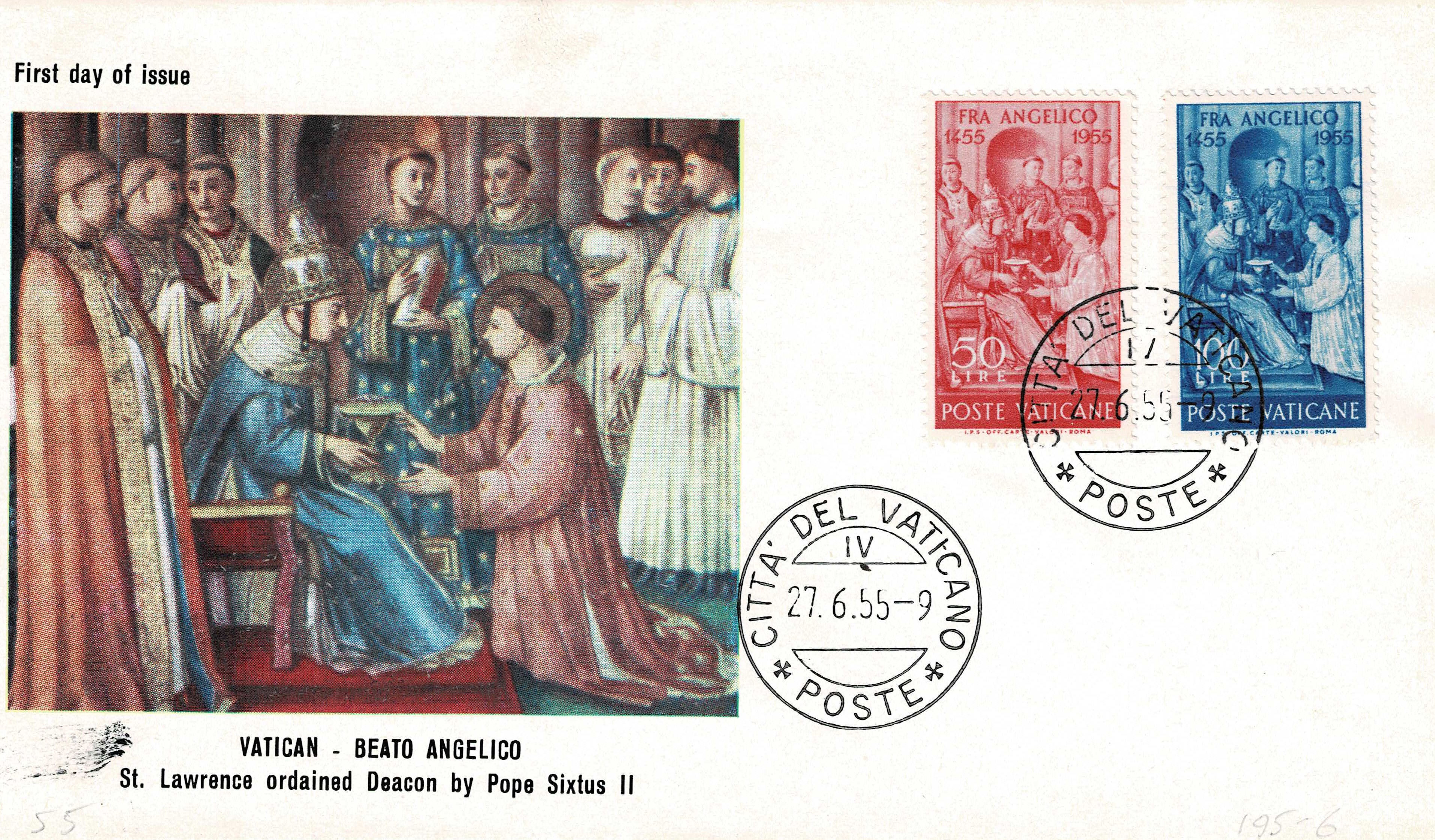
 Fra Angelico: 5th Centenary of Death Stamp Design from the fresco "Pope Sixtus II Conferring Diaconate on St. Lawrence" Scott 195-196 (1955) On June 27, 1955, the Vatican Postal Administration released a set of two commemoratives to mark the fifth centenary of the death of one of the world's greatest religious painters, Fra Angelico. Though the stamps have not been attributed to any particular designer, it might be said that they were designed by Fra Angelico himself as the design was taken from one of his most celebrated works in the Vatican. The future Fra Angelico was born in 1387, in Vicchio, Province of Mugello, Tuscany. At baptism, he received the name of Guido, and as his father's name was Pietro, he was known as Guido (or Guidolino) di Pietro. Along with his younger brother, Guido entered the Dominican convent at Fiesole in 1407. Upon entering the convent, he adopted the name of Giovanni and has henceforth been known as Fra Giovanni da Fiesole. His younger brother became known as Fra Benedetto da Fiesole, (or da Mugello). Both brothers began their art careers about this time as illustrators and illuminators of missals and manuscripts. In 1409, Fra Giovanni and his brother journeyed to Foligno, Umbria, where the Dominicans had established a convent. Five years later a devastating pestilence forced them to move to Corona. While here, Fra Giovanni executed his first extant paintings which are regarded by some as his best pictures. In 1418, he and his brother returned to Fiesole where he spent sixteen years. It was during this period that Fra Giovanni painted four small panels, the most important of which is known as the "Madonna of The Star". He also executed a celebrated predella, or altarpiece, called, "Christ in Glory surrounded by Saints and Angels" which contained over 250 distinct figures. Among the many fine pieces he painted during this Fiesolan period are the "Coronation of the Virgin" and two of the "Last Judgement". In 1431, Fra Angelico began the "Madonna of the Linen Weavers" which contained famous representations of twelve angels making music. This painting might be considered a turning point in his career. Prior to this, his work had been typically medieval in character, but now his paintings began to reflect the influence of the new techniques and themes introduced by the Renaissance. In 1436, the Dominicans acquired the Convent of San Marco in Florence for their order. The convent was under the extremely generous patronage of Cosmo de' Medici, and Fra Angelico was invited to decorate the convent. Some claim that his brother, Fra Benedetto, assisted him in executing these famous frescos (before he became superior of San Domenico, an office he held until his death in 1448). During his stay in Florence, Fra Angelico came under the influence of such famous Italian artists as the Michelozzo who designed the buildings of San Marco, and the painter Masaccio. The Florentine period of Era Angelico was responsible for such noted frescos as "Christ as a Pilgrim", the "Crucifixion", and the "Transfiguration". Pope Eugenius IV summoned him to Rome in 1445, to paint frescos in the Chapel of the Sacrament, which has since been destroyed by fire. In 1447, at the request of Eugenius IV, Fra Angelico and his pupil the Florentine painter Benozzo Gozzoli, journeyed to Orvieto to work in the Chapel of the Madonna de San Brizio in the Cathedral of Orvieto. He did not finish this work however but returned to Rome in the fall of the same year. The chapel was finished by Luca Signorelli sometime later. In 1448, at the request of Pope Nicholas V, successor of Eugenius IV, Fra Angelico was commissioned to paint a series of frescos depicting scenes in the lives of Saints Stephen and Lawrence. It was from this series, the last executed by Fra Angelico, that the design of the stamps was taken. The scene, depicted on the stamp, is St. Lawrence being ordained Deacon by Pope Sixtus II. So faithfully has the center of this fresco been reproduced on the stamps that we can say that Fra Angelico was the designer of the stamps marking the anniversary of his death. In 1449, Fra Angelico was appointed superior of his old convent in Fiesole where he labored until his death six years later. His earthly remains were transported to Rome where he was buried in the Church of Santa Maria sopra Minerva. Fra Giovanni da Fiesole earned the title of "Fra Angelico" not only for his dedication to painting religious subjects, but for his personal characteristics of sincerity, goodness and piety. He always began his works with a prayer. With the aid of the Almighty, it is no wonder that his works are held in such high esteem. As a painter, Fra Angelico attained his most notable effects in his representation of devout facial expressions. He was a greatly skilled colorist and master of the technical problems such as the transferring of movements and perspective to canvas. He was also the first to paint the Christ Child in a realistic manner and the first Renaissance artist, of which he was the greatest, to paint landscapes which can still be identified as actual places today. This is the man we remember as "Blessed Fra Angelico Giovanni da Fiesole".  Tomb of Blessed Angelico Photo by Sailko From Wikimedia Commons, used under the terms of the Creative Commons Attribution-Share Alike 3.0 Unported license The Feast of Blessed Fra Angelico is celebrated on February 18, marking the anniversary of his death in 1455. In 1982, Pope John Paul II proclaimed him "Blessed", in recognition of the holiness of his life. Two years later, in 1984, he was named a patron saint of artists. Pope John Paul II stated: "Angelico was reported to say 'He who does Christ's work must stay with Christ always'. This motto earned him the epithet 'Blessed Angelico', because of the perfect integrity of his life and the almost divine beauty of the images he painted."The works of Fra Angelico have appeared on many stamps issued by Vatican City. Click on the Reference below that brings you to the Daily Email for February 18, which contains a compilation of stamps featuring the works of the great Fra Angelico, The article presented first appeared in Vatican Notes in 1960. It has been edited and updated to add color images of the stamps, the photo of the tomb, and the closing two paragraphs. Click on the Vatican Notes reference below to view the original article (found on pages 11 and 12). REFERENCES |