Home


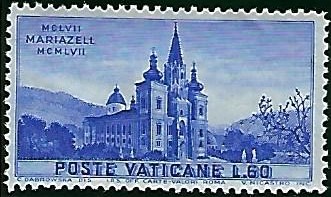

In either 1066 or 1103, the Benedictines established the Abbey of St. Lambrecht in a picturesque setting about 60 miles southwest of Vienna on the northern border of the Province of Styria, Austria. An old legend recounts that a monk named Magnus came to the monastery in the year 1157, bringing with him a statue of the Blessed Virgin Mary and the Christ Child, carved from lime-wood. A small hut was built to house the statue but soon the number of local inhabitants, who came there to pray at the shrine of the Blessed Virgin, became so great that is was necessary to build a larger wooden edifice. The fame of graces, granted at the shrine, drew Count Henry Ladislaus of Moravia who built the first stone church on the spot in 1200. About 100 years later Louis the Great of Hungary made a pilgrimage to Mariazell and in 1300 built a large gothic basilica to commemorate his victory over the Bulgars. The original chapel was preserved in the church and it became the principal shrine of Central Europe. About 1600 King Ferdinand III had the style changed to baroque by the Lombard architect, Domenico Selassie, who built the dome on the church and to the original gothic tower added two smaller towers. About this time the interior of the church (207 feet long by 69 feet wide) was decorated by several Italian artists. Numerous votive pictures are found in the ambulatory, but the more ancient, representing remarkable occurrences connected with Mariazell, are found above the arches. Above the altar was placed a grouping of marble statues of Sts. Anna & Joachim by Lorenzo Matielli. Queen Maria Theresa and Francis I, in 1757, had the high altar covered with silver as a more fitting throne for the statue of the Madonna and Child. Two life size figures of marble and an ebony crucifix donated by Emperor Charles VI decorate the main altar. From Bohemia, Moravia and other slavic countries, and from Austria and Hungary, more than 100,000 pilgrims made their way to the shrine even in the 19th century. With modern transportation, more than 300,000 pilgrims arrive each year. Under Joseph II of Austria it was the most important shrine in Austria, and by his orders time of pilgrimage was assigned to certain areas of his country, to ensure a constant flow to the shrine. Vienna started its pilgrimage on July 1, and Gratz on August 14. Under Nazi domination pilgrimages were forbidden. But even greater numbers came during the Marian Year of 1954 and in the 800th anniversary year of 1957. The Blessed Virgin Mary has been given several titles at this shrine: The Mother of the Slavonic Peoples; The Great Lady of Hungary; The Great Mother of Austria. The church is still under the Benedictines who founded the Abbey of St. Lambrecht. To celebrate the Marian Year Pope Pius XII made the Abbey an independent priory. In the 800th anniversary year the same Pius granted a plenary indulgence to all pilgrims who came during the time of the celebration which lasted from March to October 15, 1957. Technical Details: Scott Catalogue - 229 - 232 Date Issued - 14 November 1957 Face Value - 5 l, 15 l, €1.25, 60 l, 100 l Perforations - 13 Printer - The Italian State Printing Office |
| (From Vatican Notes Volume IX, Number 3, November - December 1960, Pages 11 - 12) |