Home
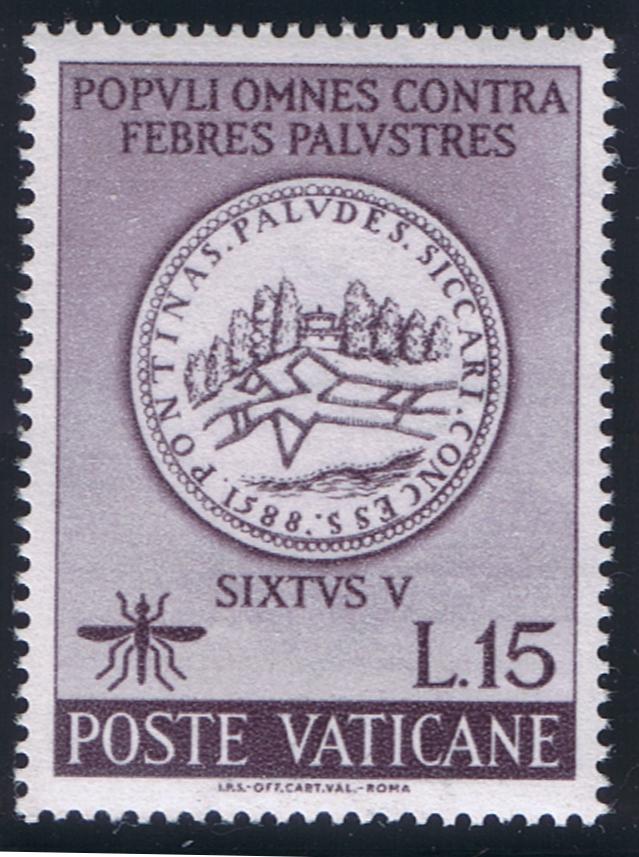
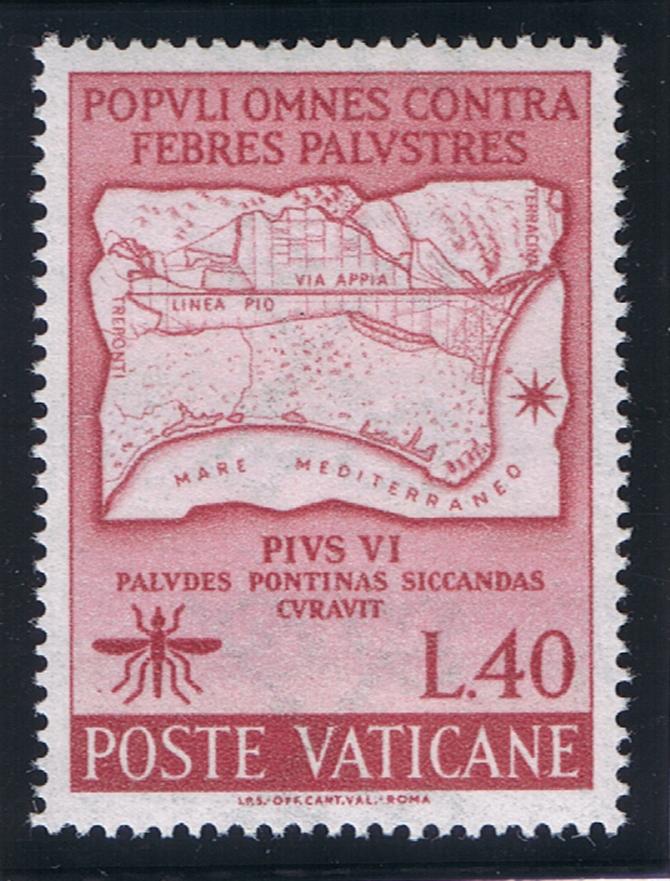
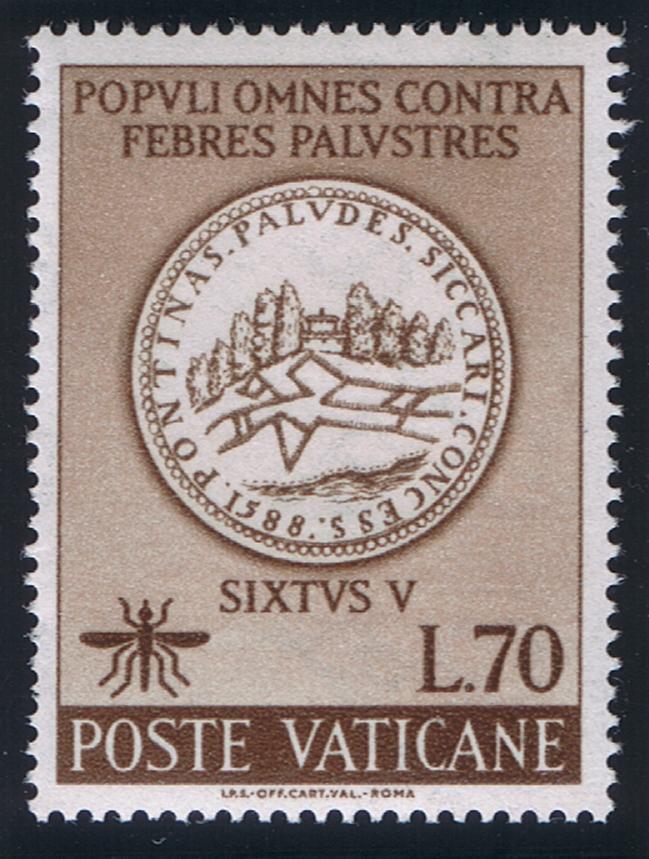

Ludwig von Pastor in his 'History of the Popes" gives accounts of the efforts of Pope Sixtus V (Vol. XXI) and Pope Pius VI (Vol. XXXII) to drain the Pontine Marshes. The first attempt in point of time was made by Pope Sixtus V (1585-1590) who turned his attention to the unhealthy swamps of Chiana near Orvieto, those at the mouth of the Tiber River, swamps near Ravenna and especially to the Pontine Marshes. The Pontine Marshes are situated south of Rome between the Alban and Volscian Hills and the sea. The problem of draining these marshes had had the attention of the Romans two centuries before Christ. Julius Caesar and the Emperors Augustus and Trajan had attempted to drain the water from the marshes, as had King Theodoric of the Goths, and several popes, especially Pope Boniface VIII (see 1949 Holy Year stamp) and Leo X who wished to reclaim this district for purposes of agriculture. Failure of others did not hold back the energetic Sixtus V from making an attempt to dry out the marshes to free them from malaria and make them fit for agriculture. He felt that from the reclaimed lands enough corn would be produced to remedy the periodic scarcity suffered by Rome, and that it would be a help to the Apostolic Camera. He became enthusiastic over a plan presented to him in the spring of 1586 for the draining of the marshes by Ascent° Fenizi, an engineer from Urbino. One of the principal obstacles encountered by his predecessors and successors was the opposition of the great landowners, who were interested in maintaining the existing state of affairs. Fabio Orsini was entrusted with this problem and was quickly successful in dealing with it. Ascenio Fenizi obtained from the Pope all those lands between Terracina Pipero and Secce which had not been cultivated for the preceding five years, in order that he might drain them and put them under cultivation. Fenizi and his heirs, as long as the work went on, were to pay to the owners each year whatever the land in question had hitherto produced. Once the draining was accomplished, they either went on paying this sum or were to hand over land to an equivalent value from the rescued district. Fenizi, after the work was finished, was to pay 5-1/2% of the revenues from the land placed under cultivation to the Apostolic Camera which, at the discretion of the Pope, was to be divided among the interested parties according to their shares in the cultivated land. Fenizi was given full power to widen existing waterways, making new channels and canals to the sea, provided he compensated the owners. As the undertaking involved a large expenditure, and the advantages accruing should be very great, the privileges granted to those who helped in the promotion were never to be suspended. Because of the malaria which was rampant in the Pontine Marshes during the summer, the work was not started on a large scale until autumn of 1586 with the employment of 2,000 workmen. The plan called for bringing the waters of the mountain streams which fed the Marshes, which stopped in the so—called Piscinara in the Fiume Antico, through a new way to be opened which was to enter the sea between Terracina and Cape Circe. All the proprietors of the Pontine Marshes who were to benefit by the project were invited in February, 1587 to contribute to the expense. There were reports of good progress in January, 1588, and in 1589 the works were practically finished. The large outlet which took a great volume of water to the sea was named Fiume Sisto after the Pope, and another smaller channel was planned beside it. Considerable acreage had been reclaimed which was found quite suitable for agriculture. On receiving this news, Pope Sixtus V decided to visit the works, which were regrettably to be abandoned after his death. On the eleventh of October, 1589, he set out with a large retinue to Terracina, passing through Marino, Velletri, Sermonetta and Sezze. Three kilometers west of Sezze at the foot of the hills of Trevi there is a stone which still bears the name *Stone (seat) of Sixtus' where he rested from his journey and looked out over the drainage works. The medal which appears on the 15 Lire and 70 Lire stamps commemorates the great project. The work of Pope Pius VI came about 190 years later. He had been the Auditor of Cardinal Ruffo at Velletri and had first-hand information about the Pontine Marshes and the various plans for their drainage. Soon after his election to the papacy he consulted experts on the possibility of draining the malaria-infested stretch between Cisterns. and Terracina and by early 1777 had decided to carry out this vast undertaking, which would be of great economic importance as well as being a great stride in public health. Gaetano Rappini, an engineer of Bologna, drew up a plan which was approved by two other engineers and work began in the autumn of 1777. Water coming from the hills was to be carried in a canal known as the Linea Pia, running parallel to the Via Appia, and was to be discharged into the sea at Terracina. The work continued rapidly and a large area was dried out by October, 1778. So that the Apostolic Camera would not be financially over-burdened, a stock company was formed with a capital of 120,000 scudi, but by May of 1779 it was found that a greater expenditure would be necessary, which led to much opposition. Pius VI would not be deterred, and was encouraged by a dry summer in 1779 which rendered the work easier; however, in November great rainfalls did considerable damage which hearsay exaggerated. Despite the risk of malaria, Pius decided to visit the works and find out just how much damage had been done. On April 6, 1780 he set out for Terracina and took up residence in the Palazzo Vitelli. Since no pope since Benedict XIII had journeyed further south in this direction than Castel Gandolfo, people flocked from all sides to greet him. The original course of the canal had to be diverted, but with satisfactory results. Considerable acreage was reclaimed and the Pope returned to Rome in a happy frame of mind. He repeated his inspection in April, 1781, but was unable to come there in the following year because of his visit to Vienna. He came again in April, 1783 and returned satisfied with the results, even though floods had done some damage. The cost of the drainage, which employed 3,500 men, caused much ad-verse criticism but Pius VI was not deterred because he saw great benefit and much profit would come when the project was completed. With the exception of 1791-1793 the Pope made this his spring holiday and from 1784 to 1796 he annually inspected the works, which time and again were held up by floods. The total amount expended over the years was 1,500,000 scudi, but in the end all that was gained was a reduction of the marshy area and not its elimination. The transformation of the Pontine Marshes into arable land remained a pious hope for more than a hundred years. Even in the early 20th century the Italian Government was not successful in its first efforts with modern equipment. Eventually the problem was solved under Mussolini. The achievements of Pius VI which his enemies tried to minimize or deny, have been judged by impartial critics of this century to have been considerable. On the 40 Lire and 300 Lire stamps appears a map of the project of Pius VI, on which can be distinguished the drainage canals, the Via Appia and the Linea Pia running parallel from Treponti to Terracina. Both designs bear the inscription at the top "All Peoples Against Malaria", and the efforts of the two Popes, Sixtus V and Pius VI, were not only to reclaim the Pontine Marshes for agricultural use but to eliminate malaria. With Vatican City State such a small area, there is no malaria problem to be solved there, but the efforts of the papacy in centuries past to eliminate this disease are recalled by the stamps, issued as part of the worldwide campaign against malaria. Technical Details: Scott Catalogue - 326 - 329 Date Issued - 06 April 1962 Face Value - 15 l, 40 l, 70 l, 300 l Perforations - 14 Printer - Instituto Poliguafico di Stato, Rome |
| (From Vatican Notes Volume X, Number 6, May - June 1963, Pages 3 - 4) |