Home
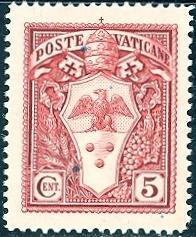
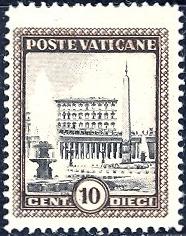

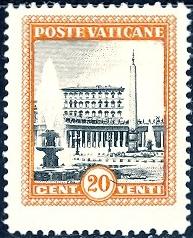
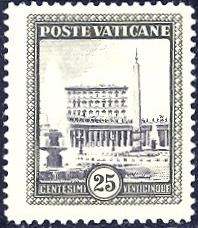


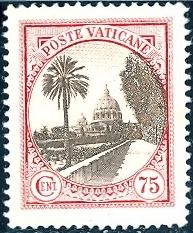

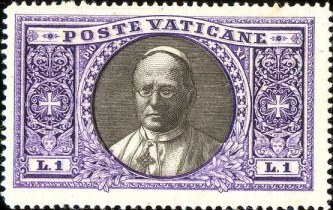
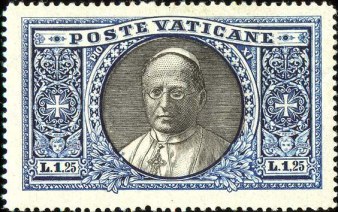


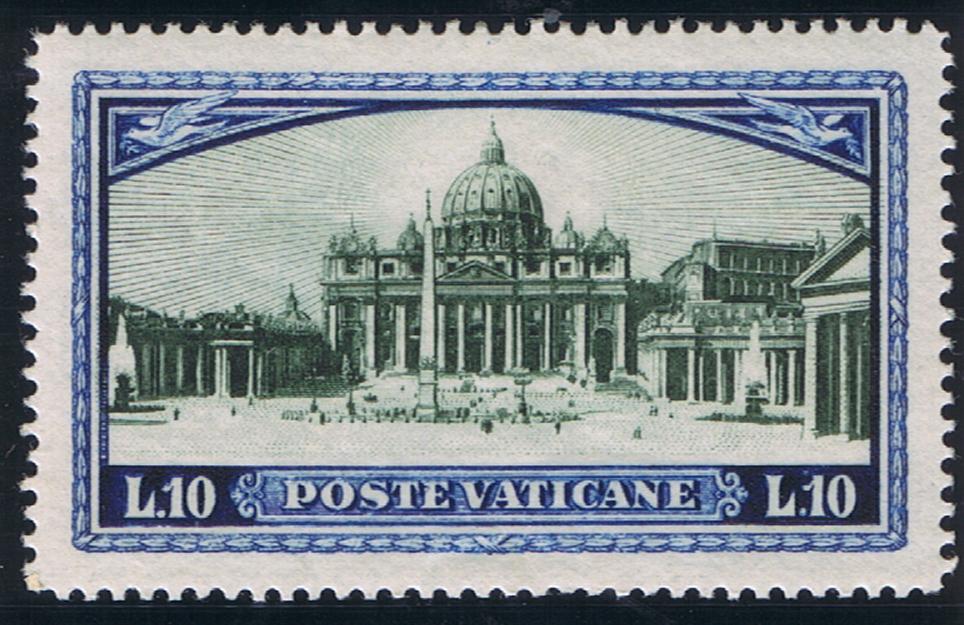
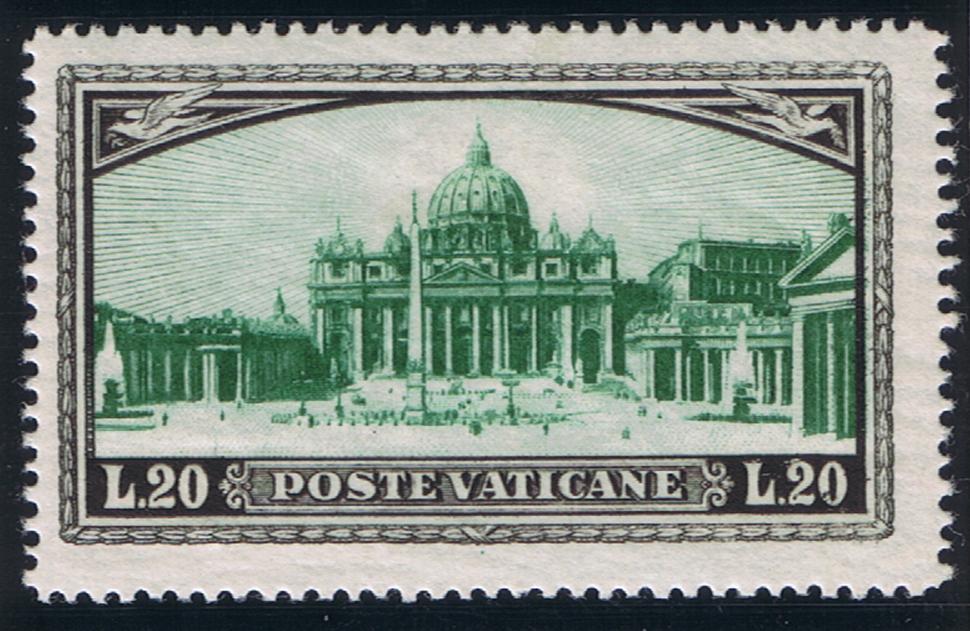
By order of the Vatican Governor dated May 20, 1933, the release of a new set of ordinary stamps was decreed. They were first placed on sale eleven days later, on May 31, 1933. The Arms of Pius XI are depicted on the 5 centesimi value surmounted by the Papal Tiara and Crossed Keys against arabesque background. The Apostolic Palace forms the motif for the 10, 12 20, and 25 centesimi values. The palace was a simple dwelling at first, erected by Pope Symmachus, in the fifth century. Subsequent Popes added to the structure and by the fourteenth century it had assumed the proportions of a palace. As it now stands, the Apostolic Palace is a group of buildings covering thirteen and one half acres to the north of St. Peter's and to the east of the Vatican Gardens. Among its some twenty courts and one thousand halls, chapels, and apartments will be found the Sistine Chapel, containing Michelangelo's famed "Last Judgement" on the rear wall. In other parts of the palace will be found the Chiarmonti Gallery, the Etruscan, Egyptian, and Pagan Museums where the priceless relics of the past ages are to be viewed with awe. The palace also houses the world renowned Vatican Library. About fifty thousand manuscripts and well over three hundred fifty thousand books are housed in this, the most American of all libraries in Europe. The scene that graces the 80, 50, 75, and 80 centesimi values is a view of the Vatican Gardens. The part of the gardens depicted is the Avenue of the Foundations with the characteristic palm tree. In reality, there are two gardens, the new and the old. The old gardens were begun so long ago their origin is lost in the annals of history. They are formally laid out in a series of vistas with irregular paths that often lead to a boxwood inglenook where a statue stands in a shady corner. The new gardens are less formally laid out. Here a vast assortment of flowers greets the viewer's eyes with great stretches of open green lawns dotted with rose gardens, and those laid out in the classic Italian patterns to finish the picture. The new gardens are kept fresh and flowering by modern irrigation. One central tap controls the spray of thirty-two acres of hidden lawn fountains. The two gardens combined cover approximately a quarter of the total area of the Vatican State. The 1, 1.25, 2, and 2.75 lire values of this depict the reigning Pontiff, Pope Pius XI. Pius XI entered this world early in the morning of May 31, 1857 in the commune of Desio, Italy, and baptized Ambrose Damien Achille. He spent a great deal of his childhood with his uncle who was the parish priest of Asso. His schooling passed rapidly and at the age of twenty-two he was ordained in the Church of San Carlo al Corso, in Rome, on December 20, 1879. A postgraduate course at the Gregorian University brought to young Achille the Doctorates of Theology, Philosophy, and Canon Law. In 1888 the future Pope was appointed to the Faculty of Doctors of the Ambrosian Library, in Milan. After serving in this capacity for nineteen years he was chosen Prefect. The year 1913 saw Father Ratti summoned to the Vatican by Pope Benedict XV, to serve as assist-ant prefect of the Vatican Library. A year later he became the Library's Prefect and Canon of the Archbasilica of St. Peter. At the age of fifty-seven he was raised to the rank of Monsignor. When Poland requested a Papal representative in 1918, Monsignor Ratti was sent by Pope Benedict XV. A year later a Nunciature was established in Warsaw with the recently elevated Archbishop Ratti serving as the Papal Nuncio. Some time later he was bestowed with the red hat and appointed Cardinal Archbishop of his Archdiocese of Milan, to which he returned on November 8, 1921. Exactly 150 days later he ascended to the Throne of St. Peter to serve a remarkable pontificate of seventeen years as Pope Pius XI, the 260th successor of St. Peter. The high values, 5, 10 and 20 lire stamps depict the Square of St. Peter's. The square is open at the front with two curved colonades straightening out before reaching the Basilica roughly in the shape of a keyhole. Two hundred and eighty four columns in four rows supporting nothing but one hundred sixty-four purely ornamental statues, architecturally, it seems absurd, but yet this art of building is the masterpiece of the famed Bernini, and forms a fitting approach to the final resting place of the body of St. Peter, the first Pope. In the center of the square stands an Egyptian obelisk with a crowning bronze cross containing a fragment of the True Cross. The obelisk is surrounded by a double row of small pillars to protect it from traffic. Flanking the obelisk are the fountains, spouting water fifteen to twenty feet into the air. This colorful pictorial issue is completed with two special delivery stamps bearing an aerial view of the Vatican City State. This, the tiniest nation in the world, can best be described in the words of Pius XI, "That much territory we need as a basis for sovereignty; that much territory without which we could not exist; . . . that much body required to keep the soul together." |
| (National Philatelic Museum, Volume VII, Number 1, 1954, pages 61-107) We are greatful to the Cardinal Spellman Philatelic Museum for allowing the Vatican Philatelic Society to use the copyrighted text on our website. |