Home
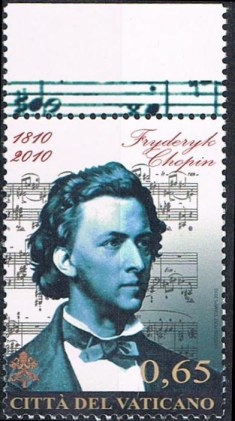
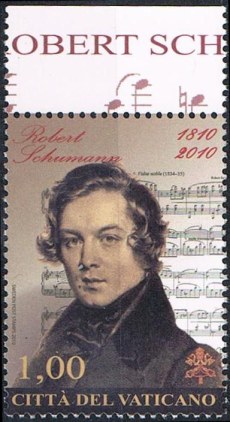
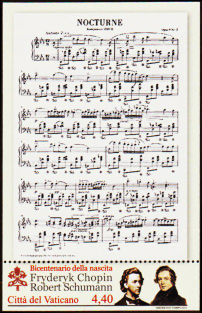
Vatican City made an annual music issue to celebrate the centenaries of notable composers. The 2010 issue recognized the bicentennial of the birth of Frederic Chopin and Robert Schumann. two of the nineteenth-century greatest composers of the Romantic era. In addition to individual postage stamps, the Philatelic Office released a leaflet consisting of a stamp depicting both composers as well as a portion of a Chopin Nocturne (E4.40). and a compact disc containing selections of music by Chopin and Schumann (the philatelic set, leaflet, and CD is offered at E9,90). The E0.65 Chopin and the E1,00 Schumann postal issues contain contemporary photographs of each composer superimposed over a sheet of music. The Schumann image is from an 1839 lithograph by Josef Krichuber. The Philatelic Office issued the first CD in this format in 2009. Fryderyk Franciszek Chopin (1810-1849) was born in a small Polish village in the Duchy of Warsaw, the son of a Polish mother and a French father. Chopin, a child prodigy by age 8, is widely recognized as one of the most significant composers of the Romantic era and composed exclusively for the piano: waltzes, nocturnes, preludes, mazurkas, and polonaises. Chopin spent two summers of his youth in the Polish countryside and portions of his compositions include folk music themes. Chopin was a fervent Polish nationalist. In the later eighteenth century. Prussia. Austria. and Russia absorbed Poland. and as a political entity, Poland was restored after World War I. Although he departed Poland for Paris at age twenty. Chopin is considered not only a national hero but also the greatest of Polish composers. From 1837-1847 Chopin carried on a romantic relationship with novelist George Sand (Amandine Aurore Lucile Dupin) at times wintering in Majorca. Plagued with tuberculosis, the poet of the piano died in Paris in 1849. Visitors today find his tomb at the Parisian Prue Lachaise Cemetery frequently adorned with flowers! Robert Alexander Schumann (1810-1856) was born in Zwickau. Saxony, a north German kingdom then recently dissolved by Napoleonic conquest into the Confederation of the Rhine. At a young age, he injured a finger on his right hand so that an intended career as a concert pianist Was set aside for that of a composer of works for the piano and, later. lieder and works for orchestra. Schumann composed exclusively for the piano during most of the 1830s. His song cycles, four symphonies, and other works occupied later years. He conducted a long romantic relationship with Clara Weick. also an accomplished pianist, and daughter of Chopin's piano teacher Friedrich Weick. who opposed their relationship. His later years of varying productivity were plagued by illness (perhaps mercury poisoning, syphilis, or bipolar disorder). Suffering from dramatic mood swings, in 1854 he attempted suicide by leaping into the Rhine River and spent his final Iwo years in a Bonn sanatorium, at his request. Robert and Clara Schumann's tomb is found at the Zentralfriedhof (Central Cemetery) in Bonn. Germany. |
| (From - Vatican Notes Volume 59, Issue 347, Q1 2010 pages 19-20) |