Home
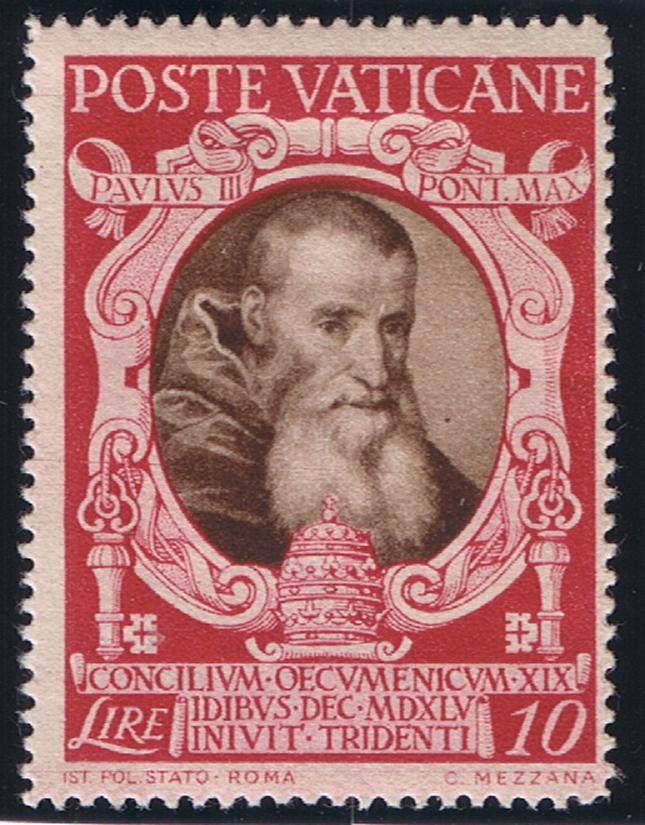 Pope Paul III, Council of Trent Issue (Scott 121, 1946) 
 Left: John Fisher, Council of Trent Issue (Scott 115, 1946) Right: Saint Thomas More, 450th Anniversary of Death (Scott 755, 1985) NOTE: the article below first appeared in Vatican Notes in 2002 and draws attention to one of the most important popes of the 16th century. Pope Paul III served from 1534 until his death on November 10, 1549. Alessandro Farnese was born in 1468 and although his early life was not beyond reproach (he fathered four illegitimate children), he converted. At the age of 51 he was ordained to the priesthood. Fifteen years later he was elected the 222nd successor of St. Peter, taking the name Paul III, a title aptly chosen. His 15 years as pope interest historians mainly for these events – the martyrdom of Sts. Thomas More and John Fisher, the convening of the Ecumenical Council of Trent, and the reforming of the Papal Court. Earlier in the same year in which Pope Paul III was elected, his predecessor Clement VII finally declared that King Henry VIII’s marriage to Catherine of Aragon was valid and no divorce from it possible. In the year following, the apostate Henry of England had imprisoned and condemned to death Sir Thomas More and John Fisher, Bishop of Rochester, both whom had refused to subscribe to the laws proclaiming the king’s spiritual supremacy. Surprising to many, even while the 77 year old bishop awaited his beheading in prison, Paul III raised him to be cardinalate! Three years went by and the pope having long last given up any hopes that King Henry VIII would experience any change of heart excommunicated him. It was no coincidence that exactly 400 years later Pope Pius XI chose the year of 1935 to canonize both More and Fisher martyrs thereby raising them to the honors of the altar. Paul III launched a new era in the history of the papacy when he reformed the College of Cardinals in the Papal Court. He limited his choices to men of erudition, integrity, and deep courage. For example, there is no doubt that Paul, by naming the imprisoned Bishop John Fisher a cardinal, intended to show that this martyr-to-be would return to the red hat and cassock these garments’ deeper meaning. Paul III is considered the most important pontiff of the Counter Reformation (a.k.a Catholic Reform), that 125-year effort to halt the rise of Protestantism by means of deep reform and restoration of Catholic life. Fittingly, the last ten years of the pope’s life saw him striving to convene a general Council. It opened in 1545 but four years later Paul III died at the advanced age of 81. This Council of Trent lasted on-and-off and did not close until three more successive popes presided over its many wise deliberations. The year was 1563. Finally, a word should be said about the beginning of the new America. Throughout the 15th and 16th century the Church made attempts to help the native Indians whose lands were being discovered by explorers in the New World. Pope Paul III’s bull on Pastorale Officium (1537) forbid their enslavement, “nor are they to be deprived of their freedom or ownership of their own possessions, since they are human beings and consequently, capable of faith and salvation.” REFERENCES: |