Home
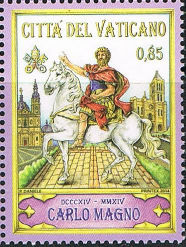

Charlemagne: 1200th Anniversary of Death Scott 1566-1567 (2014) January 28 is the anniversary of the death of Charlemagne, the Emperor of the Carolingian Empire who died on this date in 814 AD. In 2014 Vatican City issued the two-stamp set shown above to commemorate the 1200th anniversary of Charlemagne’s death. The €0.85 stamp features an equestrian statue of Charlemagne by Agostino Comacchini, along with views of the Benedictine Abbey of Fulda (Hesse, Germany) and Cathedral of Saint Denis (Paris, France) in the background. The €1.90 stamp depicts a classic iconographic image of Charlemagne, with scepter and orb. The Cathedral of Aachen, the site of his tomb, is also presented on the stamp. Charles the Great (Karl der Grosse, or Charlemagne) was born in 748 AD in Francia, or the Kingdom of the Franks. His father was Pepin the Short, who served as the King of the Franks from 751 to 768. "The Donation of Pepin", the transfer of Frankish territory in central Italy to Pope Stephen II in 756, is credited with "effectively establishing the temporal authority of the papacy" and formed the foundation for the Papal States. Following the death of Pepin in 768, Charlemagne, along with his brother Carloman I, would became the Kings of the Franks. Charlemagne became the sole ruler three years later. He would go on to become the King of the Lombards after 774.  The Crowning of Charlemagne by Pope Leo III Unknown artist (14th Century) From Wikimedia Commons, in the Public Domain Charlemagne has been called the Father of Europe, and has great historical importance for the Church, the spread of Christianity, and the foundation of Western Europe. The idea of the later Holy Roman Empire dates from his coronation as emperor on Christmas Day 800 by Pope Leo III at St. Peter’s Basilica, making him the first Western emperor in over 300 years. With his assumption of this title, he became the forerunner to the line of Holy Roman Emperors which persisted for over 1100 years. Charlemagne engaged in reforms in the areas of governmental administration, law, education, military organization, and religion, helping to form the basis for modern Western Civilization. According to historian and diplomat James Bryce, the union of the Roman and Germanic civilizations led to the formation of Europe in the wake of the Roman Empire. Charlemagne also continued the Frankish protections and support of the Church (and the papacy) that began under Pepin the Short. The concept of a centralized government has its roots in the "Carolingian Renaissance" that flourished in the Kingdom of the Franks under Charlemagne. Charlemagne died on January 28, 814 AD, in Aachen, Germany. A cult supporting Charlemagne dates from the 12th century. He was named a saint by Antipope Paschal III in 1165, a designation which was later revoked at the Third Lateran Council in 1179. Charlemagne's name does not appear in the Roman Martyrology, although he could be considered a local or regional saint in parts of the former Frankish Kingdom (now portions of eastern France and western Germany). REFERENCES: |