Home
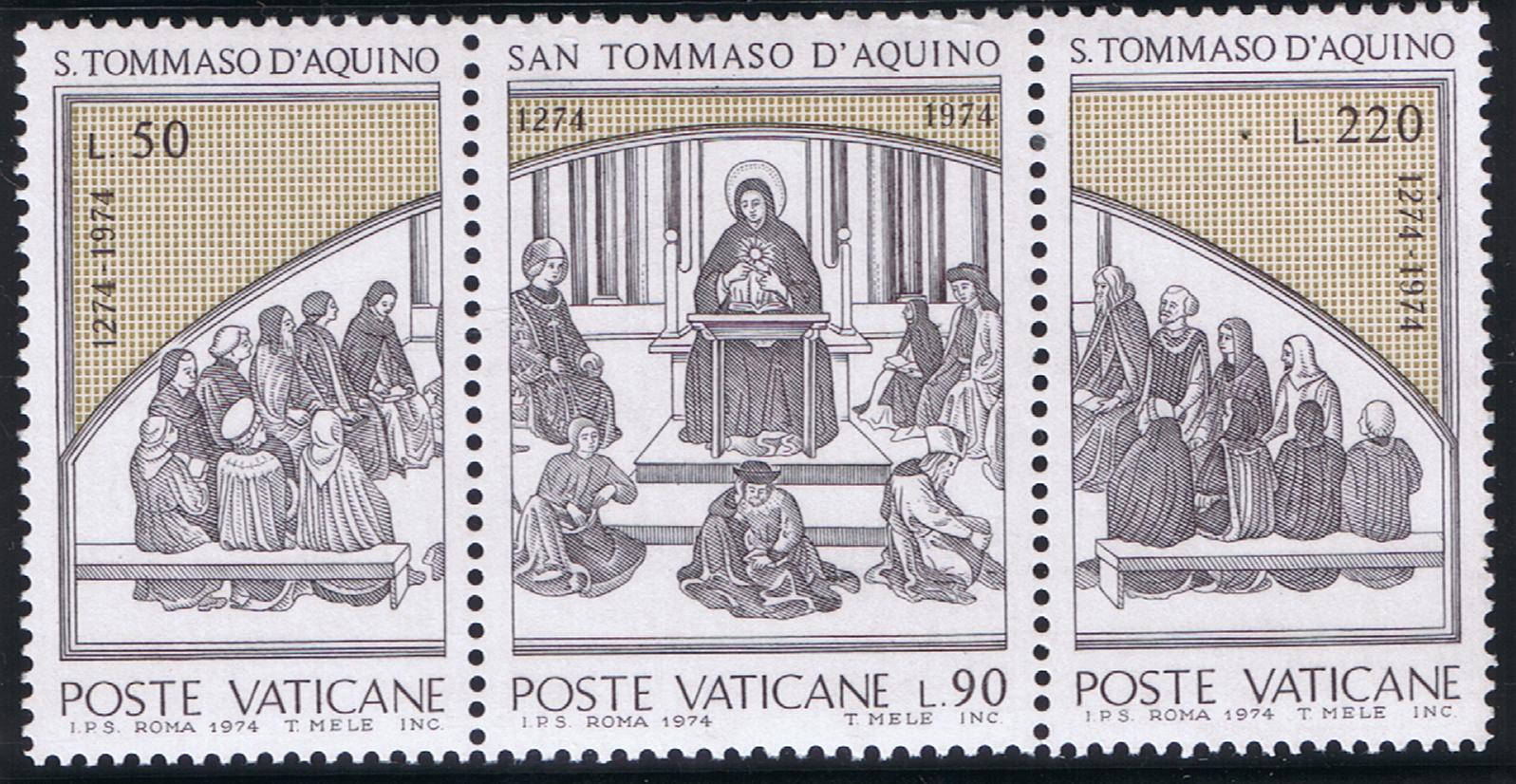 Saint Thomas Aquinas: 7th Century Of Death Scott 557a (1974) January 28 marks the Feast of Saint Thomas Aquinas, who died on this date in 1274. The three stamp triptych shown above was issued in 1974 to commemorate the 700th anniversary of his death. Thomas Aquinas was born around 1225 into a Lombard noble family near Aquino, Italy. Initially, he studied at the Benedictine monastery of Monte Cassino and later the University of Naples. While at Naples, he was attracted to the Dominican Order and eventually became a Dominican, much to the displeasure of his family. As a scholar-theologian, Aquinas divided his time between Italy and France, particularly Naples and Paris, both teaching and writing. To this day, Aquinas is considered one of the most influential thinkers in the history of Catholic theology and Western philosophy. He developed a school of thought encompassing both theology and philosophy known as "Thomism". As a proponent of natural theology, he contended that God is "the source of the light of natural reason and the light of faith". His thoughts encompassed ideas espoused by Aristotle, and he attempted to incorporate Aristotelian philosophy with the principles of Christianity. He has been described as "the most influential thinker of the medieval period" and "the greatest of the medieval philosopher-theologians".  Saint Thomas Aquinas Altarpiece in Ascoli Piceno, Italy, by Carlo Crivelli (15th century) From Wikimedia Commons, in the Public Domain Saint Thomas Aquinas is of monumental importance in the development of western thought and Roman Catholic theology. Aquinas employed both reason and faith in his studies of science, philosophy, and religion. He accepted the existence of God on faith, and offered five logical proofs of God’s existence to support such a belief which came to be known as the "quinque viae" ("Five Ways"). A famous quote from Aquinas regarding faith is: Of his voluminous writings, Aquinas is best known for his Summa Theologica. Unfinished at the time of his death, the work is a concise but comprehensive summary of Christian theology in a thesis/antithesis format, leading to a conclusion. Over time, it became the standard theological text in seminaries and universities into the 20th century. Historian David Farmer writes: "His deep contemplative devotion at prayer, which was sometimes ecstatic, was matched by an intense power of concentration and an ability to dictate to four secretaries at once. In respect to his Summa, its intrinsic excellence, its insistence on Aristotle combined with Platonist philosophy, its patristic learning and clear reasoning, have commended it to generations of theologians."In addition to his philosophical writings, Aquinas also composed several hymns, including O Salutaris Hostia, O Saving Victim Opening Wide, and Sing my Tongue the Saviour Glory. Aquinas was invited to appear at the Council of Lyons in France, but died on the way to that gathering on March 7, 1274. This is still his feast day in the old (pre-reform) Roman calendar. In revising the calendar of saints after the Second Vatican Council, his feast day was moved to January 28, commemorating the transfer of his relics to the Dominican friary in Toulouse in 1369.” Saint Thomas Aquinas was canonized in 1323 by Pope John XXII, and was raised to the title of Doctor of the Church in 1567 by Pope Pius V. In addition to the triptych release shown at the top of the page, in 2024 Vatican City issued the stamp below for the 750th anniversary of his death: 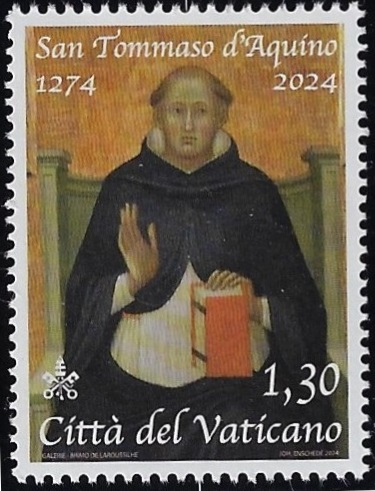 Saint Thomas Aquinas: 750th Anniversary Of Death Scott 1855 (2024) REFERENCES: |