Home


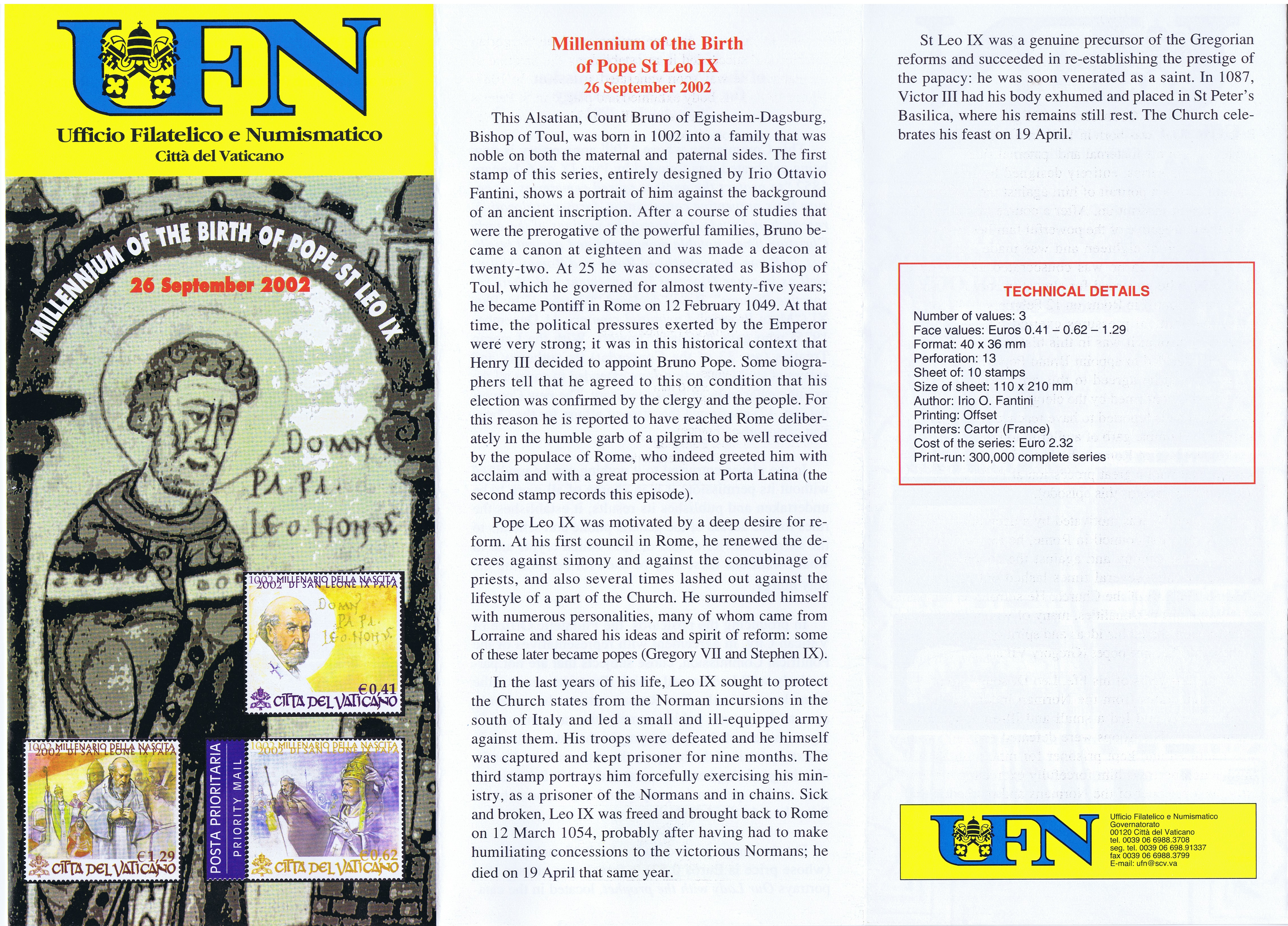
 Pope Saint Leo IX Millennium of Birth Scott 1225-1227 (2002) The millennium of the birth of Pope Leo IX was commemorated by Vatican City in 2002 with the three-stamp set shown above. He served as pope and ruler of the Papal States from February 12, 1049, until his death on April 19, 1054. He is viewed as one of the most historically significant popes of the Middle Ages. Born Bruno von Egisheim-Dagsburg on June 12, 1002, in Egisheim, Alsace, Duchy of Swabia, Holy Roman Empire (in the present-day northeastern France), with noble lineage on both sides of his family. Choosing to follow a religious life, he became a canon at age 18, a deacon at age 22, and in 1027 he would be consecrated as the Bishop of Toul at the age of just 25. In 1048, he was elected pope, an election influenced by the Holy Roman Emperor Henry III. The new pope only agreed to accept the position if his election was approved and confirmed by the clergy and the common people. The 0.62-euro stamp above depicts the pope, first on the left dressed in the rough garb of a simple pilgrim, arriving in Rome, followed by his coronation shown on the right. He took the name Leo IX. 
 Medallions of Pope Leo IX and Pope Gregory VII Basilica of Saint Paul Outside the Walls, Rome From Wikimedia Commons, in the Public Domain From the beginning of his reign, Pope Leo IX embarked on a campaign of reforms, and traveled extensively through Italy, France, and Germany. He aimed to eliminate various clerical abuses such as simony, nepotism, and priestly marriage. His reforms also would lead to the elimination of much of the interference in Church matters by emperors and nobility, which is somewhat ironic given that Leo IX owed his initial appointment to the influence of Henry III. The reforms he proposed were not entirely implemented during his papacy. One of his closest confidants was a young monk, Hildebrand, who would become Pope Gregory VII, under whose name most of Leo’s reforms were implemented and remembered as the “Gregorian Reforms”. In 1053, Pope Leo IX formed a military alliance against the Normans in southern Italy, who threatened Rome and papal control over the city. His army suffered defeat at the hands of the Normans, and the pope was held captive for nine months. The 1.29-euro stamp of the set above shows the pope reading from a scroll and fulfilling his ministry while in chains during his Norman imprisonment. He was released on March 10, 1054, but would die shortly thereafter, on April 19, 1054. Another important historical event during the papacy of Leo IX was the escalating tension between the Eastern and Western Churches. The pope sent legates to Constantinople to deal with heresy and questions of authority. Shortly after his death, one of his representatives, Cardinal Humbert of Silva Candida, delivered a bull excommunicating the Patriarch of Constantinople, Michael Cerularius (the bull was issued without papal authority). Mutual excommunications led to the separation of the Churches, creating the Great Schism of 1054 which continues to the present day. Following his death, Pope Leo IX was entombed at Old St. Peter’s Basilica. He was proclaimed a saint shortly thereafter, in 1082 by Pope Gregory VII, in response to miracles reported at his tomb. REFERENCES: |