Home
 St Thérèse of Lisieux: 100th Anniversary of Canonization Vatican City Aerogramme, 2025 October 1 marks the feast day of one of Catholicism's most popular saints, Thérèse of Lisieux. She was a French Discalced Carmelite who is also known as "Therese of the Child Jesus and the Holy Face" and "The Little Flower of Jesus". On two occasions, Vatican City has honored this young saint. In 1973, the centennial of her birth was commemorated with a three stamp set, which is shown at the bottom of this article. And, last year, the 2025 Vatican City aerogramme, shown above, was released in honor of the 100th anniversary of her canonization. Marie Françoise-Thérèse Martin was born on January 2, 1873, at Alençon, France, the daughter Marie-Azélie Guérin (usually called Zélie) and Louis Martin. When her mother died when she was four, the family moved to Lisieux where an aunt assisted in raising the family in very traditional French Catholicism. At one point while in her early teens, Thérèse traveled to Rome and met Pope Leo XIII during a public audience. She begged the pope for permission to enter the religious order of the Carmelites. She was allowed to enter the Order at Lisieux in 1888 at the young age of 15 (her sisters would eventually join here in the Order). Thérèse became a dedicated nun who strictly followed the demanding Carmelite rule and spent long hours in prayer and work. Her childish sweetness would mature into a more durable spirituality, with her mantra being to follow the "petite voie" (or “little way”). She composed a short biography, L’Histoire d’une Ame ("History of a Soul"), which was printed into multiple languages and became popular literature of the day. Historian David Farmer states: "[I]t is clear that her message is very close to that of the Gospels which she so frequently cited and that, carried to its logical conclusion, it requires very great courage and self-sacrifice, in which she excelled, for its realization. The way of simple, self-forgetful but complete obedience, which she recommended is a more taxing undertaking than that of the artificial use of exterior instruments of mortification she rejected."In 1895, Thérèse contracted tuberculosis and would die on September 30, 1897, at age 24. She is buried at her shrine at the Basilica of St.Thérèse at Lisieux, which is pictured on one of the stamps below. Saint Therese is typically portrayed in religious artwork in her Carmelite habit holding roses, recalling her promise for a ‘shower of roses’ of miracles and other favors. Many miraculous cures and special favors have been attributed to her, leading to her beatification in 1923 and canonization in 1925, both by Pope Pius XI. She would be further declared a patron of missions in 1937 and of France in 1947. In 1997, Pope John Paul II named St. Thérèse the thirty-third Doctor of the Church, which is remarkable given her youth. In addition, her parents were canonized in 2015, the only married couple (to date) so honored. And, the cause for beatification and canonization of her sister Léonie was opened in 2015.  Photograph of Saint Thérèse of Lisieux at Age 13 From Wikimedia Commons, in the Public Domain In an interesting historical note, Thérèse’s sister Céline was an avid photographer, so there are many photos of Saint Thérèse, going back to the time before she entered the convent. The photo above shows the saint at age 13. The photos of Thérèse would be among the first ever taken of a saint, and would compliment her writings and propel the interest in the future Saint Thérèse following her death. REFERENCES: 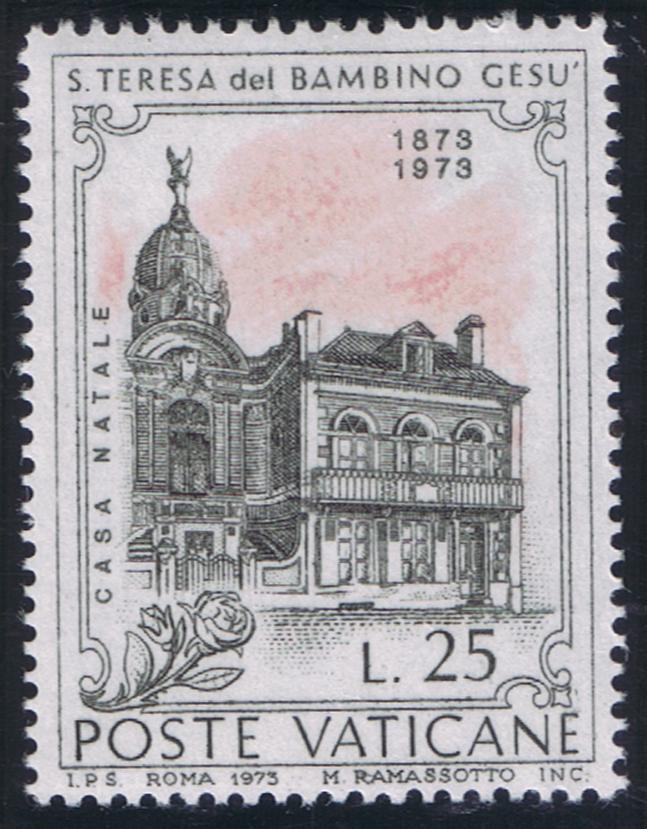
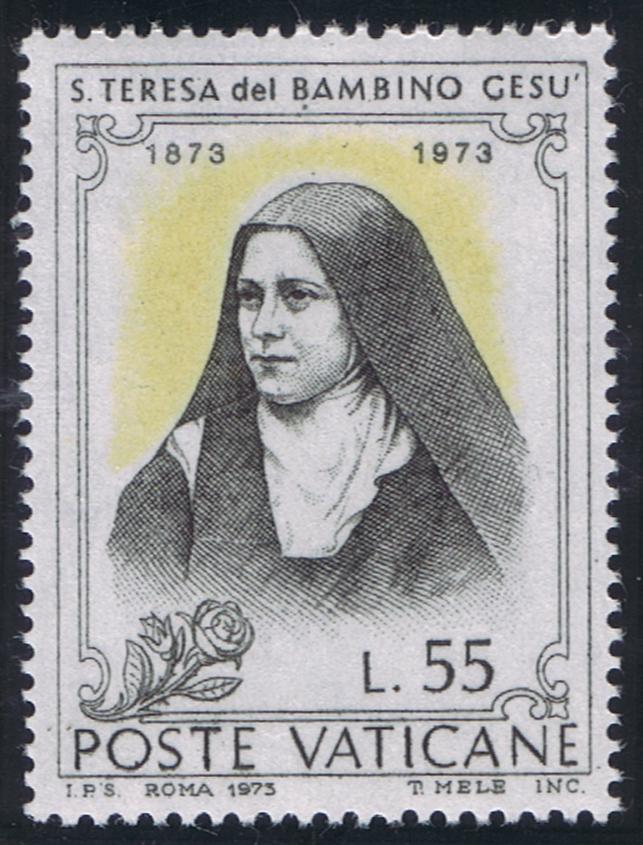
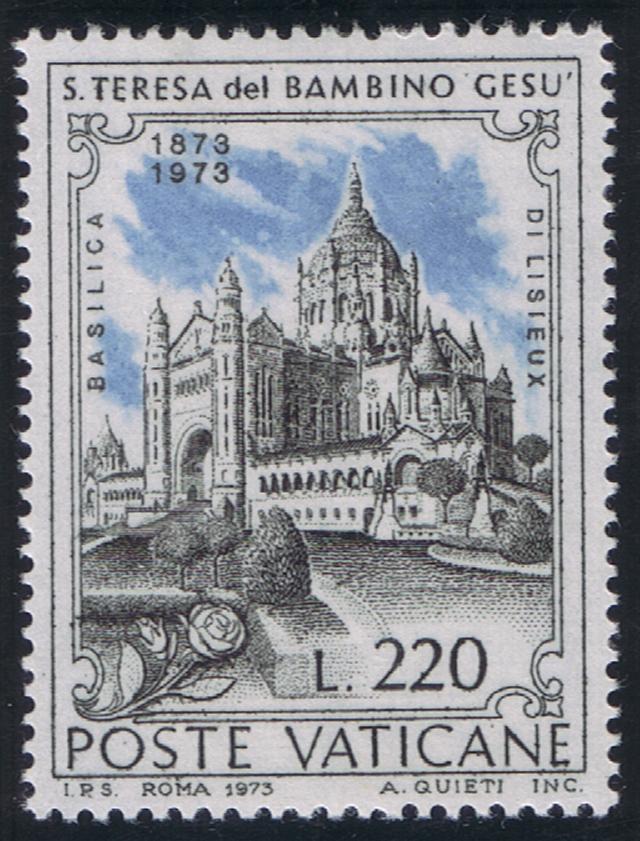 St Thérèse of Lisieux: 100th Anniversary of Birth (1973) 25 L: Birthplace of St. Thérèse (Scott 534) 55 L: St. Thérèse (Scott 535) 220 L: Lisieux Basilica (Scott 536) |