Home

 Art Masterpieces by Beato Angelico: Preaching of St. Stephen and the Stoning of St. Stephen Scott 1242 &1244 (2003) December 26 is celebrated as the Feast of Saint Stephen, who is venerated as the first Christian martyr (protomartyr). A deacon in the early Church in Jerusalem, Saint Stephen was known for his powerful preaching and wisdom. Around the year 34 or 35 AD, he was stoned to death after being accused of blasphemy. This martyrdom is recorded in the Acts of the Apostles (Acts, chapters 6 and 7). He was a Hellenistic Jew who was appointed a deacon by the Apostles to look after the faithful, likely the distribution of alms to widows, and also to preach. His lengthy discourse to the Sanhedrin (found in Acts 7) summarized the history of Judaism and explained that Christ was the Messiah, proclaimed by Moses and the prophets, and not tied to or dependent upon Mosaic Law or the Temple. He charged his hearers as being "stiff-necked men" who did not listen to the Holy Spirit, and he said they were guilty of killing of Jesus, just as their fathers had killed many of the prophets. He was then taken outside the city and stoned for blasphemy. The crowd was “…enraged, and ground their teeth against him.” There is no mention of a formal trial. During his martyrdom he saw a vision of Christ standing at the right hand of God: “Behold I see the heavens opened, and the Son of man standing at the right hand of God. …And as they were stoning Stephen, he prayed, ‘Lord Jesus, receive my spirit.’ And he knelt down and cried with a loud voice, ‘Lord, do not hold this sin against them.’”Saul (later St. Paul), who was then persecuting Christians, was present at Stephen’s stoning (Acts 7). After Stephen’s stoning, "a great persecution arose against the Church” in Jerusalem, scattering Christians throughout Judea and Samaria, activities directed by Saul (Acts 8). 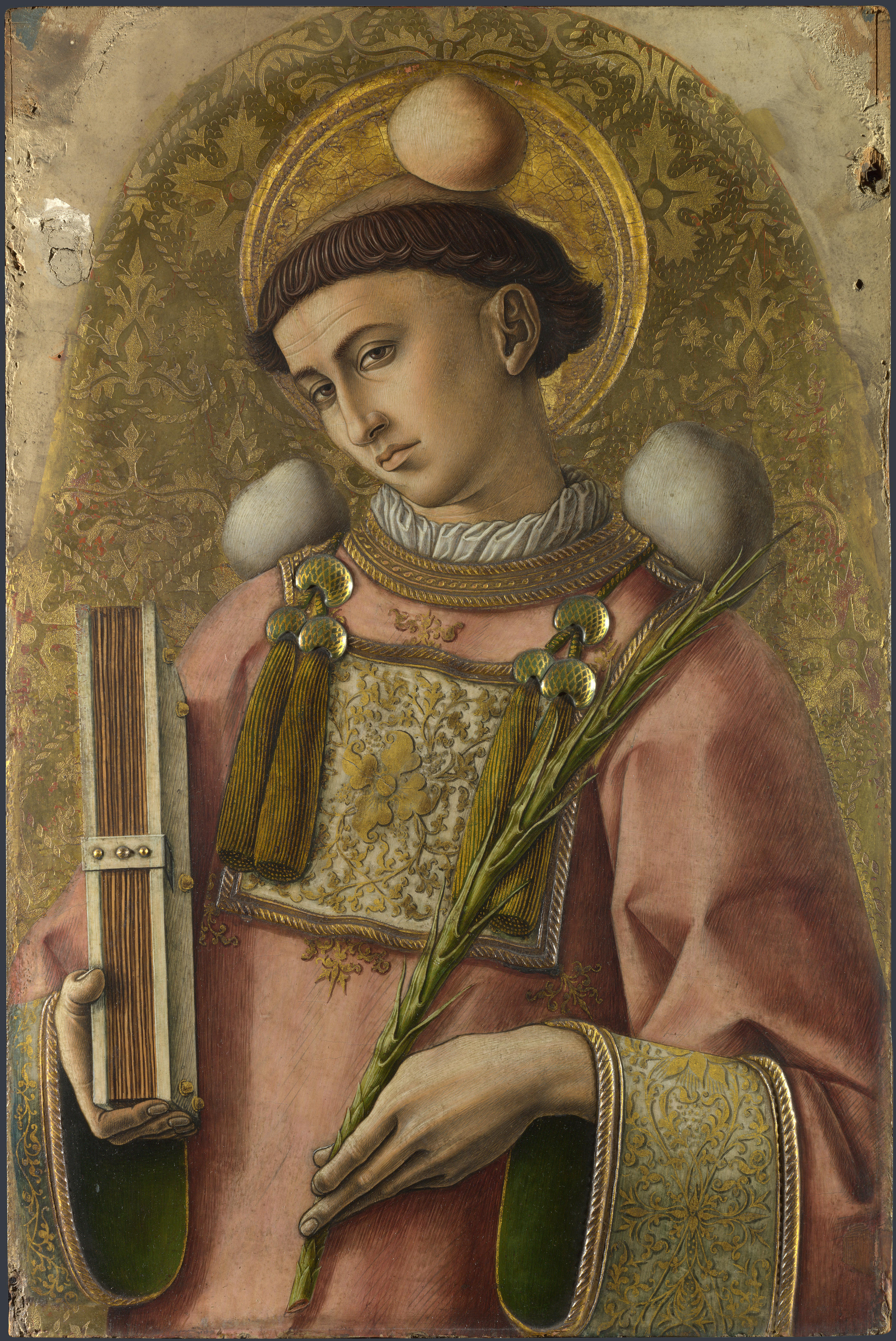 "St. Stephen the Martyr" by Carlo Crivelli (circa 1475) From Wikimedia Commons, in the Public Domain Saint Stephen is widely venerated and is the patron of altar servers and masons, among others. His iconography often depicts him with stones, as shown in the painting above, recalling his martyrdom. The feast for St. Stephen was celebrated in both East and West before the fourth century. He may have been first buried at or near St. Stephen’s Gate in Jerusalem, later the site of a monastery. It is said his relics were scattered from Constantinople to Rome. Under Pope Pelagius II (579-590) some or his relics were interred in the crypt of St. Lawrence Outside the Walls. REFERENCES: |