Home
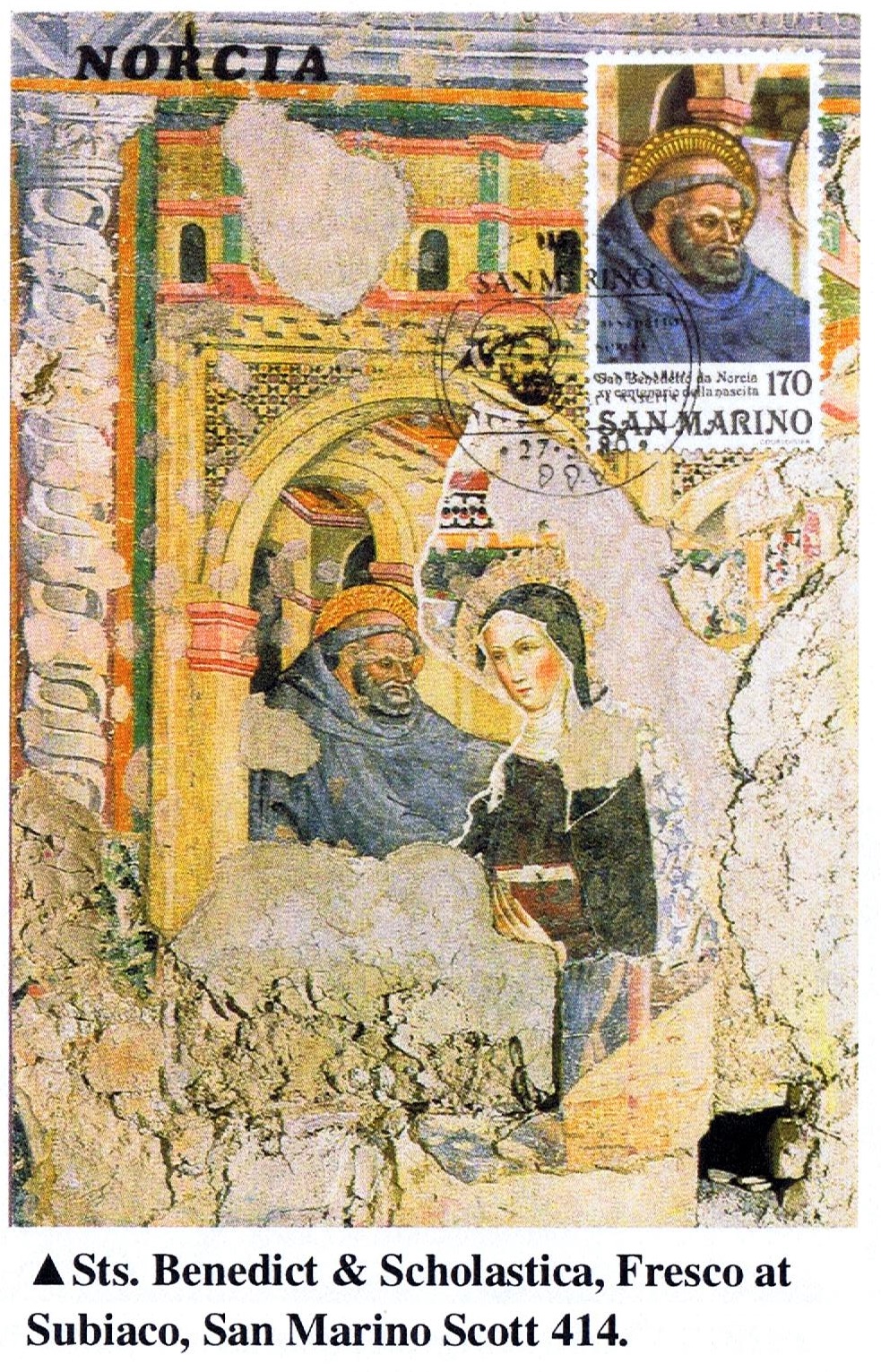 St. Scholastica is the sister of St. Benedict, the founder of Western monasticism and a patron of Europe. She is considered the founder of Benedictine communities for women. Information about St. Scolastica (as well as St. Benedict) is sketchy and somewhat based upon tradition. The source for contemporary information about St. Scholastica is the Dialogues of St. Gregory, the Great (Pope Gregory I, the Great, 590-604). She is sometimes depicted as Benedict’s twin sister and appears to have been dedicated to God at an early age. It is held that she established a convent for women about five miles from Benedict’s monastery at Monte Cassino. A church, the Monatero di Santa Scholastica, is located at the foot of Monte Cassino. An alternative view is that she lived in her father’s house with a few other dedicated women and they moved to be nearer Benedict after their father’s death. Scholastica died on 10 February 543 and she was buried in a tomb originally prepared for Benedict at Monte Cassino which may be visited today behind the abbey’s high altar. There is no Vatican City stamp depicting St. Scholastica, although she is depicted on a mosaic which served as a San Marino issue on St. Benedict. Article Link: • James C Hamilton, St. Benedict: From Subiaco and Monte Cassino to Patron of Europe, Vatican Notes, Vol. 60, No. 351, pp. 10-18 (2012) From Vatican State website--to be edited: Scholastica, the twin sister of Saint Benedict of Nursia, is inextricably linked to her brother’s name. She served God in contemplation and communal life. Saint Gregory the Great’s Second Book of Dialogues, which focuses on Benedict’s life, contains only a few hagiographical accounts of her life. Scholastica was born in Norcia, Umbria, in 480 A.D., most likely on 2 March, into a wealthy family. Her father was a descendant of the ancient senatorial Anicii family, while her mother was the Countess of Norcia. Unfortunately, shortly after giving birth to the twins, Scholastica’s mother died and her father vowed to have his daughter enter monastic life. Left on his own, he tried to take care of his children’s education. He decided to send them to Rome to further their classical studies. However, both children were disappointed by the frivolous life of the city. Benedict was the first to decide to become a hermit, in a cave in Subiaco. Scholastica then became the sole heir of the large family fortune. Nevertheless, she asked her father if she too could dedicate herself entirely to God in religious life. Although her decision caused him suffering, her father remembered his vow and accepted her choice. After making a vow of chastity, Scholastica moved to Subiaco, near her brother’s hermitage, along with other consecrated virgins. A few years later, when Benedict had left Subiaco to found Montecassino Abbey, Scholastica followed him with her companions and founded her own monastery in Piumarola, some seven kilometres from the Abbey, which was the first female monastery of the Benedictine Order. She adopted the Rule established by her brother. One of Scholastica’s main demands was that her sisters observe the rule of silence and avoid any conversations with people who were not part of the monastery, including the faithful. Scholastica never broke this vow. Scholastica and Benedict decided to meet once a year in a house located halfway between their two monasteries. On 6 February 547 A.D., sensing that her end was near, she begged her brother not to leave and asked him to stay with her until the following day. However, Benedict did not want to stay. In response, Scholastica prayed to the Lord and a violent storm broke out, which prevented her brother from leaving. Benedict then asked her, “What have you done”? She replied, “I asked you and you would not listen, so I asked my God and he did listen”. The twins spent the night discussing various spiritual topics. Only a few days later, on 10 February, Scholastica died. Benedict saw her soul ascending to heaven in the form of a dove. He then ordered that his sister’s body be transferred to Montecassino Abbey and placed in the tomb he had set aside for himself. Benedict died the following year, on 21 March. He was laid to rest alongside his sister. The following words are inscribed in Latin on a marble slab on their tomb: “They who could not be separated in life, are now joined in death”. Reference: VaticanState.va, https://www.vaticanstate.va/en/state-and-government/general-informations/saint-of-the-day/1500-10-february-saint-scholastica.html 10 February: Saint Scholastica |