Home
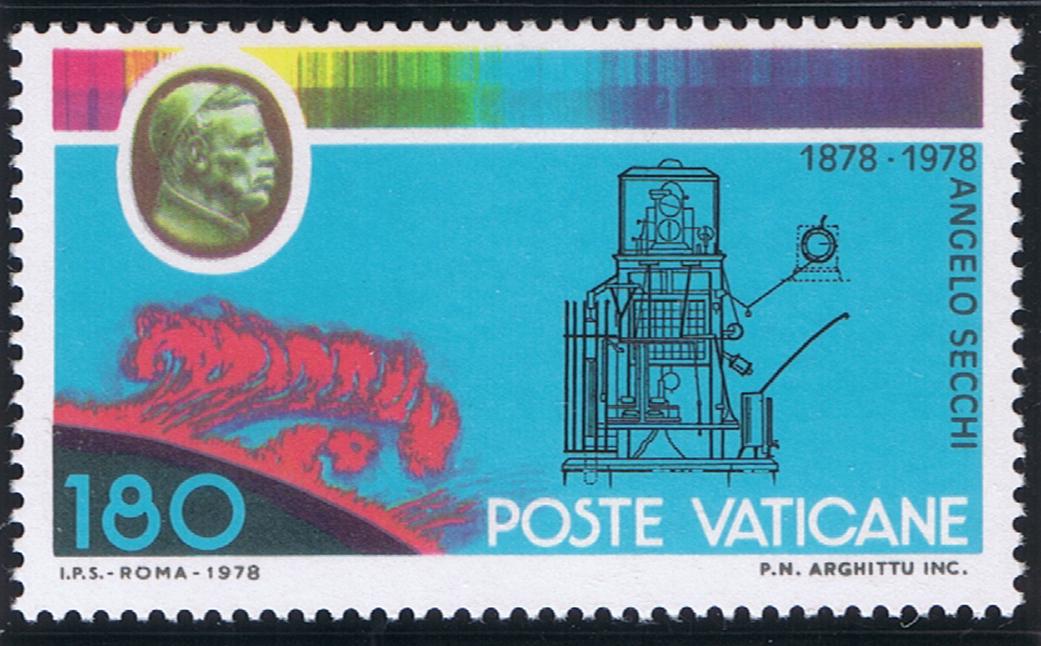
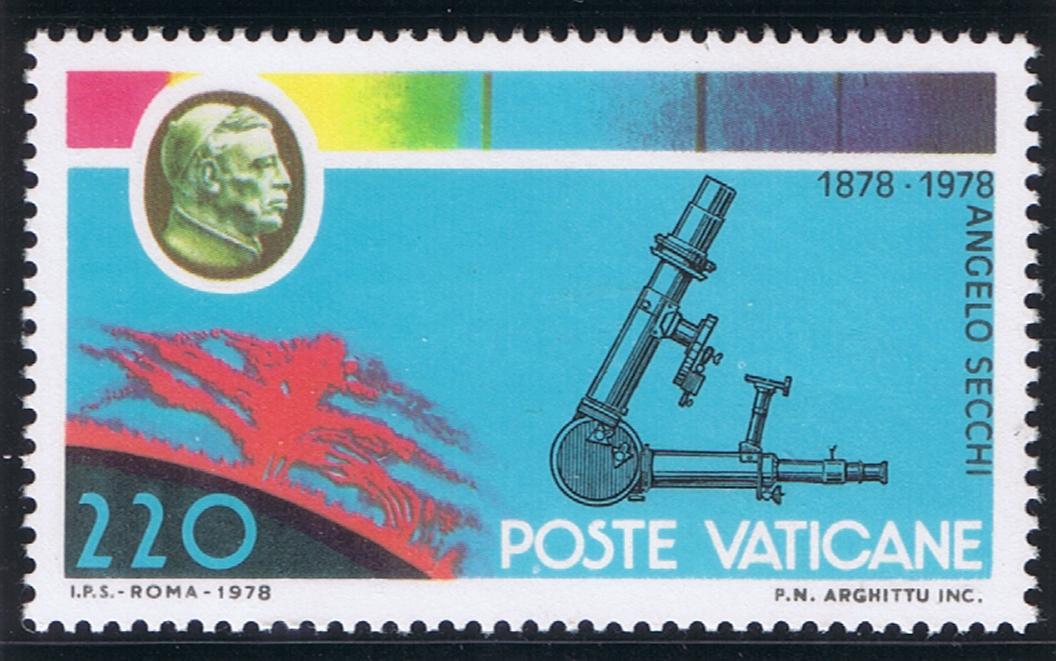
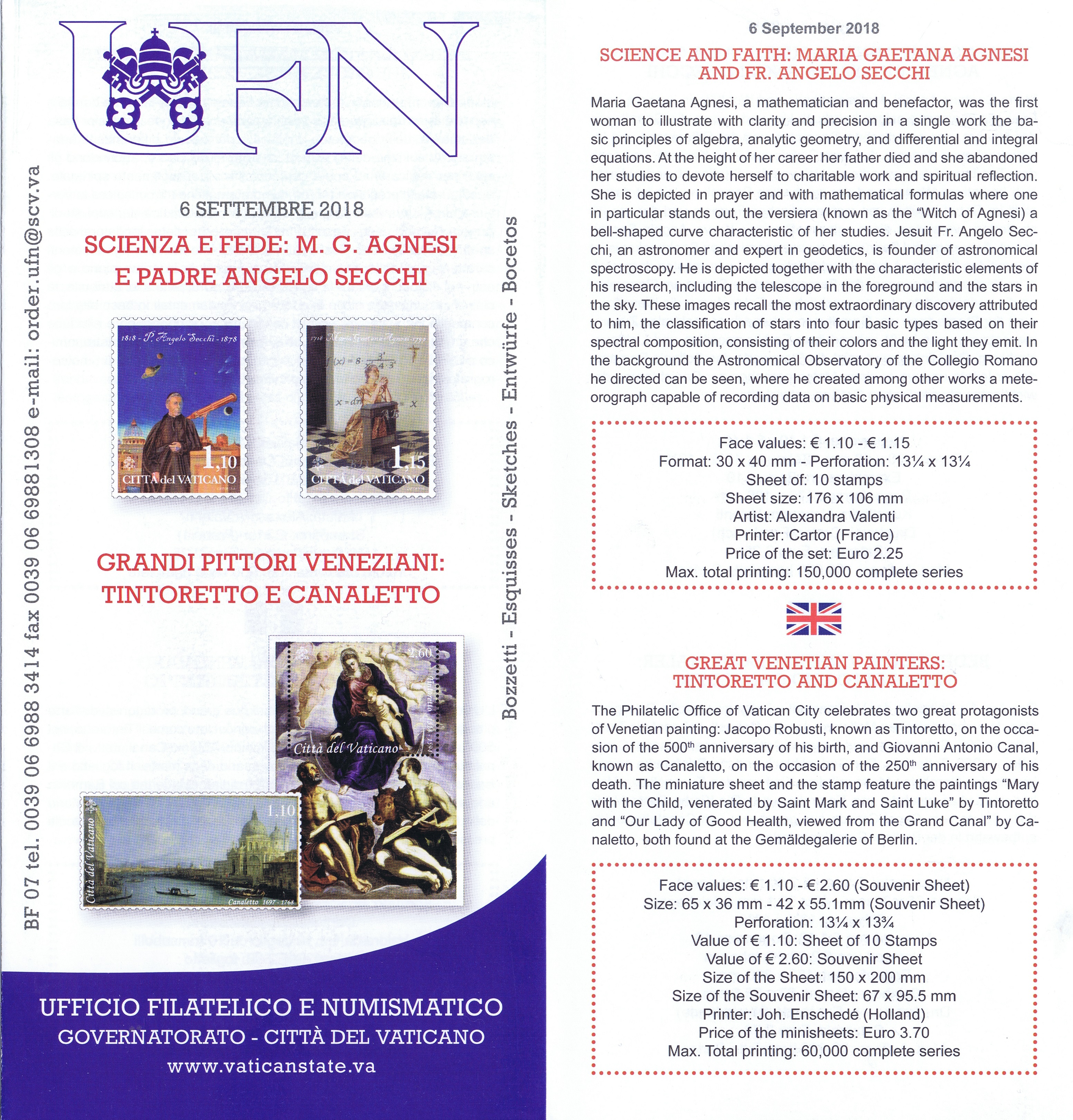
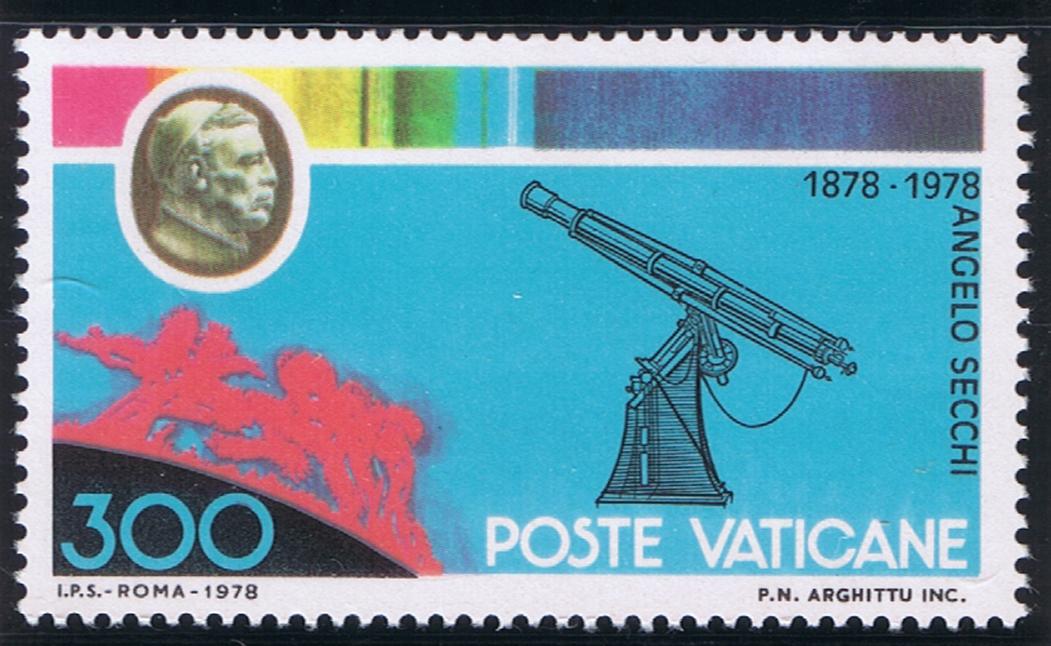 100th Anniversary of Death Of Father Angelo Secchi Scott 654-656 (1979) Famed astronomer Father Angelo Secchi died in Rome on February 26, 1878. On June 25, 1979, the Vatican issued three stamps commemorating the centennial of his death. The series is comprised of three values, with each stamp depicting representations of solar protuberances. Each stamp also displays an astronomical instrument or machine which was either created or perfected by Father Secchi: a meteorograph on the 180L; a spectroscope on the 220L; and a telescope on the 300L. The series was originally slated to be released in 1978 but, due to the deaths of Pope Paul VI and Pope John Paul I, was delayed until 1979. Angelo Secchi was born on June 18, 1818, in Reggio, Italy. At age 15, he joined the Jesuit order and began his theological studies in 1844. He was ordained priest in 1847. During this time, he began lecturing on physics and mathematics at the Jesuits' Collegio Romano, and in 1841 he was appointed professor of physics at the Jesuit college at Loreto. As a result of political unrest in Italy, the Jesuit order was effective expelled from the county in the late 1840’s. In 1848, Father Secchi was forced to flee Loreto and left Italy, first for England, teaching at Stonyhurst College, and then to the United States, where he took a teaching position at Georgetown University in Washington, DC. There he taught the natural sciences and was engaged in scientific research.  Bust of Father Angelo Secchi, Pincio, Rome Photo by Lalupa From Wikimedia Commons, used under the terms of the Creative Commons Attribution-Share Alike 3.0 Unported license In 1852, Secchi returned to Rome, founding a new observatory at the Collegio Romano. While there, he made many important observations in the field of astronomy. He is most remembered for his groundbreaking work using spectroscopy for the purpose of classifying stars. He established a four-part classification scheme which was the predominant tool used for most of the second half of the nineteenth century, and paved the way for future classification schemes. Secchi was also engaged in the study of solar physics, where he focused on “prominences” during solar eclipses. “Prominences” are the bright, pinkish-red loops or spots of plasma that appear along the edge (limb) of the Sun when the Moon completely blocks the Sun during an eclipse. Appearing like spikes of fire, they are actually massive structures of cool, dense gas trapped in the Sun's magnetic field. Secchi studied these formations visually and spectroscopically, and provided the first demonstrations that prominences are features belonging to the Sun. Secchi was also the first astrophysicist to suggest that the solar core is in a gaseous state (with the temperature steadily decreasing from the center to the surface), and he proposed theories on the significance of sunspots. Father Secchi also left his mark in the field of meteorology, where he is most famous for his invention of the “meteorgraph”, an instrument which automatically and continuously records barometric pressure, temperature, wind velocity, rainfall, and humidity. Father Secchi was a prolific writer, with an estimated 775 titles to his name. Some of his works were quite technical, but he also wrote books for the general public, including one for children. Perhaps his most impactful work is the monograph "Le Soleil" (“The Sun”), first published in Paris in 1870. Among his many honors, Father Angelo Secchi was elected to England's Royal Society, the Royal Astronomical Society of the French Académie des Sciences, and Russia's Imperial Academy of St. Petersburg. In Italy he presided for many years over the Accademia dei Nuovi Lincei (Pontifical Academy of New Lincei) and founded the Societa degli Spettroscopisti Italiani, devoted to spectroscopic studies of the Sun. Father Secchi remained in Rome until his death on February 26, 1878. In addition to the stamp set at the top of the article, in 2018 the Vatican Post Office released another stamp picturing Father Secchi. The two-stamp set, entitled "Science and Faith", also honored mathematician Maria Gaetana Agnesi. The 1.10-euro stamp commemorated the 200th anniversary of the birth of Father Secchi. Although not a joint issue, Italy also released a stamp depicting Father Secchi for the same purpose in 2018. 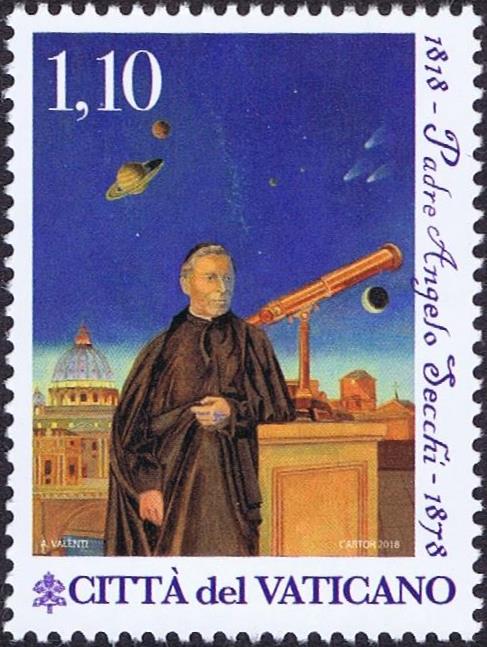 Father Angelo Secchi Science and Faith Issue Scott 1691 (2018) REFERENCES: |