Home
 450th Anniversary of the Birth of Caravaggio "The Martyrdom of Saint Matthew" Scott 1776 (2021) Michelangelo Merisi da Caravaggio was born in 1571 in Milan. Known simply as Caravaggio, he was the dominant painter in the early Baroque era who worked primarily in Rome. Vatican City issued the mini-sheet shown above in 2021 to commemorate the 450th anniversary of his birth. Caravaggio led a restless and turbulent life. Described as a "violent, touchy and provocative man", Caravaggio's personal characteristics are clearly exhibited in his works, which combine a realistic observation of the human state with a dramatic use of lighting. Many of his paintings show the subjects seemingly appearing out of a dark background, a technique known as "chiaroscuro" or "tenebrism", where strong contrasts between light and dark affect the composition as a whole. Caravaggio rarely worked from drawings or drafts, preferring to work with live models and directly painting his works in their final form. His works influenced later artists, including Rubens, Bernini and Rembrandt. Caravaggio's personal history of violence and agitation is well documented. He was involved in numerous duels and brawls over the years, and he fled Rome in 1606 as the result of an impending death sentence for the murder of a Roman gangster, Ranuccio Tommasoni. During the final four years of his life he moved between Malta, Sicily and the Italian mainland. Caravaggio died on July 18, 1610, at the age of 38 in Porto Ecole, Italy. The circumstances beind his death are shrouded in mystery and controversy. He reportedly died of a fever, but a number of theoretical causes of his death have been presented: lead poisoning (from the paints used at the time), syphilis, malaria and brucellosis. It has also been theorized that he was murdered in revenge by the Tomassoni family. Despite living a turbulent and erratic life, Caravaggio leaves behind a wealth of stunning works of art that continues to influence artists to this day. This Daily Email shows three of his works commemorated on Vatican City stamps. The souvenir sheet at the top of the page shows the painting "The Martyrdom of Saint Matthew" found in the Cappella Contarini in the Church of San Luigi dei Francesi (Saint Louis of the French) in Rome. The painting is one of three depicting scenes from the life of Saint Matthew commissioned by the heirs of Cardinal Matthieu Contrel housed in the chapel. The series represents the first public commission executed in Rome by Caravaggio from 1599 to 1602. Another of Caravaggio's masterpieces appeared on the Vatican City stamp issued in 2010 to memorialize the 400th anniversary of his death. Depicted is his painting of "The Deposition", which has an interesting history. Commissioned in 1602 for the Chiesa di Santa Maria in Vallicella (the "Chiesa Nuova") in Rome, the church of the Oratorian Order, the painting was at first viewed as somewhat controversial. It was taken to Paris in 1797 during the Napoléonic invasion, and returned to Rome and installed in the Vatican in 1816 (it is now housed in the Vatican Museums). The blank space at the church was replaced with a replica of "The Deposition", a work by Austrian painter Michael Köck. 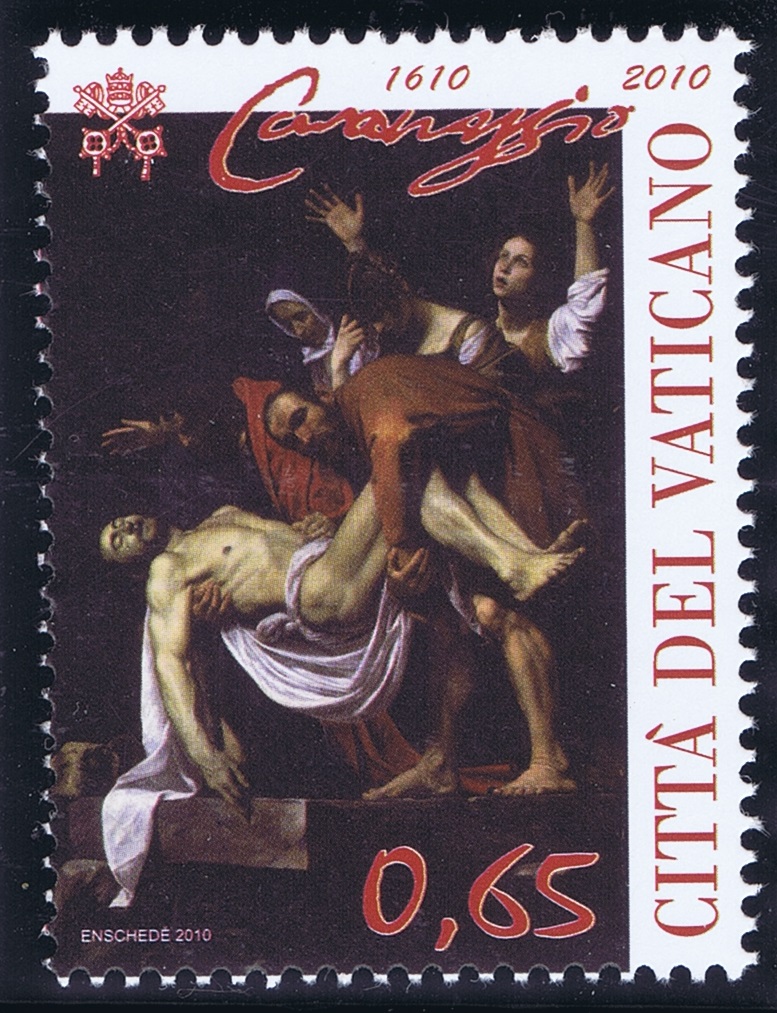 Fourth Centenary of the Death of Caravaggio "The Deposition" (or "The Entombment of Christ") Scott 1438 (2010) Also, the 2019 mini-sheet shown below was jointly issued by Vatican City, Italy and the Sovereign Military Order of Malta to mark the 50th anniversary of The Carabinieri Unit for the Protection of Cultural Heritage. It features "The Nativity with Saint Francis and Saint Lawrence" by Caravaggio in the selvage. This painting was stolen from the Oratory of Saint Lawrence in Palermo, Sicily, in 1969. The theft is considered one of the most significant art crimes in history. The painting, which has been valued at around $20 million, has not been recovered. A reproduction of the work was placed in the church in 2015.  50th anniversary of The Carabinieri Unit for the Protection of Cultural Heritage Left Margin: "The Nativity with Saint Francis and Saint Lawrence" Scott 1717 (2019) REFERENCES: |