Home

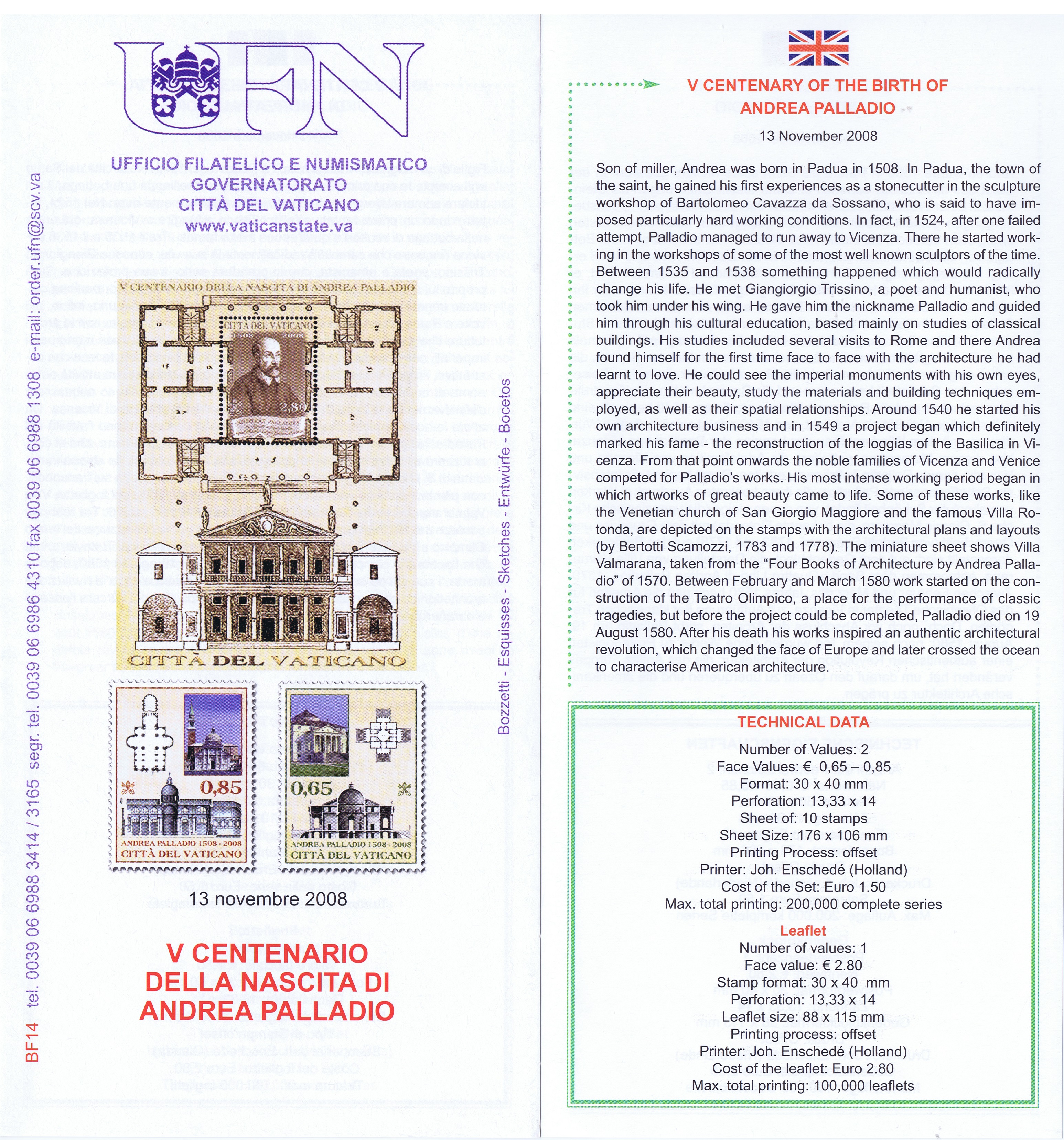
  Fifth Century Anniversary of the Birth of Andrea Palladio (2008) Top Left: Villa Rotonda, Vicenza (Scott 1396) Top Right: San Giorgio Maggiore Church, Venice (Scott 1397) Bottom Leaflet: Palladio and Villa Valmarana (Scott 1398) The fifth centenary of the birth of Italian architect and sculptor Andrea Palladio was commemorated with the release of a three-part set on November 13, 2008. The two stamps depict the images and floor plans for two of Palladio's works: the Villa Rotonda in Vicenza (0.65 euro stamp) and the San Giorgio Maggiore Church in Venice (0.85 euro issue). The 2.80 euro stamp on the leaflet displays an image of Palladio, with the image and floorplan for the Villa Valmarana in the selvage. Andrea Palladio was born on November 30, 1508, in the city of Padua in the Republic of Venice. Working initially as a stonecutter, Palladio moved to Vicenza in 1524 and began to work with a number of well-known sculptors. During the 1530's, he transformed into an architect following a period of "cultural education" under the tutelage of poet and humanist Giangiorgio Trissano. Palladio began to focus on the potential of transforming society through architecture, and was greatly influenced by classical Greek architecture. He also visited Rome to study its ancient buildings. In 1540, he started his own architectural business, and in 1549 began the project which would define his style and bring him his fame: the reconstruction of the Basilica of Vicenza. He went on to design churches, civic buildings and palaces around the region, and is perhaps best known for the country houses and villas he designed for the nobility of Vicenza and Venice. As a result of his work, Palladio is widely considered to be one of the most influential individuals in the history of architecture. His teachings, summarized in his architectural treatise, The Four Books of Architecture, gained him world-wide fame and recognition. One admirer was Thomas Jefferson, who included the study of architecture among his many interests. Palladio's influence can be seen in the design of Monticello, Jefferson's estate in Virginia.  The front page of I quattro libri dell'architettura (The Four Books of Architecture) by Andrea Palladio From Wikimedia Commons In the Public Domain Palladio died at the age of 71 in 1580 near Venice. An enduring testament to his fame lies in the designation of the "City of Vicenza and the Palladian Villas of Veneto" (a collection of 23 buildings and 24 villas designed by Palladio) as a UNESCO World Heritage Site. In addition, churches designed by Palladio are also found within the "Venice and its Lagoon" UNESCO World Heritage Site. Shown below are contemporary photographs of the structures presented in the stamps shown at the top of today's article. These striking works cement Andrea Palladio's reputation as one of the greats in the field of architecture.  Photo by Marco Bagarella From Wikimedia Commons Used under terms of the Creative Commons Attribution-Share Alike 3.0 Unported license The Church of San Giorgio Maggiore, Venice  Photo by Didier Descouens From Wikimedia Commons Used under terms of the Creative Commons Attribution-Share Alike 4.0 International license Villa Valmarana, Vicenza, Veneto, Italy  Photo by Hans A. Rosbach From Wikimedia Commons Used under terms of the Creative Commons Attribution-Share Alike 3.0 Unported license REFERENCES: |