Home
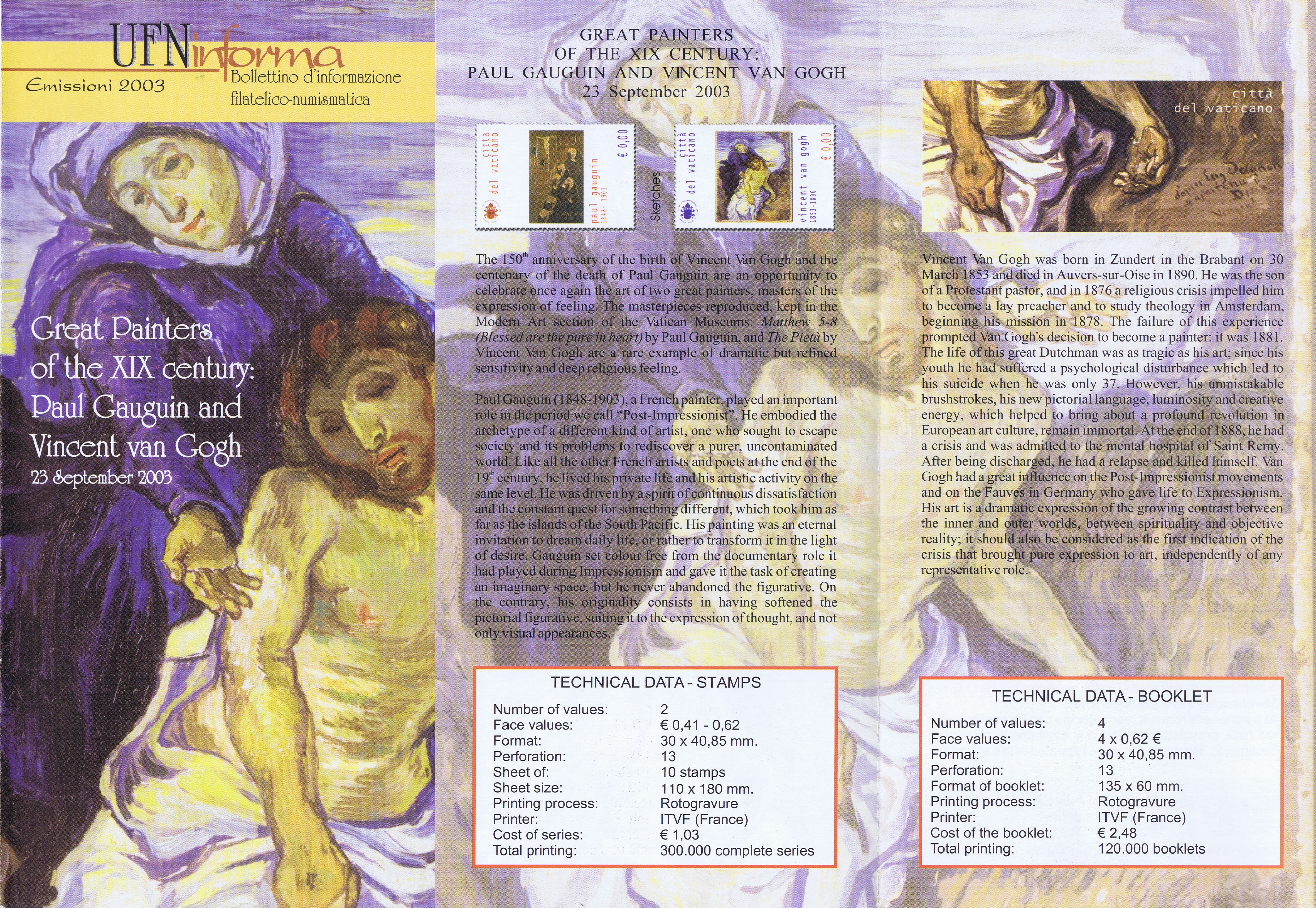
 Paul Gauguin, Scott 1246 (2003) In keeping with a tradition of portraying the works of great artists, Vatican City issued two stamps in 2003 under the title Great Painters of the XIX Century: Paul Gauguin and Vincent van Gogh. The stamp shown above, Scott 1246, depicts Gauguin's Matthew 5-8 (Blessed are the pure in heart), a polychrome wood sculpture which is housed in the Vatican Museum's Modern Art section. Paul Gauguin was born on June 7, 1848, in Paris, France. He was a painter, printmaker, and sculptor who sought to achieve a primitive expression of spiritual and emotional states in his work. The artistic terms post-Impressionism, synthetism and symbolism, among others, have been used to describe his styles. He developed a creative relationship with van Gogh during his lifetime, but also worked with and influenced many of the great artists of the 19th and 20th centuries, including Camille Pissarro (his primary mentor), Cézanne, Manet, Degas, Renoir and Picasso. His artistic experiments influenced many of the avant-garde developments of the early 20th century. In addition to living in France and Spain, Gauguin is well known for his time spent on the island of Tahiti in French Polynesia. Gauguin wished to experience the primitive nature and purity of the island, and many of his works aim to present his views of the island during his stays there. As Western influences crept into the culture of Tahiti, he moved to a more remote Polynesian island, Hiva Oa, in 1901. He died on that island on May 8, 1903, at age 54. REFERENCES: |