Home

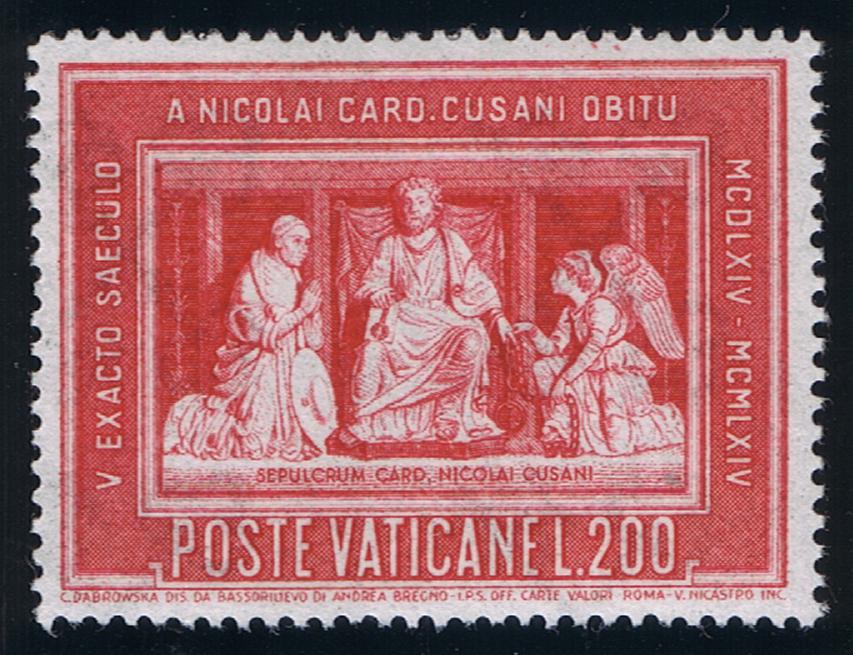 Nicolas Cardinal Cusanus Issue of 1964 Left: Birthplace of Cardinal Nicolas Cusanus (Scott 395) Right: Cardinal's Sepucher, Church of San Pietro in Vincoli, Rome (Scott 396) On November 16, 1964, Vatican City issued a two-stamp set commemorating the 500th anniversary of the death of Nicholas Cardinal Cusanus (also known as Nicholas of Cusa and Nicholas of Kues). Born in 1401 in Kues in modern-day southwestern Germany, Nicholas was a philosopher, theologian, jurist, mathematician, and astronomer. One of the first German proponents of Renaissance humanism, he made numerous scientific, spiritual and political contributions which impacted European history.  Birthplace of Nicholas of Cusa (Kues, Germany) Photo by Sir Gawain From Wikimedia Commons Used under terms of the Creative Commons Attribution-Share Alike 3.0 Unported license Nicholas played an important role in the struggles between Rome and the German states of the Holy Roman Empire. As papal legate to Germany from 1446, he traveled throughout Europe preaching and negotiating diplomatic affairs for the Holy See. He was appointed cardinal by Pope Nicholas V in 1448 and Prince–Bishop of Brixen two years later. In 1459, he became vicar general in the Papal States. Perhaps his greatest achievements were in science and philosophy. His works formed major advances in Renaissance mathematics, astronomy, and mysticism. For example, before the time of Copernicus and Newton, he posited that the nearly spherical earth revolved on its axis about the sun. In mathematics, he proposed significant concepts of the infinitesimal and contributed to modern relativity theory. His ideas on mystical religious philosophy were presented in a set of essays, the most important being De Docta Ignorantia ("Of Learned Ignorance"), in which he maintained "the finite human mind cannot fully know the divine, infinite mind ('the Maximum'), but the human intellect can become aware of its limitations in knowing God". His writings presaged the growth of Renaissance humanism as it related to man's nature and his relationship to the cosmos. Nicolas died on August 11, 1464. He was buried at the Church of San Pietro in Vincoli in Rome. His tomb bears the sculptured relief "Cardinal Nicholas Before Saint Peter", by Andrea Bregno:  Tomb Of Cardinal Nicholas Cusanus Basilica of San Pietro in Vincoli, Rome Photo by Luciano Tronati From Wikimedia Commons, used terms of the Creative Commons Attribution-Share Alike 4.0 International license In accordance with his wishes, his heart rests within the chapel altar at the Cusanusstift in Kues, which currently houses his library and serves as a home for the aged. REFERENCES: |