Home
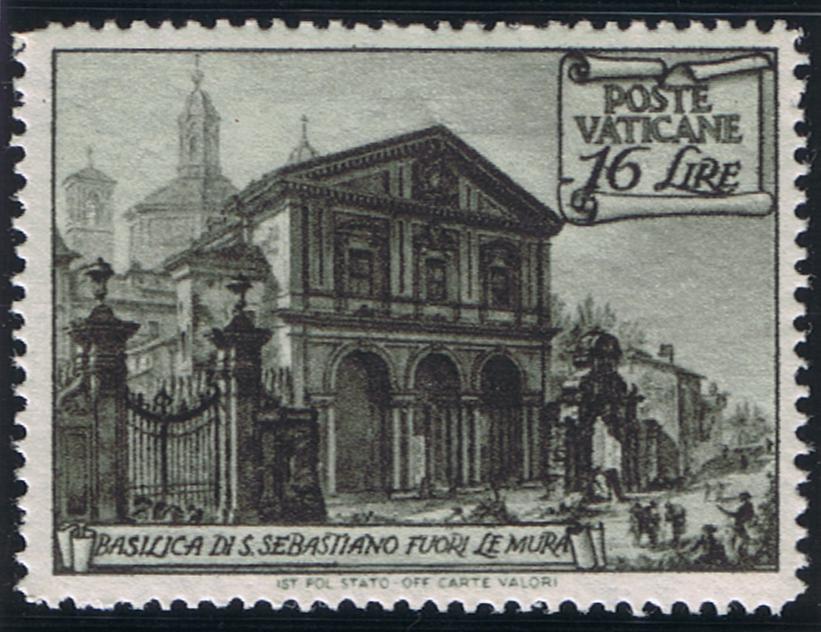
Roman Basilicas Issue Saint Sebastian Outside the Walls Scott 127 (1949) The Liturgical Calendar celebrates the Feast of Saints Fabian and Sebastian on January 20. Some dioceses celebrate the Saints separately, with the Feast of Saint Fabian falling on January 19 and Saint Sebastian on January 20. These two saints and martyrs are linked to the period of the Roman Persecutions of the third century AD. Neither saint is specifically depicted on a Vatican City Stamp, but the Basilica of Saint Sebastian Outside the Walls appears on one of the stamps from the Roman Basilicas Issue of 1949 and is shown above.  Fabian, Pope and Saint Chromolithograph, 1879 Municipal Library of Trento From Wikimedia Commons, used under the terms of the Creative Commons CC0 1.0 Universal Public Domain Dedication Fabian was a layman who tended a farm outside of Rome. He came to the city as the election was being held to choose the successor to Pope Anterus, who had died in 236 AD. According to legend, a dove landed on head of Fabian, which was taken as a sign for selection. The clergy and laity united to unanimously chose Fabian as Pope. He would serve as the 19th successor to Saint Peter for 14 years, from 236 AD to 250 AD. He died a martyr’s death during the persecution of Decius. In fact, it appears that he was one of the earliest victims of Decius, dying on January 20, 250, at the beginning of the Decian persecutions. The stone covering his grave can still be seen in the catacombs of Saint Callixtus. It is broken into four pieces and bears the Greek words Fabian, bishop, martyr. 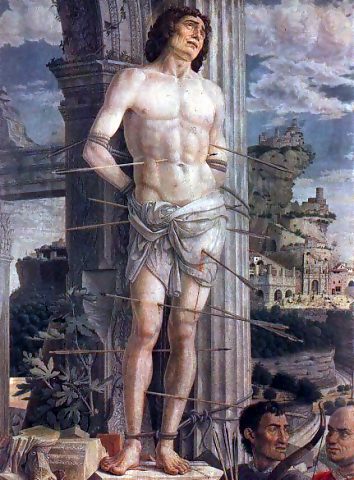 "Saint Sebastian" by Andrea Mantegna (circa 1480) Louvre Museum, Paris, France From Wikimedia Commons, in the Public Domain Little is known about Saint Sebastian that can be defined with certainty. He was born in Gaul around 255 AD, and was educated in Milan. One account has it that he entered the Roman army to render assistance to Christian martyrs. He carefully concealed his religion but was eventually found out and condemned to be shot to death by arrows. The sentence was executed, but he survived and was nursed back to health by Saint Irene of Rome. He eventually confronted Emperor Diocletian to reproach him for his injustice against the Christians. The stunned Emperor then commanded that Sebastian be beaten to death with clubs, around the year 288 AD. The patron saint of many causes, including athletes, soldiers and (fittingly) archers, Saint Sebastian is often depicted in religious art as being pierced with arrows.  Saints Fabian and Sebastian Painting by Giovanni di Paolo (circa 1475) From Wikimedia Commons, in the Public Domain REFERENCES: |