Home
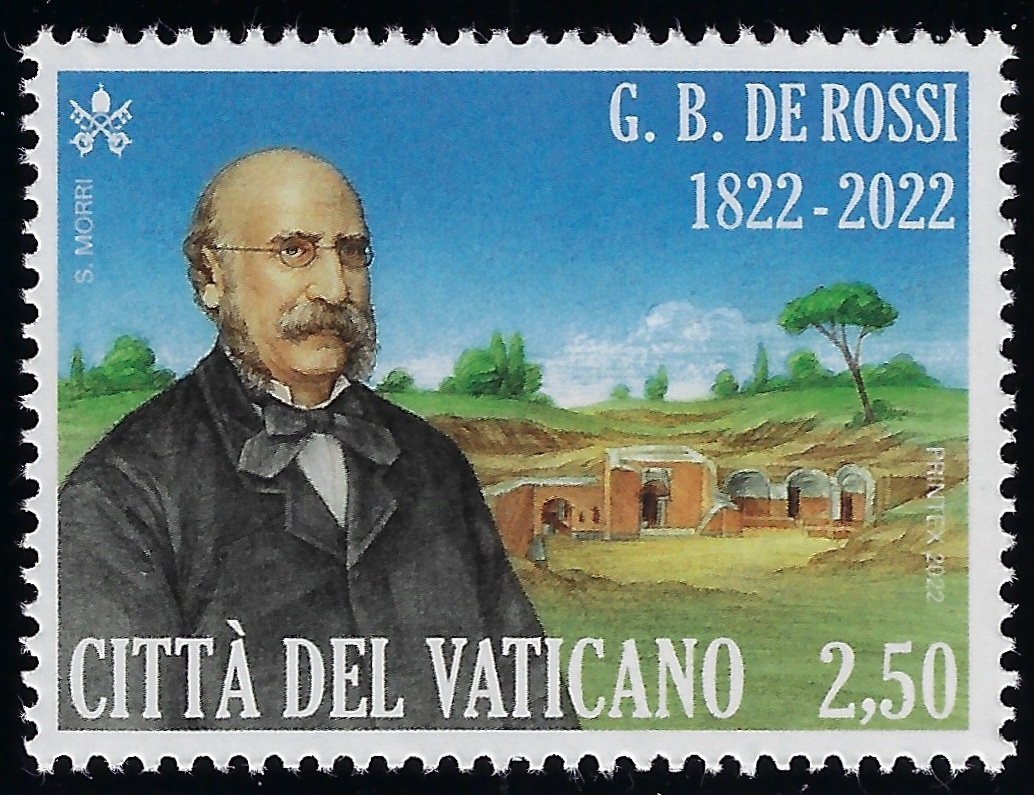 Bicentenary of the Birth of Giovanni Battista de Rossi Scott 1788 (2022) Much attention has been focused on Christian archaeology over the past couple of months. In December, 2025, Pope Leo XIV released the Apostolic Letter “On the Importance of Archaeology on the Occasion of the Centenary of the Pontifical Institute of Christian Archaeology”. The letter is dated December 11, coinciding with the Feast Day of Saint Pope Damasus I, who played an important role in preserving and honoring the early martyrs of the Church with his works tied to the Roman catacombs during the fourth century. Tied to that event was the release of a stamp two weeks earlier to celebrate the centennial of the institute (shown at the bottom of this article). Today (February 23) marks the birthday of one of the most important figures in the study of Christian archaeology, Giovanni Battista de Rossi. He was an Italian archeologist who gained fame for rediscovering early Christian catacombs in Rome and for establishing the field referred to as Christian Archeology. Born in Rome in 1822, de Rossi showed a keen interest in Christian antiquity at a young age. In 1838, during a visit to Tuscany, he was exposed to the art treasures of the region, further fueling his interest in history and ancient art. He attended the Collegio Romano and studied law at the Sapienza, where he was graduated with the degree of doctor utriusque juris, covering both civil and church law.  Marble Bust of Giovanni Battista de Rossi (at Pincian Hill, Rome) Photo by Flazaza From Wikimedia Commons, used under the terms of the Creative Commons Attribution-Share Alike 4.0 International license While still in school (as early as 1841), he began a long working relationship with the Jesuit archeologist Giuseppe Marchi. They worked in the ancient catacombs and pursued numerous archaeological studies together. In 1843, he developed a plan for the documentation of ancient Christian inscriptions. He also worked in Hernici and Naples, developing a practical knowledge of the period of the Roman Republic. Once he had completed his studies, de Rossi was appointed scriptor at the Vatican Library. Although this was not a particularly prestigious position, his access to the holdings of the Vatican Library and its archives proved a rich source of knowledge as he further developed his interests. He is credited with carefully cataloguing hundreds of Vatican manuscripts. He then brought his attained skills in the areas of archaeology and epigraphy (study of inscriptions), along with his knowledge of the topography of Rome, to numerous early Christian sites as he helped develop the field of Christian archaeology. De Rossi is best remembered for rediscovering the lost Catacombs of Callixtus, along the Via Appia Antica, in 1849. These catacombs were first opened in the early 3rd century as the principal Christian cemetery in Rome and is the burial site for nine 3rd-century popes. De Rossi died at the age of 72 on September 20, 1894, at Castel Gandolfo. 
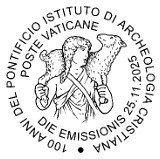 Centennial of the Pontifical Institute of Christian Archaeology (2025) REFERENCES: |