Home
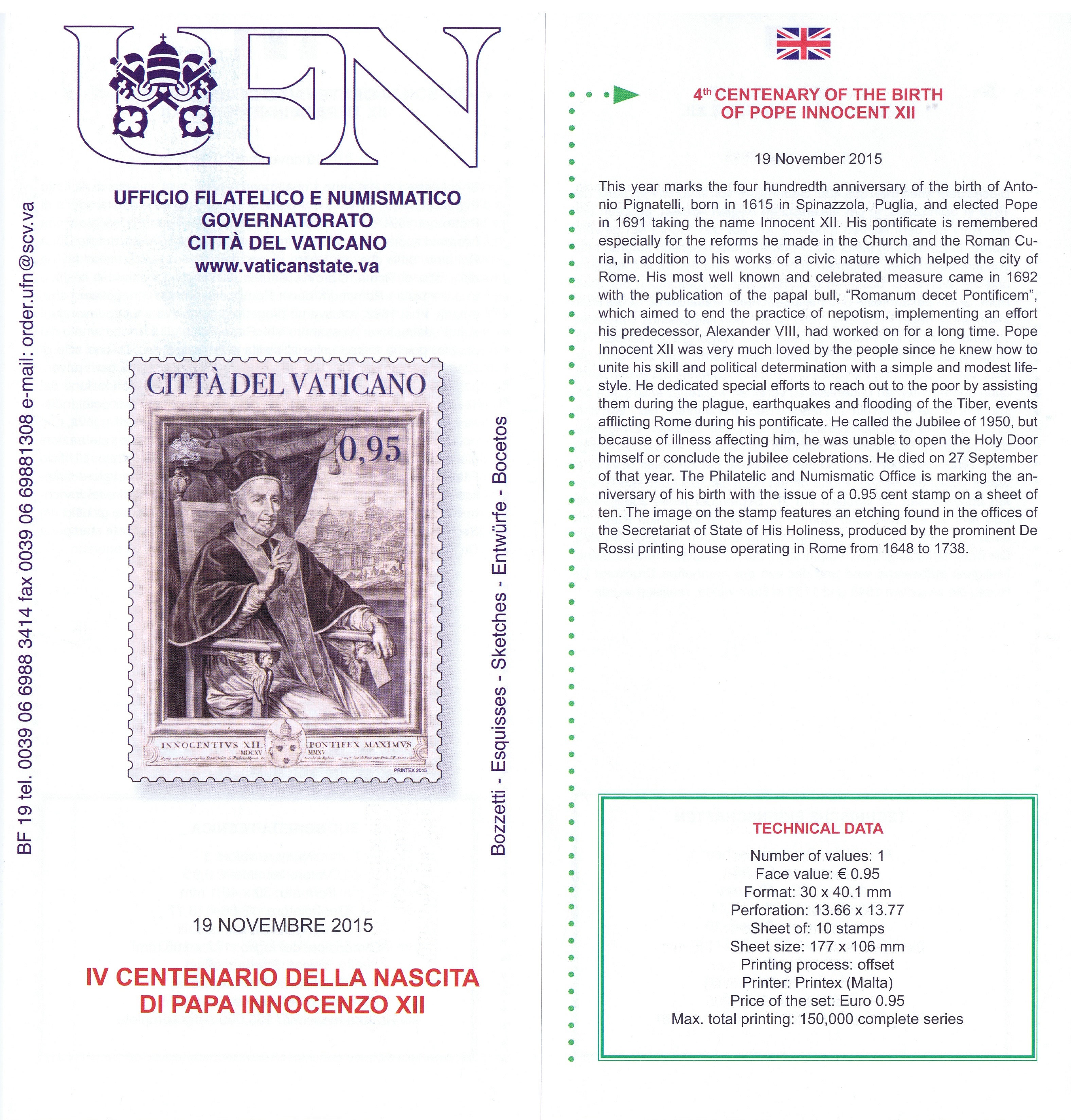
 Birth of Pope Innocent XII Scott 1604 (2015) Vatican City commemorated the fourth centenary of the birth of Pope Innocent XII with the issuance of a single €0.95 stamp on November 19, 2015. The stamp, issued in sheets of ten, is based on a contemporary etching produced in Rome by De Rossi printers. The future Pope Innocent XII was born Antonio Pignatelli on March 13, 1615 in Spinazzola in the Apulia region of southeastern Italy, into one of the most aristocratic families of the Kingdom of Naples. He would go on to earn a doctorate in both canon law and civil law at the Collegio Romano in Rome, and soon began a diplomatic career in the court of Pope Urban VIII. Following his priestly ordination and consecration, he served in a variety of roles within the curia across Italy and Europe (with stops in Poland and Austria). He was created a cardinal in 1681, and would serve as the archbishop of Faenza, Lecce and Naples prior to his election as pope in September of 1691, succeeding Pope Alexander VII.  Papal medal of Pope Innocent XII by Giovanni Hamerani (1693) Photo by John Hamilton From Wikimedia Commons, used under the terms of the Creative Commons Attribution-Share Alike 4.0 International license Pope Innocent XII immediately took up the cause of reform in both the governance of Rome and the Papal States and within the Curia. His administration stressed the economy and impartial administration of justice. He is remembered for his efforts to prohibit nepotism and ensure the papal nomination of bishops and abbots (especially in Germany). In 1692, he issued the papal bull "Romanum decet Pontificem", which banned the curial office of the "Cardinal-Nephew" and prohibited the pope from bestowing items of value such as estates, offices, or revenues to relatives. During his pontificate, diplomatic relations were restored with France, after an absence of 50 years over claims by the French crown to control the appointment of bishops. Innocent also supported the Empire's efforts against the Ottoman Turks, a continuation of the policies of one of his predecessors, Pope Innocent XI. As the Holy Year of 1700 approached, Pope Innocent XII was 85 years old and in failing health. Due to illness, he was not able to participate in the opening of the Holy Door at Saint Peter's Basilica on December 24, 1699. In an interesting coincidence to the recent Jubilee Year, the pope participated in the celebration of Easter Sunday, and gave a blessing from his balcony. He was rarely seen in public thereafter, and died September 27, 1700. He was succeeded by Pope Clement XI, who closed the Holy Year of 1700. This was the last time a Jubilee Year was opened by one pope and closed by his successor prior to the recent Holy Year of 2025 (opened by Pope Francis and closed by Pope Leo XIV). In one additional historical note, Pope Innocent XII is the most recent pope to not be clean shaven. REFERENCES: |