Home
 Scott#:1849 Date Issued: 02/19/2024 Face Value: €2.45 Perforation: 13 1/4 x 14 The stamp shown above was issued by Vatican City to commemorate the 200th anniversary of the death of Cardinal Ercole Consalvi, who twice served as Cardinal Secretary of State for the Papal States and who played a crucial role in restoring the Papal States following the defeat of Napoleon in 1814. He represented the Holy See at the Congress of Vienna, the diplomatic meetings which reshaped Europe in the post-Napoleonic period. Ercole Consalvi was born in 1757-1824). He was a deacon of the Church who received training but never received the sacrament of Holy Orders. He served at the request of Pope Pius VII (1742-1823) as Secretary of State for two terms: from 1800 to 1806 and from 1814 to 1823. He was brilliant in his task as a diplomat in dealing with tremendous upheavals in the social structure of a changing world. These ramifications have influenced our society to this day. 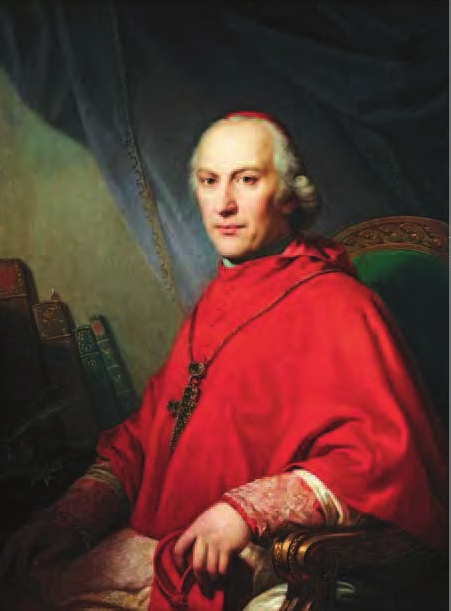 Cardinal Ercole Consalvi Painting Johann Baptist von Lampi the Elder (circa 1815) From Wikimedia Commons, in the Public Domain To give context to Consalvi’s service to the church, you have to look back to the reign of Pius VI (1717-1799). Papal influence in Spain, France, Portugal, and Austria was ready to explode. The general population was Catholic, but they had little trust in the church – its wealth, grandiosity, power and clericalism. The French Enlightenment’s quest to promote progress had little fondness for the influence of the church. The dam broke with the French Revolution when the church was stripped of its wealth, and political influence on the society. Clergy were told to give loyalty to the government before the Papacy. The outlook was that Christendom was on the brink of destruction. Pope Pius VII had no contingency plans to deal with what was happening other than God’s providence in this purging. During the turmoil of the French Revolution, Napoleon by a coup d’etat in 1789 took control of the French government, the legal system and the military. In 1796 Bonaparte entered into Italy and the Papal States. Pope Pius VI was forced to leave Rome and be placed in exile in France. He died in a prison in France. Cardinal Luigi Barnaba Chiaramonte was elected Pope Pius VII in a conclave held in Venice on March 14, 1800. Pope VII appointed Ercole Consalvi, who was only 34 years old, to be a deacon and then Secretary of State under him. Without exaggeration, the Church was in one of its darkest hours. The objective now was how to preach the Gospel message in missionary territory - Europe. As a start Pius VII had to negotiate a relationship with Napoleon. He did not want the church to be dead in France. Consalvi was his main negotiator. Consalvi’s strategy was to focus on the spiritual needs of the people – sacred teaching and sacraments, while negotiating away power, property, prestige and wealth. A concordat between the Papacy and France was signed on July,15, 1801. What Consalvi got was that the church would not be dead in France, and hopefully could be rekindled at a later date. Napoleon invaded the Papal States in 1808. With this invasion he forced the Pope to dismiss Consalvi from his position of Secretary of State. Upon the defeat of Napoleon’s forces in Europe, the Congress of Vienna in 1814 restored the Papal States under the Pope. Consalvi was a part of negotiating with other countries in Europe. He also developed a relationship with England in helping obtain some level of civil rights for Catholics. Consalvi’s genius was always to negotiate in a manner that the Catholic Church would have a legal right to be present to the people of Europe and for the Pope to be able to speak to his flock.  Ercole Consalvi First Day Cover Issued by the Vatican Post Office,February 19, 2024 References: |