Home


 First Centenary of the Encyclical Rerum Novarum Scott 882-884 (1991) In 1991 three stamps were issued by the Vatican in recognition of the first centenary of the encyclical Rerum Novarum. The coat of arms of Pope Leo XIII, who wrote the encyclical, is placed in the upper left corner of each of the stamps. L600 shows the title of the first page of the encyclical, L750 shows the church holding the cross and the encyclical at the center of the stamp with workers on the left side and owners on the right. This stamp is an allegory of workers and owners looking to the church for social justice guidance; encouragement for the betterment of the temporal affairs of all; and the giving of charity to the less fortunate. L3500 show a portrait of Pope Leo XIII. He was born in 1810 and was Pope from 1878 to 1903. Rerum Novarum is one of the first significant encyclicals on social justice issued by a pope. Prior to this, ecclesiastical authorities spent most of their time on territorial affairs and relationships with the ruling classes. Social justice was a back burner issue. The Saints, religious and lay were providing education and charitable works of mercy to the people. Enlightenment philosophy (18th Century) and the Industrial Revolution (18th and 19th Centuries) were taking place. Prior to the industrial revolution landownership, small farming and medieval guides were the major drivers of economic activities. Adam Smith’s “Wealth of Nations” was published in 1776. Karl Marx, along with Fredrich Engels, published the “Communist Manifesto” in 1848. Marx published a three-volume book “Das Kapital” in 1867, 1885 and 1894. In 1891 Pope Leo XIII, in Rerum Novarum, tried to provide theological guidance on the treatment of labor and the use of capital caused by the Industrial revolution. Also, It was meant to counter the writings of Marx, and to some extent counter the Enlightenment idea that man’s reasoning is the primary source of lawfulness. Pope Leo XIII was the first modern Pope. With the unification of Italy in 1870, he held the position of Pontiff with no territory to fight for or be concerned about. He was a Pope with a new vision for the Church. In a benign and pragmatic way, he was not fearful of the need for change within the Church to fight against anti-Roman Catholic philosophies that had been taking hold in Europe. He also tried to make efforts in ecumenism with Orthodox and Anglican Churches. In his 25 years as Pope, he wrote 90 encyclicals which is approximately a third of all encyclicals written. With the industrial revolution in full force, both the ruling class and organized religions were not set up to deal with such issues as: As of this writing the encyclical is 133 years old (the document was written in 1891). It was also inspired by Westminster’s Cardinal Manning and Archbishop James Gibbons of Baltimore to offset the trending in the society towards Socialism and Marxism. The Socialist Party of America (SPA) was founded in 1901. The party was spawned by the American Railway Union (ARU) strike in 1894. The ARU strike was ended by federal troops. In Europe the ruling and land owning class had their own confrontation with the Socialist economic philosophy and actions. The Russian revolution started in 1917. In reading the encyclical, the reader can see that the issues raised and the guidance provided has relevance today. The encyclical deals with the age-old dilemma of social justice, prudence and charity versus worldly pride, immoderate love of self, injustice and sacrifice to help the poor. Also, It states that the family unit is a necessary factor for society’s well-being. The encyclical criticizes Socialism and an unregulated laissez-faire capitalism. It states that the government has a role to play in social justice issues. Private property is a right and laborers have a right to organize as a means of collective bargaining. Also, charity to the poor is a responsibility for all. The biggest issue, which is expressed on L750, is the role of the church. The encyclical states that the Gospel, and virtues taught and communicated by the teachings of the Church, is a requirement for the natural harmony of capital, labor and the government to co-exist rightfully: “Capital cannot exist without labor, nor labor without capital”. Though it does not state it outright, the assumption contained in the encyclical implies that a secular society would not bring harmony between capital, labor and government intrinsically themselves. References: Papal Encyclicals Online, Pope Leo XIII, 1891, Rerum Novarum Gutierrez, O., A Summary of Rerum Novarum or On Capital and Labor, 2020 Himes, K., 'Rerum Novarum' is 130 years old. What would Leo XIII say about today's gig economy? Costa, V., Rerum Novarum: 15 Key Lessons, Summary and Review Wikipedia, Rerum Novarum Wikipedia, Industrial Revolution 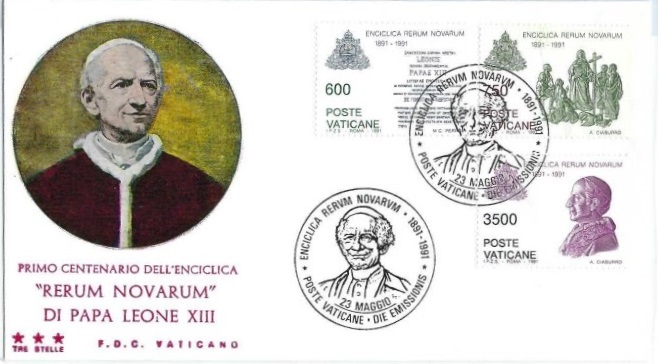 First Day Cover: Centenary of the Encyclical Rerum Novarum Scott 882-884 (1991) CARD |