Home
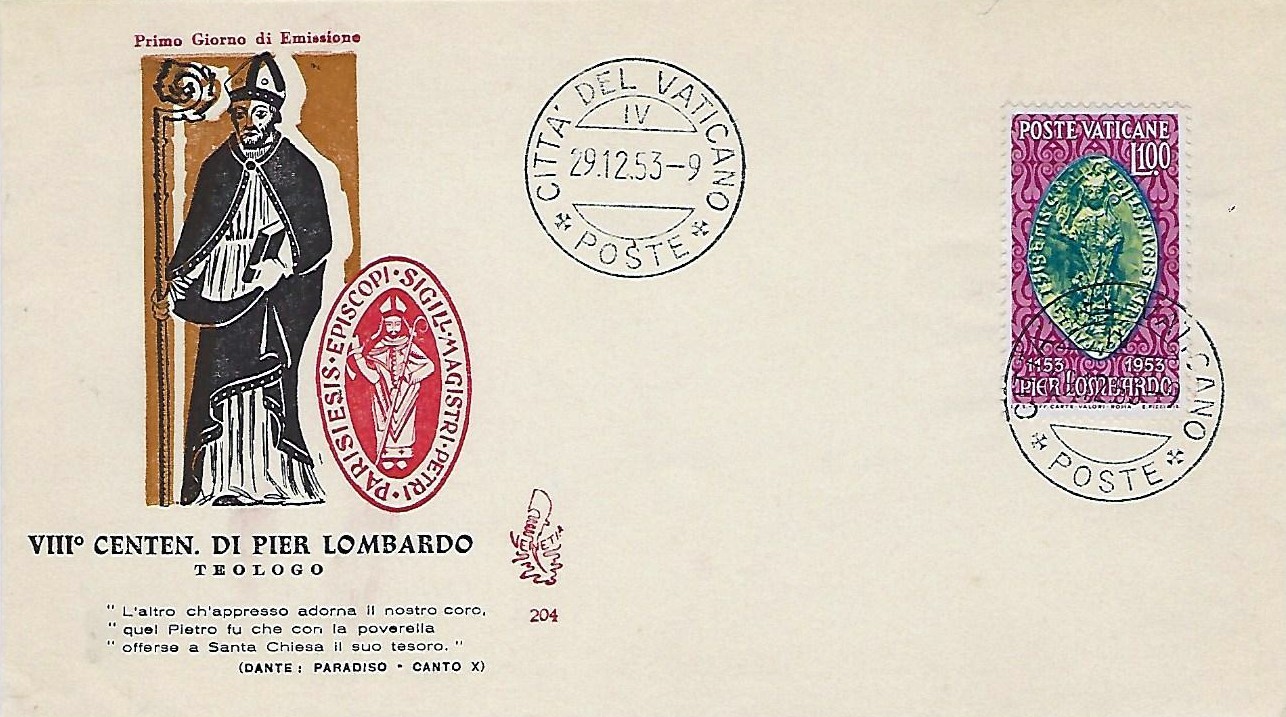
 Peter Lombard Vatican City, Scott 173 (1953) In late 1953, and without much fanfare or advance notice, Vatican City released a stamp honoring the 12th century theologian Peter Lombard. Issued on December 29, the single, 100-lire denominated stamp was described by Vatican Philatelic Society’s first president, William Wonneberger, as follows: ” The stamp issued as the Pier Lombard commemorative depicts the Episcopal Seal he used as Archbishop of Paris. The seal is of white wax (a color very infrequent in Episcopal Seals) and oval in shape. The inscription on the seal reads "Sigillum Magistri Petri Parisiensis Episcopi." The figure in the center of the seal is an effigy of Peter Lombard in Pontifical garb with a banner. His right hand is raised for benediction, while the pastoral cane is held in his left hand…The seal of the Archbishop of Paris, Peter Lombard, is important because it preserves the only known picture of a great person. The original seal is housed in the Archives of Paris.”Peter Lombard was born around the year 1096 in Lumellogno, a small rural commune of Novara, in the Piedmont region of northwestern Italy, to a poor family. His studies started in Bologna, but he would be recommended to Saint Bernard of Clairvaux, leading to his relocation to Reims and then to Paris. He was ordained a priest around the year 1156 and was appointed as Archbishop of Paris in 1159. But he died shortly thereafter on August 21/22, 1160. In a historical note, his successor, Maurice de Sully, would commission the building of the Cathedral of Notre Dame in Paris. Peter Lombard was buried in the Church of Saint-Marcel in Paris; however, his tomb was destroyed during the French Revolution.  Peter Lombard (or Petrus Lombardus) From "Sententiae" ("The Sentences") Bibliotheque Municipale at Troyes From Wikimedia Commons, in the Public Domain Although little is known about the man, the works of Peter Lombard have had a lasting impact on the Church. His early works included commentaries on the Psalms and the letters of St. Paul, but his most famous work by far is “Libri Quatuor Sententiarum” (“The Four Books of Sentences”). This would become the standard textbook of Christian theology for the next three hundred years, and influenced many of the great theologians who were to follow him, including Saint Thomas Aquinas, Saint Bonaventure and Saint Albert the Great, all of whom were to become Doctors of the Church. Even the book considered the great theological text of all time, Aquinas's “Summa Theologiae”, did not supplant the “Sentences” until around the 16th century. It is said that other than the Bible itself, no book of Christian thinking was commented upon more frequently in medieval university courses than the “Sentences”. Despite the monumental impact of the “Sentences”, Peter Lombard is neither a saint nor a Doctor of the Church. In fact, the stamp to this obscure giant created a bit of controversy upon its issuance, since little was known about him in the 20th century as he had faded into history. The stamp actually honors the 700th anniversary of the publication of the “Sentences”, rather than dates associated with its author. But his influence cannot be ignored, and he is referred to as the “Magister Sententiarum” ("Master of the Sentences"). REFERENCES: |