Home

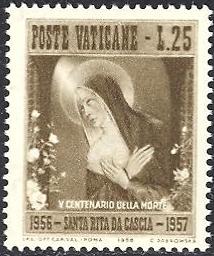
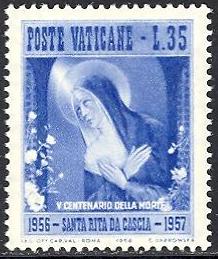 Saint Rita of Cascia Scott 209-211 (1956) The feast day of Saint Rita of Cascia is celebrated on May 22. Vatican City issued the three-stamp set shown above on the 500th anniversary of her death. Saint Rita of Cascia was born Margherita Lotti in Roccaporena, a town in the Central Apennines of Italy in 1381. Her parents Antonio and Amata were devout Catholics and taught her the love God. Growing up St. Rita wanted to enter the local Augustinian convent of Saint Mary Magdelena in the nearby town of Cascia. Her parents disagreed and arranged a marriage with Paolo Mancini, and the couple would have two sons. Through the ages there were rumors that Paolo was a brute and that Rita suffered in her marriage. Recent research does not support this legend. Regardless, throughout her marriage Saint Rita remained devoted in her trust in God and prayers for a blessed family life. After 18 years of marriage, her husband was killed in a vendetta with another family in the town. Because of their father’s murder the sons wanted to avenge the killing. Saint Rita prayed that her sons would never commit the sin of taking another person’s life. She prayed that both sons would be infused by God with the virtue of forgiveness. Subsequently, both sons were stricken with a fatal illness and never committed the sin of murder. During their illness, they acknowledged forgiveness to the family who killed their father. Rita always wanted her family to follow God’s will in all circumstances. With Rita being freed of family responsibilities, she made repeated attempts to enter the Augustinian convent. The reasons that she was not originally accepted included that she had been married and also that some members of the religious community were related to the family that killed her husband. Eventually, she was accepted. In 1413 she became a religious sister, and followed a path of obedience and faith in her religious life. Throughout her life she was a woman of prayer and devotion. She did special works and offered prayers and actions to the sick and the neglected in the town and the convent community. Shortly after hearing a sermon on the crown of thorns by Saint James Della Marca, in 1442 Saint Rita received a stigmata: a wound on her forehead from the thorn of Christ’s passion. The wound was a sickening sight, and she suffered the pain of the wound the rest of her life. Religious depictions of Saint Rita, including the image on the stamps above, often portray her receiving the partial stigmata on her forehead. Here is an example from a work of art from the 16th century:  "Saint Rita of Cascia", Artist Unknown from the 16th-century Portuguese School Wikimedia Commons, in the Public Domain At the time of her death, she asked to be given a rose. Though the time of year was January, there was miraculously found a fully bloomed rose in the garden. She died on May 22, 1457 at the age of 76. Saint Rita’s actions were motivated by a fervent love of God, and she is celebrated as the “Saint of the Impossible Causes and Hopeless Circumstances”. Saint Rita was canonized in 1900 by Pope Leo XIII. Over time, devotion to Saint Rita grew in America. A National Shrine to her was built in 1907 in Philadelphia, PA. Devotion to her by the faithful came from her holiness as a wife, mother, widow and religious. She is a saint who understood the challenges of family life, widowhood, being a religious and suffering both physically and emotional pain in all of her vocations of life. St. Rita’s uncorrupted body is displayed to this date in the Basilica of St. Rita of Cascia in Italy. The stamps shown at the top of the page were issued during the period when some Vatican City stamps were released in sheets displaying ornamental corner blocks. The blocks are displayed below, along with the technical details of the stamps. 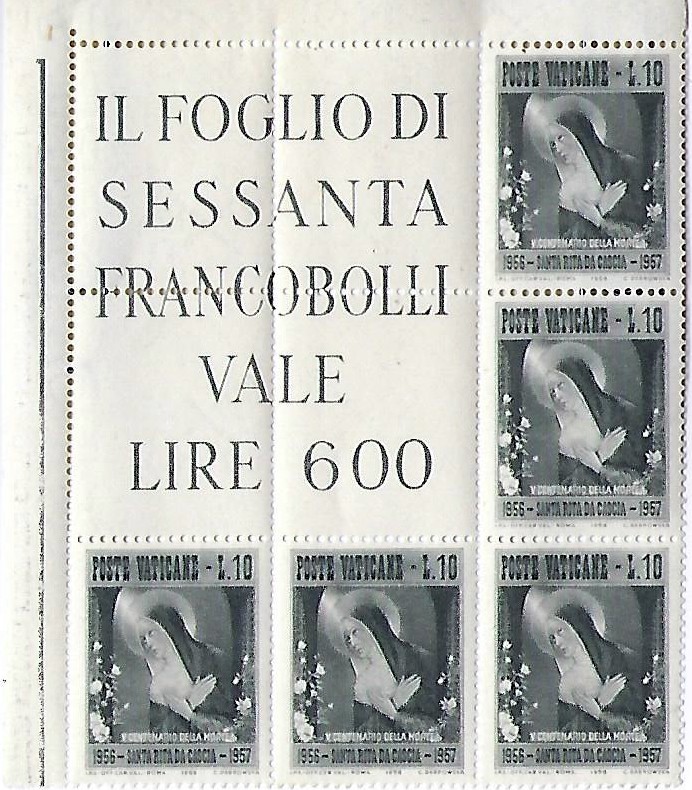
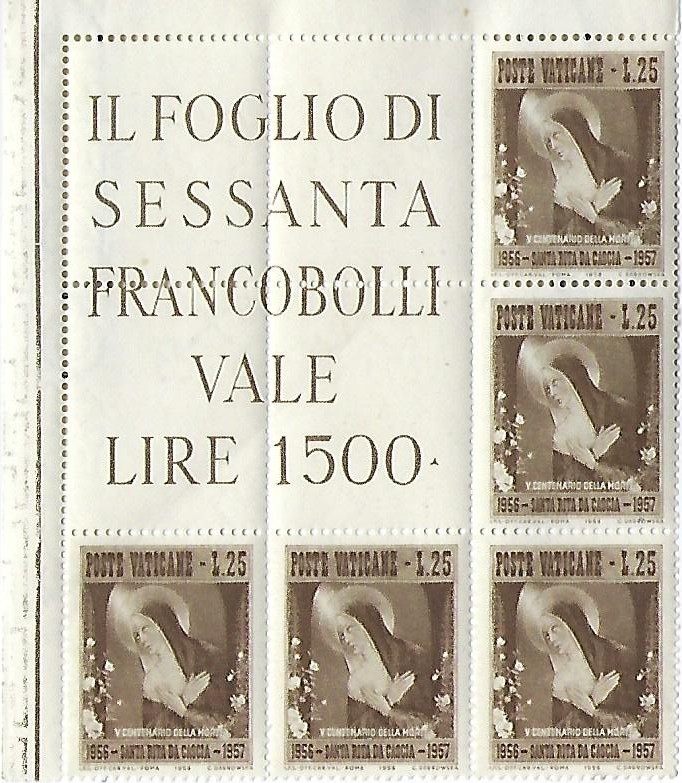
 Ornamental Corner Blocks: Saint Rita of Cascia Issue of 1956 Technical Details: Scott Numbers: 209-211 Face Values: L.20, L.60, L.45 Perforation: 14 Issued: May 19, 1956 References: |