Home

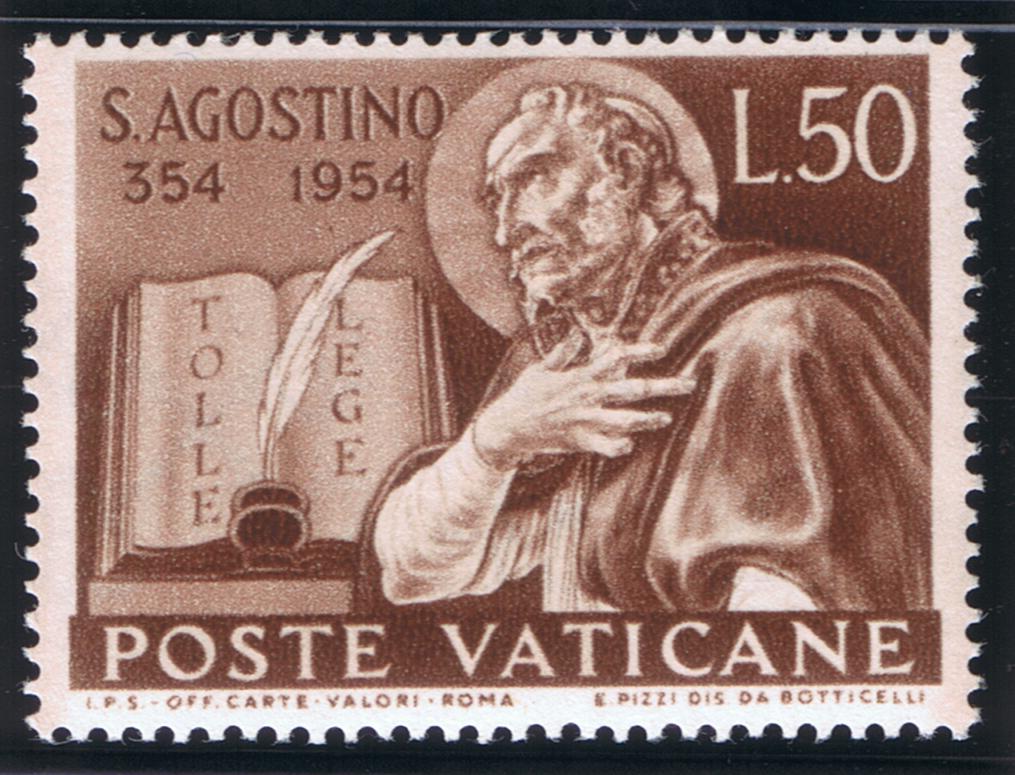 Saint Augustine, 16th Centenary of Birth Scott 187-188 (1954) August 28 marks the Feast of Saint Augustine, who died on this day in 430 AD. He was one of the most influential theologians and philosophers in Western history, and his transformation from a restless, secular youth to the celebrated Father and Doctor of the Church helped shape the foundations of Christian theology and philosophy. Born Aurelius Augustinus in 354 AD in Thagaste in Roman North Africa (modern-day Algeria), his parents were Patricius, a pagan, and Monica, a devout Christian and future Saint. Augustine possessed a brilliant mind and excelled academically. However, as a young man, he forsook his mother's faith and sought fulfillment in worldly pleasures. In Carthage, he took a concubine, fathered a son named Adeodatus, and embraced Manichaeism (a dualistic heretical philosophy) which he followed for nearly a decade. In 383 AD, Augustine moved to Italy, first to Rome and then to Milan, where he had secured an academic position. He was followed to Milan by his mother. It was here that his life underwent a radical transformation following his introduction to Saint Ambrose, Milan’s intellectually brilliant bishop. Exposure to Ambrose’s eloquent and insightful sermons provided Augustine a deeper understanding of the Christian scriptures and shattered his intellectual objections.  "Conversion of Saint Augustine" by Fra Angelico From Wikimedia Commons, in the Public Domain Legend has it that, in 386 AD in a garden in Milan, Augustine experienced an “emotional climax”. Grappling with his inability to overcome his moral struggles, Augustine heard a child's voice saying: "Tolle, lege" (“take up and read”). He opened a book of Saint Paul’s epistles, which contains the words of arguably Christendom’s greatest convert to the faith. Those words resulted in Augustine’s dramatic conversion to Christianity. He walked away from his old life and was baptized by Saint Ambrose during the Easter Vigil in 387 AD. He was baptized alongside his son, Adeodatus, with Saint Monica in attendance, her lifelong prayers for her son finally answered. Following his transformation, Augustine decided to return to Africa, joined by his mother and son. En route, Saint Monica fell ill and died at the Italian port of Ostia. Her remains now lie in the Basilica of Saint Augustine in Rome. Upon his return to North Africa, Augustine eventually settled in Hippo (present-day Annaba, Algeria). He was ordained as a priest in 391 AD and was consecrated as the Bishop of Hippo Regius in 396 AD, a role he filled for the rest of his life. During his time as Bishop of Hippo, Augustine worked to defend Christian orthodoxy against various heresies. He also wrote timeless masterpieces on Christian thought, including his spiritual autobiography, “Confessions”, and the profound philosophical work, “The City of God”. Saint Augustine died at the age of seventy-six on August 28, 430 AD. He is recognized as a Father of the Western Church and was formally named a Doctor of the Church for his immense contributions to Christian doctrine. He is known as “Doctor Gratiae” ("Doctor of Grace"). His earthly relics rest inside the Basilica of San Pietro in Ciel d'Oro in Pavia, Italy. Saint Augustine has been specifically honored with two stamp sets issued by Vatican City. The first (shown at the top of this article), was released in 1954 to celebrate the 1600th anniversary of his birth. The second (shown below), issued in 1987, remembered the 1600th anniversary of his conversion and baptism: 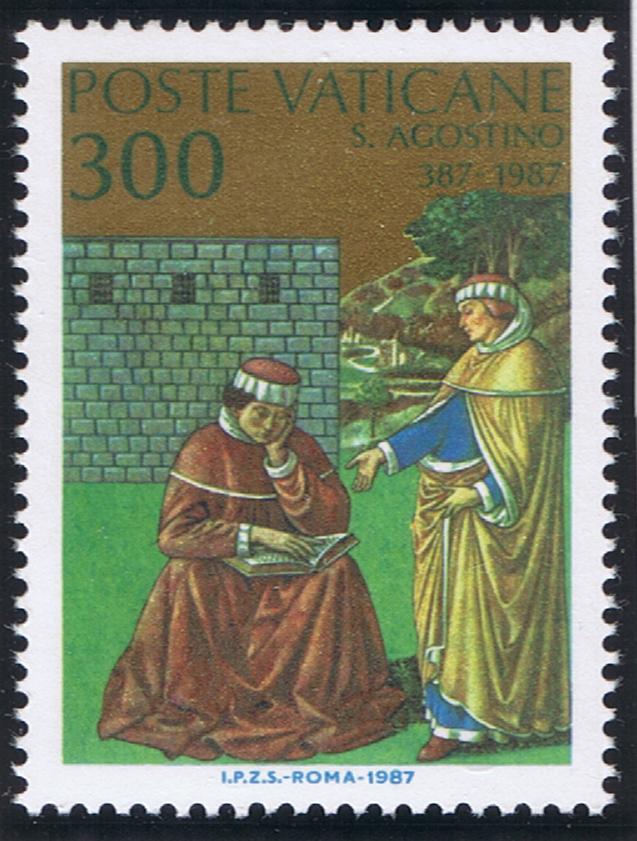
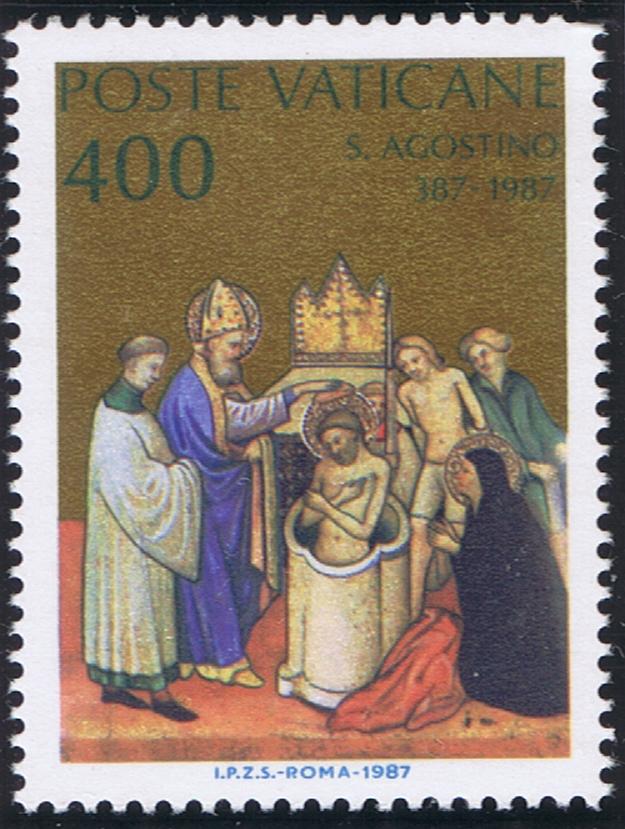 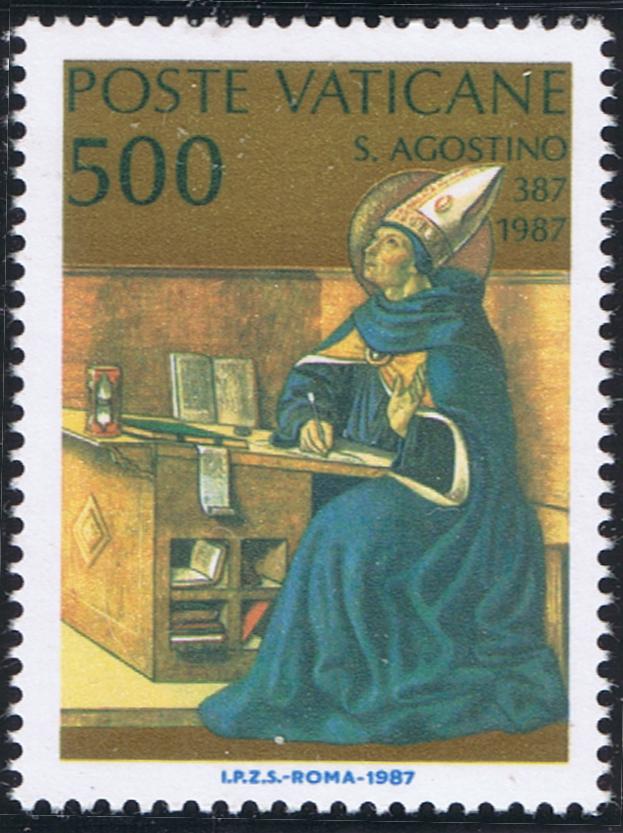
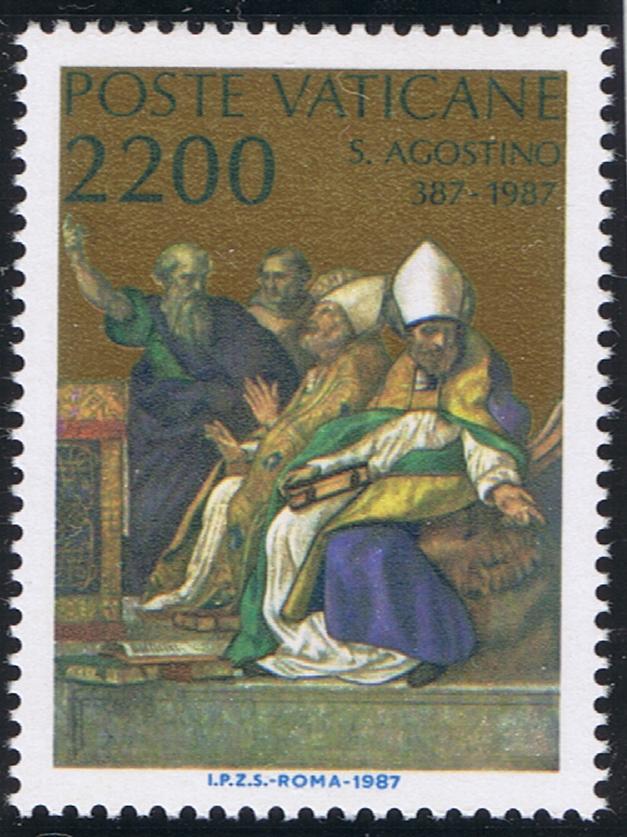 St Augustine: 16th Centenary of Conversion 300 L: St. Augustine reading St. Paul's Epistles 400 L: Baptism of St. Augustine 500 L: Ecstasy of St. Augustine 2200 L: Detail from Raphael's Disputa del Sacramento Scott 779-782 (1987) Another stamp depicting Saint Augustine was part of a five-stamp set issued in 2013 for the 6th centenary of the Cathedral at Nardo: 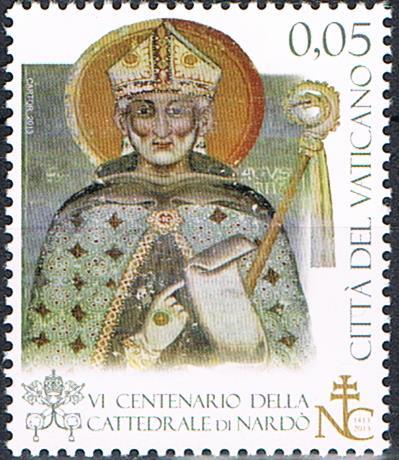
St Augustine: 6th Centenary of the Cathedral of Nardo Scott 1544 (2013) Historian David Farmer sums up the importance of Saint Augustine of Hippo by citing his: "massive influence on Christian thought...Augustine’s intellectual brilliance, wide education, ardent temperament, and mystical insight formed a personality of extraordinary quality. His understanding of Christian Revelation as shown in his voluminous writings, which have probably proved more influential in the history of any writer since St. Paul." REFERENCES: |