Home
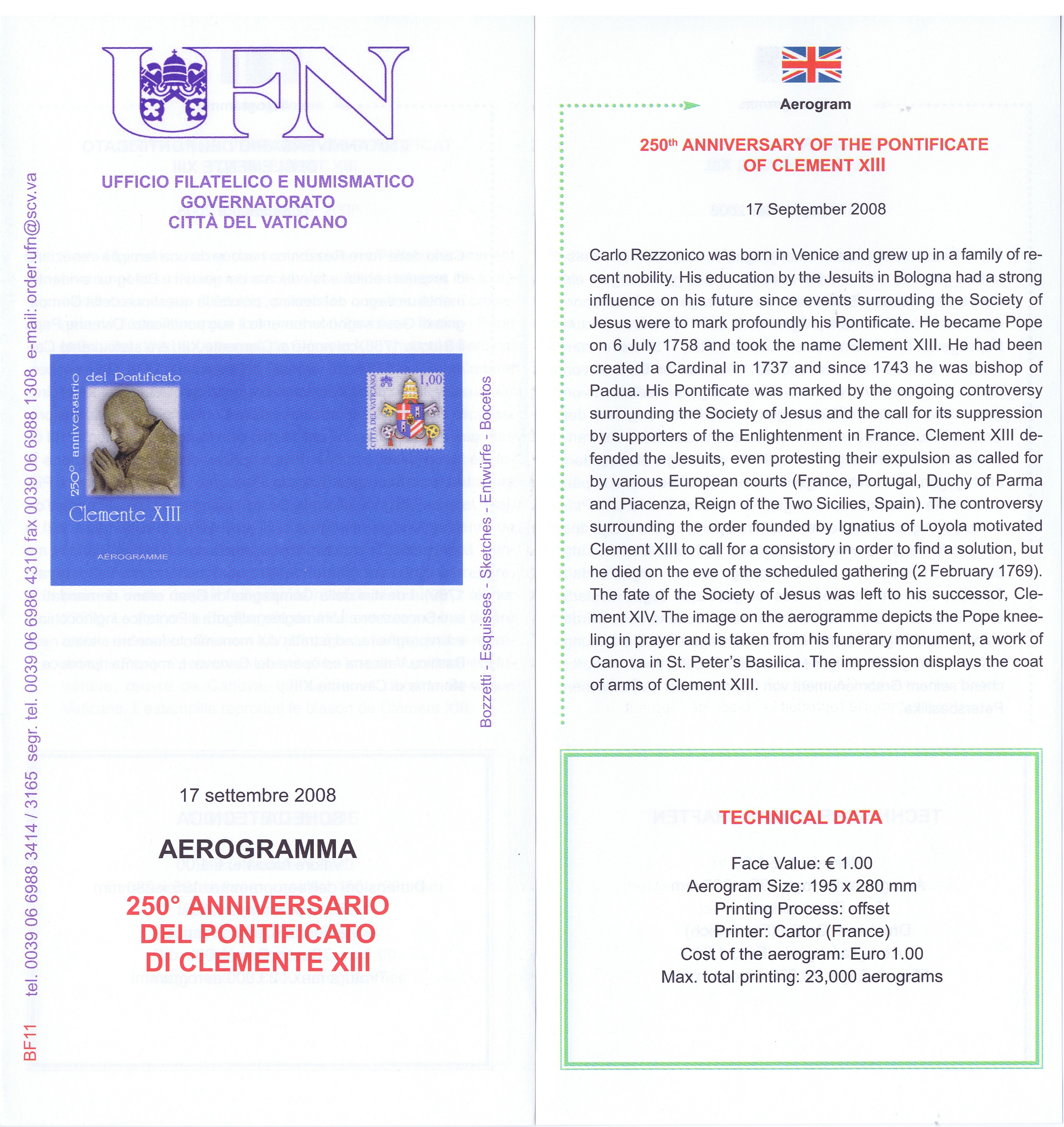
 Pope Clement XIII: 250th Anniversary of Papacy Vatican City Aerogramme, 2008 On September 18, 2008, the annual Vatican City aerogramme was released and commemorated the 250th anniversary of the pontificate of Pope Clement XIII. The aerogramme features a detail of his funerary monument, located in Saint Peter’s Basilica, and the postal impression displays his coat of arms. The monument, pictured at the bottom of the article, was created by Antonio Canova in 1792, and was previously featured on a Vatican City stamp in 1958:  Pope Clement XIII Antonio Canova: 200th Anniversary of Birth Scott 243 (1958) Born Carlo della Torre di Rezzonico on March 7, 1693, in Venice, his was an incredibly wealthy family. He received an excellent education, studied under the Jesuits in Bologna, and eventually earned a degree in law from the University of Padua. He was ordained as a priest in 1716 and quickly moved up the ranks and into important roles in the Papal States. In 1737, Pope Clement XII created Rezzonico a cardinal and, in 1743, he became the Bishop of Padua. There, he was widely admired for his kindness, generosity and love for ordinary people. He used his immense personal wealth to help the poor and was so well-loved that he was often referred to as a “living saint”. With the death of Pope Benedict XIV in 1758, the conclave of cardinals gathered in Rome to choose a successor. The election became a tense political standoff between countries that wanted to influence the Church. The cardinals would select Rezzonico as a compromise choice on July 6, 1758. He chose the name Clement XIII to honor the pope who had made him a cardinal.  "Portrait of Pope Clement XIII" Anton Raphael Mengs (circa 1760) From Wikimedia Commons, in the Public Domain The defining battle of Clement XIII’s papacy was his defense of the Society of Jesus, or the Jesuits. Powerful Catholic kings in France, Spain, Portugal, and Naples grew to dislike the Jesuits, seeing them as too loyal to the pope and too influential in politics. Attempts were made to ban the Jesuits, and the governments demanded that the pope shut the order down entirely. Clement XIII firmly refused, famously stating that the Jesuits should "be as they are or not be at all." In 1765, he issued the papal bull “Apostolicum pascendi”, which publicly defended them. Pope Clement XIII was a supporter of the arts and oversaw the completion of Rome's famous Trevi Fountain. A modest man, he would order mass-produced fig leaves to be placed over the nudity of classical statues in the Vatican and the Sistine Chapel. Pope Clement XIII died suddenly on February 2, 1769. During his 10-year-plus reign, his time was defined by the struggle against European monarchs and the growing ideas of The Enlightenment. Through it all, he protected the traditions of the Church and is remembered for his bravery in defending his beliefs and shielding his allies against overwhelming odds.  Tomb of Pope Clement XIII Saint Peter's Basilica From Wikimedia Commons, in the Public Domain REFERENCES: |