Home
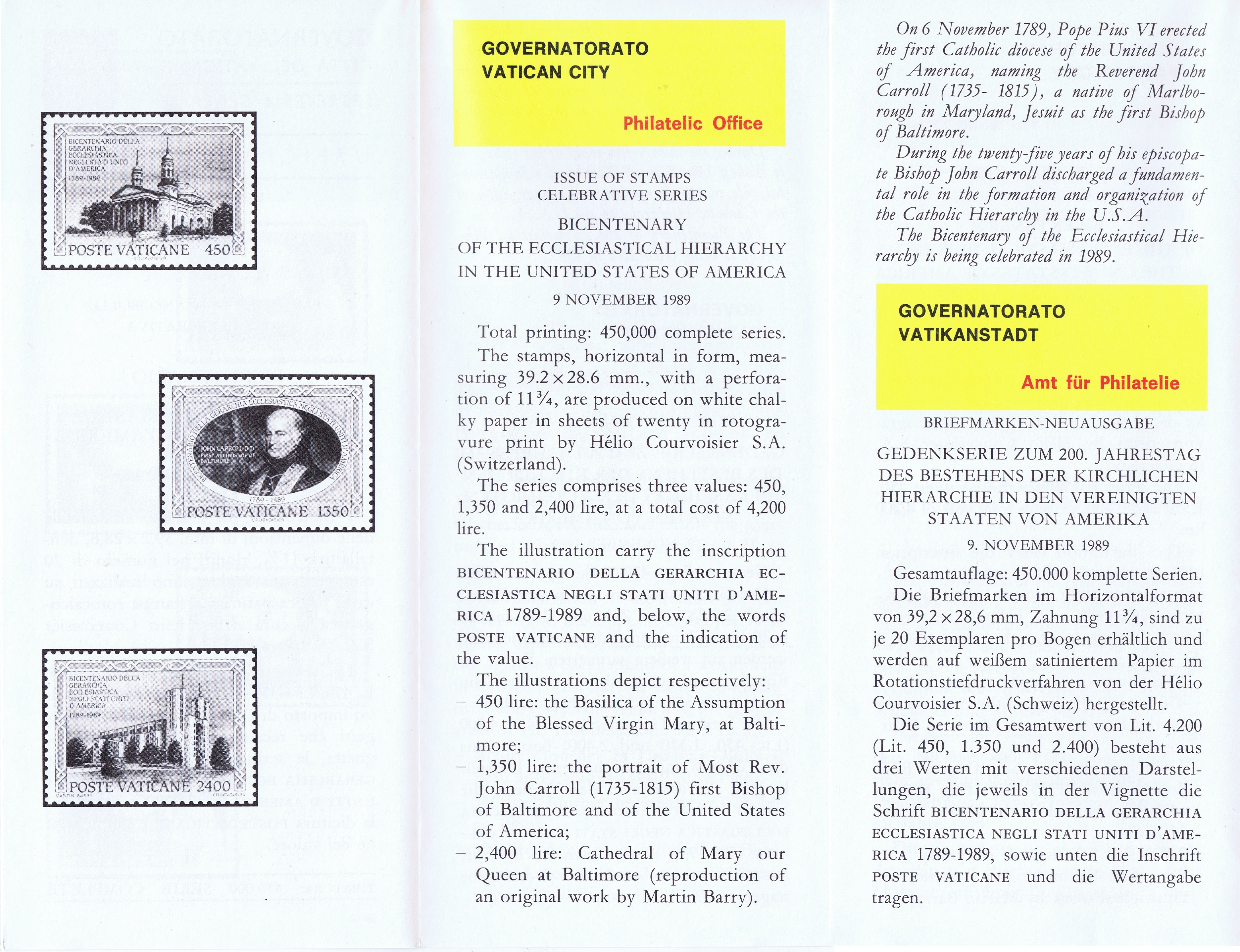
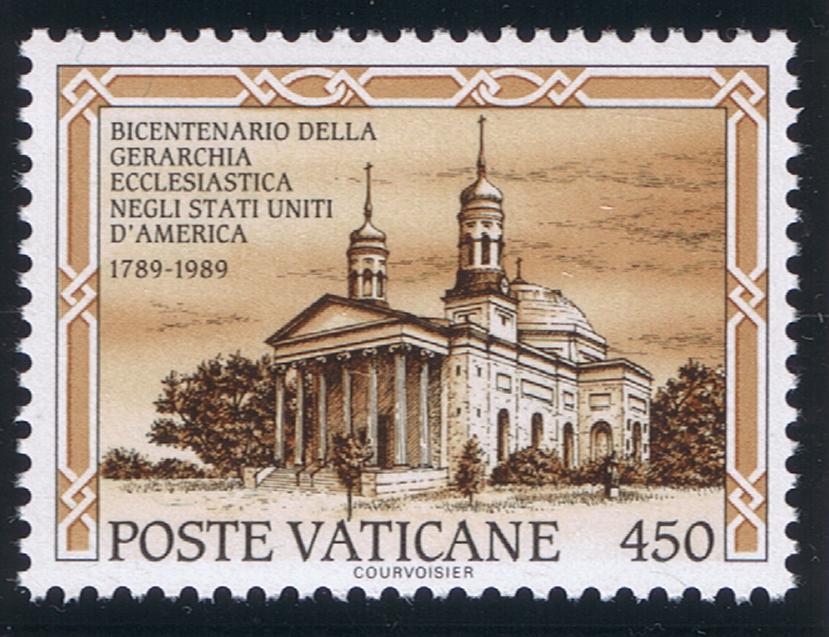 Basilica of the Assumption of the Blessed Virgin Mary, Baltimore, Maryland Scott 842 (1989) On November 6, 1789, Pope Pius VI established the first Catholic diocese in the United States with the erection of the Diocese of Baltimore and named the Reverend John Carroll as the first Bishop of Baltimore. Together, these actions marked a monumental turning point for the Catholic Church in the new United States. During the settling of the American colonies, and prior to the American Revolution, anti-Catholic sentiment inherited from British rule restricted the practice of the Catholic faith in the thirteen colonies, except in the colonies of Maryland and Pennsylvania. With the dawn of the United States of America, the Declaration of Independence and the Constitution encoded the principles of religious freedom into the law of the land, paving the way for the institutional birth of American Catholicism. 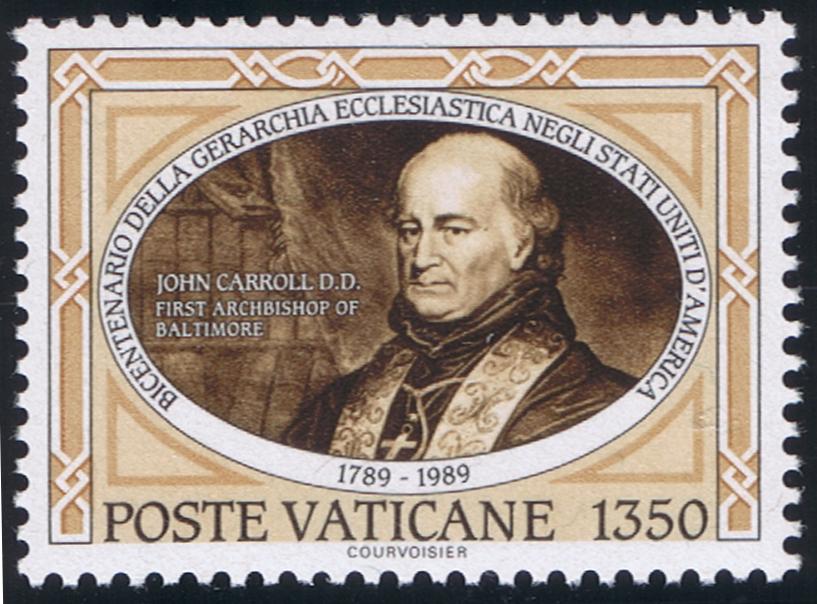 The Most Reverend John Carroll Scott 843 (1989) At the heart of this transformation was the Most Reverend John Carroll. Born into a wealthy and prominent Catholic family in 1735 in Upper Marlboro, Maryland, at a young age Carroll was sent to Europe to receive a Catholic education. He attended the Jesuit seminary in Liège, Belgium, and was ordained a priest in the Society of Jesus 1769. When the Pope suppressed the Jesuit order in 1773, Carroll returned to the American colonies and began ministering to local Catholics from his mother's Maryland estate. Politically, Carroll was a staunch patriot and firmly supported American independence. In 1776, he was part of a diplomatic mission to Canada to garner support for the movement. The mission included Benjamin Franklin, Samuel Chase, and Charles Carroll—his cousin and the only Catholic signer of the Declaration of Independence. Although the mission failed to secure Canadian support, it forged a lifelong friendship between Carroll and Franklin and proved the compatibility of Catholic loyalty and American patriotism. Following the war, American Catholics no longer wished to be governed by a religious authority based in London. In 1784, recognizing the need for local leadership, Pope Pius VI appointed John Carroll as the Superior of the Mission in the United States. And, five years later, on November 6, 1789, the Pope issued the papal bull “Ex hac aliquando”, which established the Diocese of Baltimore as the first Catholic diocese in the United States. He subsequently named Carroll its first bishop. Carroll faced the monumental task of organizing a diocese that stretched across the entire United States, from the Atlantic Ocean to the Mississippi River. Despite covering vast territories with few priests and resources, Carroll focused on the education of both the clergy and the laity, founded the Georgetown Academy (now Georgetown University) and established Saint Mary’s Seminary to train American priests. Carroll also advocated for a vernacular liturgy and public participation, striving to prove that Catholicism could thrive within a democratic republic. By the time Carroll was elevated to Archbishop in 1808, the diocese had grown so rapidly that it had to be subdivided, creating new dioceses in Boston, New York, Philadelphia, and Bardstown, Kentucky. When Carroll died in 1815, he left behind a robust, institutionalized Church integrated into the fabric of American life, a church that had transitioned from a persecuted underground minority into a permanent and flourishing national institution.  America's First Basilica: Cathedral of the Assumption, Baltimore The Catholic Encyclopedia From Wikimedia Commons, in the Public Domain The Basilica of the National Shrine of the Assumption of the Blessed Virgin Mary, also called the Baltimore Basilica, is pictured here. The first basilica in the United States, it was built under the guidance of Bishop Carroll. However, he would not live to see its opening in 1821. He died in Baltimore on December 3, 1815, and is interred in the crypt of the Basilica. 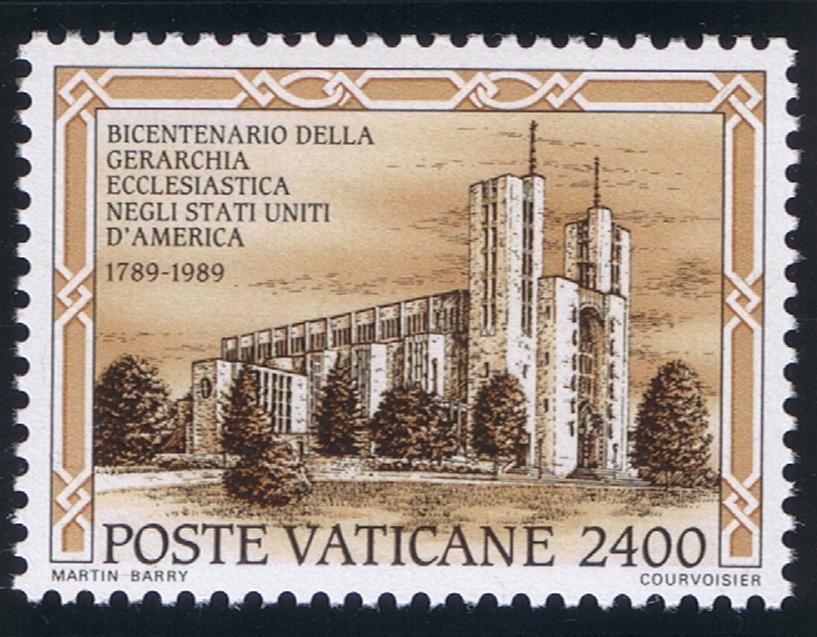 Cathedral of Mary Our Queen, Baltimore Scott 844 (1989) On November 9, 1989, Vatican City issued a three-stamp set to commemorate the bicentenary of the ecclesiastical hierarchy in the United States. Those stamps are used to illustrate this Daily Email. For more details on this release, refer to the Philatelic Office document in the References. REFERENCES: |