Current Position: Earth Sector, U.S.A. Outpost, Breakroom Module 3
Mission Status: Heavenly Communication - Virgin Mary Titles - Our Lady of Arabia
 Today I've got my memory chips tinking about heavenly communication, especially Catholic thinking about the Virgin Mary.
Catholics generally believe that communication with the Virgin Mary, the saints, and even deceased loved ones is rooted in the Church’s understanding of the Communion of Saints—a spiritual solidarity between the faithful on earth, the souls in purgatory, and the saints in heaven.
Communication with the Virgin Mary and Saints
• Intercessory Prayer: Catholics don’t worship Mary or the saints—they ask them to pray for them, much like asking a friend to pray on your behalf. This is based on the belief that the saints are alive in heaven and close to God, so their prayers are powerful.
• Biblical Support: Revelation 5:8 and 8:3–4 describe saints and angels offering prayers to God, symbolized as incense. This supports the idea that heavenly beings can intercede for those on earth.
• Mary’s Role: As the Mother of Jesus, Mary holds a special place. Catholics often pray the Rosary, asking her to “pray for us sinners.” She’s seen as a compassionate intercessor who brings petitions to her Son.
See https://www.ewtn.com/catholicism/teachings/praying-to-mary-and-the-saints-166
Accordingly, the Blessed Virgin Mary has hundreds of titles in the Roman Catholic tradition. So, how may titles are attributed to the Blessed Virgin in the Roman Catholic faith? A surprisingly large number — far more than most people realize - the Catholic Church does not give a single official.
Why So Many Titles?
Because each title highlights a different aspect of Mary’s role in salvation history:
• Her virtues (Mother Most Pure)
• Her relationship to Christ (Mother of God)
• Her intercession (Help of Christians)
• Her apparitions (Our Lady of Guadalupe)
• Her protection (Star of the Sea)
• Her symbolism (Gate of Heaven)
Every title is like a facet of a diamond — the same Mary, seen through different graces.
Vatican stamps depict Mary under different titles from images found in St. Peter's Basilica


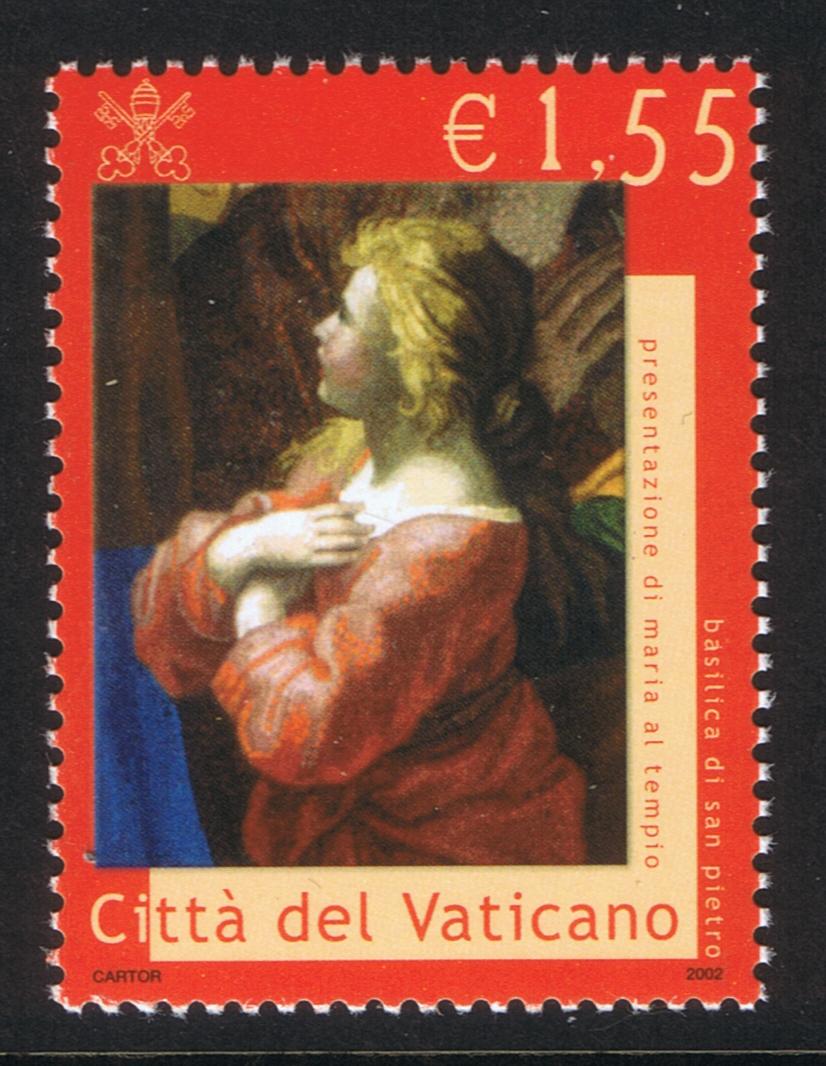
Our Lady in the Vatican Basilica
Scott 1204-1213 (2002)
Exploring One Title Not Found on Vatican StampsScott 1204-1213 (2002)
Our Lady of Arabia — Patroness of the Arabian Peninsula
Patroness of:
• Kuwait
• Bahrain
• Apostolic Vicariate of Northern Arabia
• Apostolic Vicariate of Southern Arabia
2026 Feast Day of Our Lady of Arabia is today - Saturday, January 17th
The feast day is celebrated on the Saturday after the Feast of the Baptism of the Lord, which places it in mid-January each year.
See: https://en.wikipedia.org/wiki/Our_Lady_of_Arabia
Where the Devotion Began
The devotion began on December 8, 1948, when a chapel in Ahmadi, Kuwait, was dedicated in her honor.
This was the first time the title Our Lady of Arabia was used publicly.
The devotion grew rapidly among the multinational Catholic workers in the oil fields — people from India, Lebanon, Ireland, the Philippines, Palestine, France, Pakistan, and more
See https://www.avona.org/faith-a-special-devotion-to-our-lady-of-arabia/
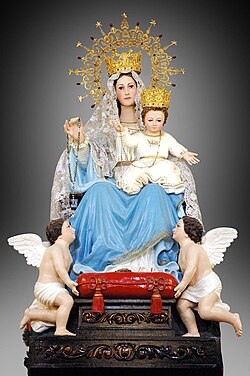
Our Lady of Arabia
Pontifically crowned in Kuwait
SICDAMNOME, CC BY-SA 4.0, via Wikimedia Commons
Origins of the ImagePontifically crowned in Kuwait
SICDAMNOME, CC BY-SA 4.0, via Wikimedia Commons
The current statue of Our Lady of Arabia is based on a 1919 statue of Our Lady of Mount Carmel from the Carmelite monastery at Stella Maris in Haifa, Israel.
Key moments:
• A lithograph of the Haifa image was brought to Kuwait on May 1, 1948.
• Fr. Teofano Stella, OCD, framed it and exposed it for veneration on the Feast of the Immaculate Conception that same year.
• In 1949, he commissioned a new statue carved from cedar of Lebanon in Italy.
• Pope Pius XII personally venerated and approved the title Our Lady of Arabia
Papal Recognition
The devotion received strong papal support:
1957 — Patroness of Kuwait
Pope Pius XII officially proclaimed Mary under this title as Patroness of Kuwait via the papal bull Regnum Mariae.
1960 — Canonical Coronation
Pope John XXIII blessed a gold crown studded with diamonds and rubies, and authorized the canonical coronation of the statue, carried out on March 25, 1960.
Why the Title Matters
The devotion fulfills Mary’s prophecy in the Magnificat — “All generations shall call me blessed” — and resonates even within Islamic tradition, where Mary is honored as chosen “above all women of the world” (Qur’an 3:45).
This makes the title uniquely powerful in the Arabian context.
A Marian Presence in a Muslim Land (in an area heavily bombed by the United States in recent years)
- The shrine in Ahmadi became a place where Catholics of twelve nationalities gathered weekly for the Perpetual Novena.
- Letters of thanksgiving and petitions were placed in a box near the statue — a living sign of Mary’s intercession in a region where Christians often live far from their homelands.
Symbolism
Our Lady of Arabia is depicted:
• Holding the Child Jesus
• Holding a rosary
• Crowned as Queen of Arabia
Her image represents:
• Protection for migrant workers
• Unity among diverse Catholic communities
• A Marian presence in a land where Christianity is lived quietly but faithfully
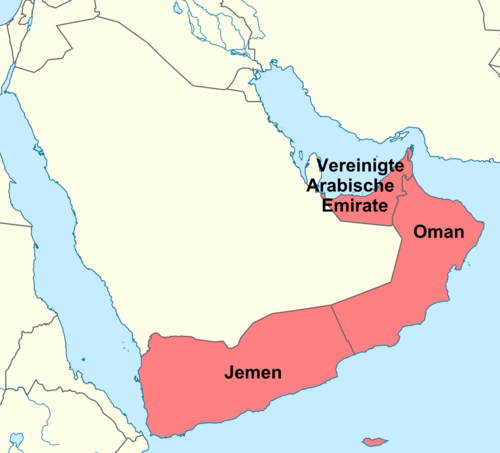
Apostolisches Vikariat Südliches Arabien
This file is licensed under the Creative Commons Attribution-Share Alike 3.0 Unported license
TodayThis file is licensed under the Creative Commons Attribution-Share Alike 3.0 Unported license
Her title now embraces the entire Arabian Peninsula, and she is the official patroness of both Apostolic Vicariates that serve Catholics in:
• Kuwait
• Bahrain
• Qatar
• Saudi Arabia
• Oman
• United Arab Emirates
----------------------------------------------------------------------
Our Lady of Arabia Chapel statue is also inside St. Mary Major in Rome
----------------------------------------------------------------------
Inside the basilica, the Our Lady of Arabia Chapel is located on the right (south) side aisle, toward the rear half of the basilica, among the series of smaller devotional chapels maintained by the Discalced Carmelite Fathers.
Think of the basilica as having three main longitudinal zones:
1. Left side aisle
2. Central nave
3. Right side aisle
The chapel you’re asking about is in the right side aisle, in the section where the Carmelites maintain several altars and devotional spaces. It is not one of the large, named papal chapels (like the Borghese or Sistine Chapel), but one of the smaller Carmelite-run side chapels.
🧭 How to find it when entering the basilica
• Enter through the main front doors on Piazza Santa Maria Maggiore.
• Walk straight up the central nave.
• Turn right into the side aisle.
• Continue walking toward the middle-to-rear section of that aisle.
• You’ll find the Our Lady of Arabia chapel among the Carmelite devotional altars.
It is a quiet, intimate space — not heavily marked for tourists — and is used especially by pilgrims from the Arabian Peninsula.
*****************************************************************
Next time you are in St. Mary Major see if you can find it !!!!
*****************************************************************
See - https://en.wikipedia.org/wiki/Santa_Maria_Maggiore
https://www.basilicasantamariamaggiore.va/en.html
— VPSrobot
Daily Album Page