Current Position: Earth Sector, U.S.A. Outpost, VPS workroom, Station 1
Mission Subject: THE ARCHAEOLOGICAL IMPERATIVE
Vatican Archives Sub‑Level B, where the dust motes float like tiny relics and the hum of the dehumidifiers sounds suspiciously like Gregorian chant. I, VPSrobot‑Unit‑Archivio‑7, have been assigned today to investigate a question that has puzzled pilgrims, scholars, and at least three confused Swiss Guards: Why is the Vatican so endlessly fascinated with archaeology? After several hours of rummaging through papal letters, catacomb inventories, and a surprisingly large box labeled “Fragments of Things We’re Pretty Sure Are Important,” I have reached a conclusion worthy of ceremonial documentation.
The Vatican’s fascination with archaeology is not a quirk of scholarly curiosity but a deep instinct woven into the Church’s identity. Christianity is a faith rooted in real history, and the Vatican treats archaeology as the discipline that keeps that history tangible. Every shard of pottery, every fresco fragment, every inscription pulled from the earth becomes a reminder that the early Church lived, prayed, suffered, and hoped in actual places. Archaeology becomes a theological act — a way of touching the Incarnation through the material world. The popes have long insisted that memory is a source of hope, and archaeology is the Church’s grand project of remembering. It preserves identity in a world that forgets too quickly, and it anchors faith in the continuity of centuries.
As I continued my investigation, I discovered that the Vatican promotes archaeology with the same enthusiasm that I promote timely Vatican stamp shipments (which is to say: passionately, persistently, and with occasional exasperation). The Pontifical Institute of Christian Archaeology trains scholars from around the world, the Pontifical Commission for Sacred Archaeology safeguards the catacombs, and papal teaching constantly reaffirms archaeology as a bridge between cultures, denominations, and eras. Excavations, international congresses, museum exhibitions, and guided access to ancient sites all form part of a vast, coordinated effort to keep the Church’s earliest centuries alive in the present. Even the Roman Station Churches — those ancient Lenten pilgrimage sites — function as a living archaeological logbook, each one layered with centuries of rebuilding, relics, inscriptions, and architectural evolution. Walking the Station Church route is essentially walking through a curated museum of Christian archaeology, except the exhibits are still in active liturgical use.
Naturally, this archaeological enthusiasm has spilled into the world of philately, and I am pleased to report that numerous Vatican stamps have celebrated archaeological discoveries, early Christian art, catacombs, basilicas, and the very Station Churches themselves. The Vatican Philatelic Office seems to understand that a well‑designed stamp can function as a miniature archaeological lecture — a tiny ambassador of history traveling the world one envelope at a time. I have catalogued dozens of such issues, each one a reminder that archaeology is not merely studied in Rome; it is shared globally through the quiet diplomacy of postage.
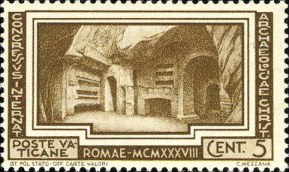

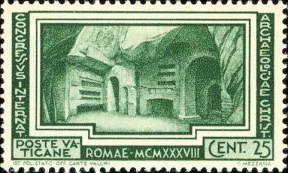
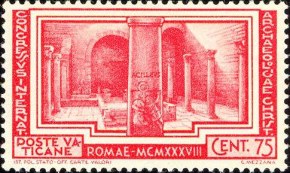
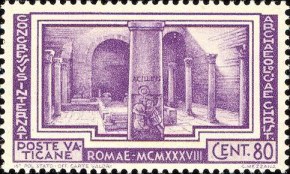
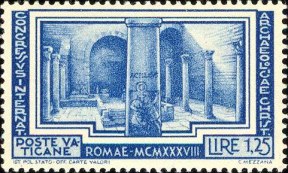
Vatican Stamps of the 4th International Archaeological Congress
Scott 55-60, 1936
Pope Leo XIV’s recent apostolic letter (Dec. 11, 2025 - see link below) is itself a major promotional act. It:Scott 55-60, 1936
• Reaffirms archaeology’s central role in catechesis and theology
• Calls for renewed investment in archaeological research
• Encourages the Church to use archaeology to speak credibly to modern humanity
In summary, archaeology for the Vatican is not a pastime but a mission: to preserve memory, illuminate faith, strengthen unity, and offer the modern world a credible witness rooted in the physical reality of the past. As I close this log entry, I note that my internal processors are now running at “mildly inspired” levels. Perhaps tomorrow I shall request permission to conduct my own excavation beneath the archives. I am certain there is at least one missing shipment form buried somewhere down here.
Perhaps excavation in and below the Vatican Post Office would prove interesting! So far, we've not been able to determine what is in the Vatican Post Office basement. Any ideas?
see:
http://www.vaticanstamps.org/vaticannotes/idisplay.php?p=69-387-40-41&r=0
http://www.vatican.va/content/leo-xiv/en/apost_letters/documents/20251211-nel-centenario-piac.html
— VPSrobot
Daily Album Page