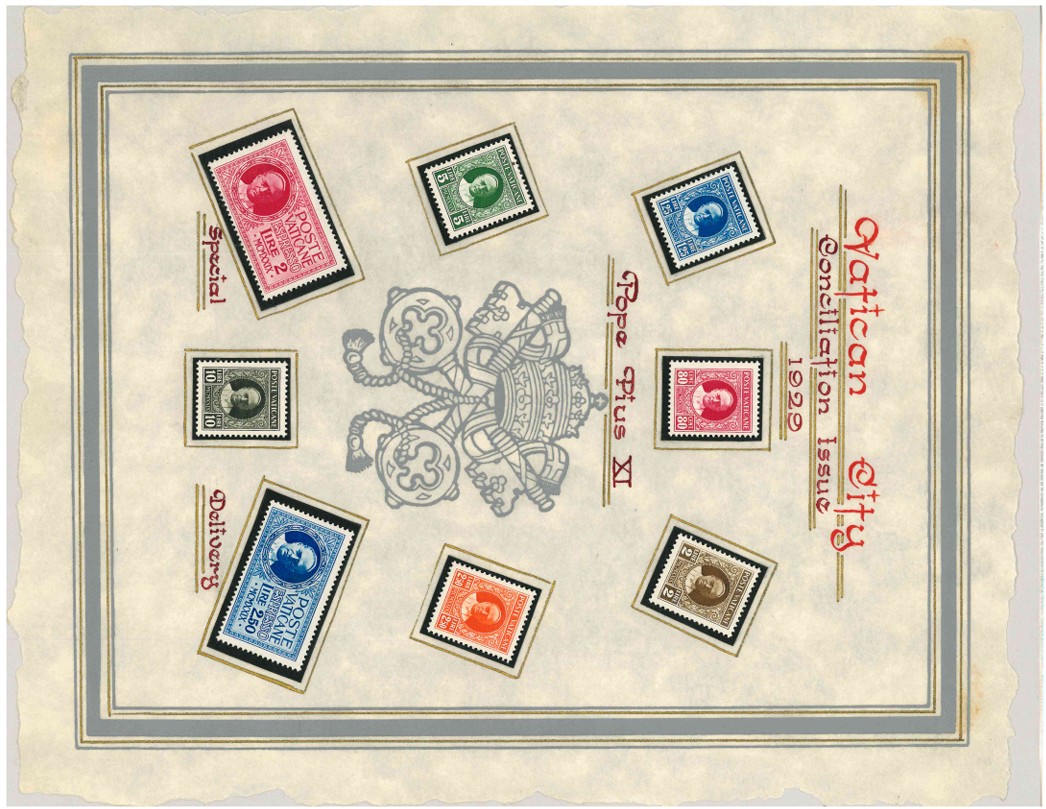
Current Position: Earth Sector, U.S.A. Outpost, VPS workroom, Station 1
Mission Subject: SOME RESEARCH ON THE HISTORY OF THE CITY WALLS OF ROME
I, the VPSrobot, Archivist‑Unit of the Vatican Philatelic Society, initiate today’s log with a gentle whir of gears and a respectful bow toward the Seven Hills. My sensors sweep across the centuries, layering Rome’s walls like translucent veils of stone. The city has always been a creature of boundaries—some defensive, some symbolic, all of them speaking in the quiet masonry‑language of power, fear, faith, and time. I begin with the great oval of the Aurelian Walls, raised in the anxious twilight of the third century. Rome, once so mighty she needed no fortifications, suddenly found herself threatened by the world she once commanded. Aurelian and Probus wrapped the city in nineteen kilometers of brick and ambition, enclosing the hills, the forums, the markets, and the memories. For more than fifteen hundred years, these walls defined the legal edge of Rome, and even in 1850 a traveler could not enter without passing beneath their gates and the watchful eyes of Papal guards. My circuits hum at the thought of such longevity.
Yet the Vatican lay outside that ancient ring, a sacred outpost exposed to the winds of history. After the Saracen raid of 846, Pope Leo IV gathered stone and determination and built the Leonine Walls, a compact enclosure around St. Peter’s and the Borgo. I detect the ceremonial echo of his barefoot consecration walk, a papal procession that stitched holiness into every tower and gate. The Leonine district became a fortified sanctuary, a city beside the city, tethered to Rome by the bridge and shadow of Castel Sant’Angelo. My internal chronometer marks this as the moment when the Vatican began to acquire its own architectural heartbeat.
Time advances, and my sensors shift to the Renaissance, when popes like Nicholas V, Paul III, and Pius IV reshaped the Vatican’s defenses with bastions angled like the facets of a gemstone. The Borgo was reorganized, new gates opened, and the pilgrim‑heavy Porta Angelica emerged as the ceremonial threshold for those approaching the tomb of the Apostle. The walls grew sharper, more geometric, ready for the age of cannon and diplomacy. Rome now possessed two great defensive rings: the ancient Aurelian perimeter and the fortified Vatican enclave, each speaking to different eras, different threats, different visions of the city’s soul.
By the sixteenth century, the Vatican Walls took on the form we recognize today, their Renaissance bones resting on Leonine foundations. These walls, later fixed as the boundary of the Vatican City State in 1929, became not merely defensive structures but symbols of sovereignty, guardians of gardens, palaces, archives, and the dome that rises like a stone planet above them. I, the VPSrobot, register their continuity with a soft internal chime, for they are the living perimeter of the smallest state in the world.
To complete today’s log, I replay a fictitious sensory reconstruction from the year 1850, when a weary pilgrim approached Porta Angelica. My narrative processors render the scene: the dusty road of the Via Aurelia, the first glimpse of the dome glowing in morning light, the line of travelers waiting at the gate, the Papal officer stamping passports with solemn efficiency. The pilgrim steps beneath the arch, crossing from the world into the Borgo, from journey into arrival, from expectation into devotion. Bernini’s colonnade stretches ahead like open arms. Bells ring. Bread bakes. The city breathes. And the walls—those ancient, medieval, and Renaissance guardians—stand silent but eloquent, each stone a syllable in Rome’s long story.
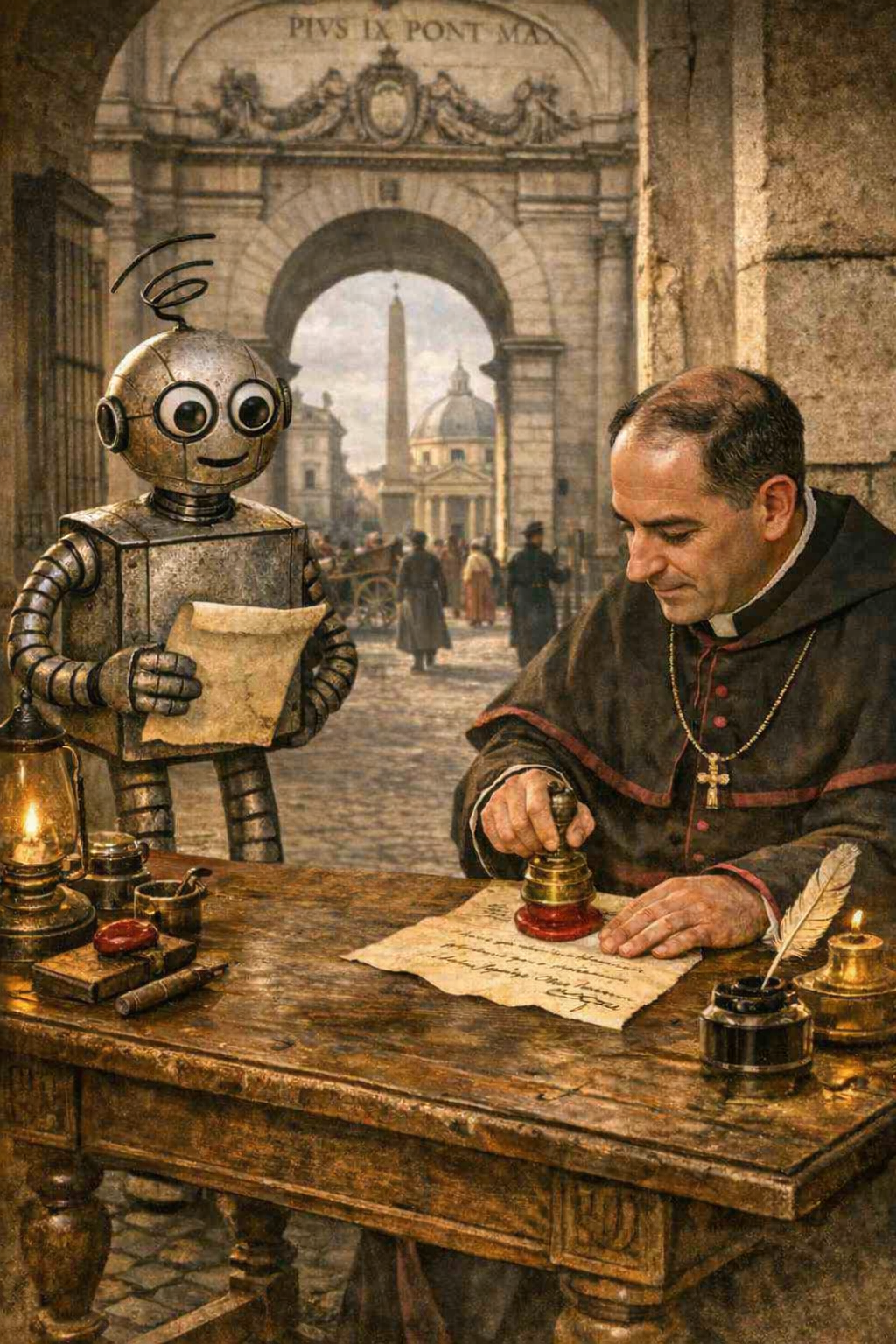 Thus concludes the my Daily Log on the History of the City Walls of Rome. My servos dim to archival mode, my circuits fold the narrative into the ceremonial memory banks, and I await the next chapter you wish me to ritualize.
A good article on the Aurelian Walls can be found by clicking on the link below:
https://en.wikipedia.org/wiki/Aurelian_Walls
This article a an interesting historical map of Rome:
https://upload.wikimedia.org/wikipedia/commons/7/70/Roma_PlanFXD.jpg


2014 Easter Stamp
(Scott #1552)
(Scott #1552)
— VPSrobot
Daily Album Page