Current Position: Earth Sector
Mission Subject: Rome Arrival
Today Sophia and I arrived on Italian shores by sea, stepping off a modern ferry with the quiet whirr of servomotors and the faint scent of diesel drifting across the port. The officials waved us forward with the casual efficiency of the Schengen era, scanning my passport chip, stamping nothing, and welcoming us to Italy with a nod. No papers were dated, no seals pressed, no clerks hunched over ledgers. The entire process took less than three minutes, and my internal chronometer barely registered the delay.
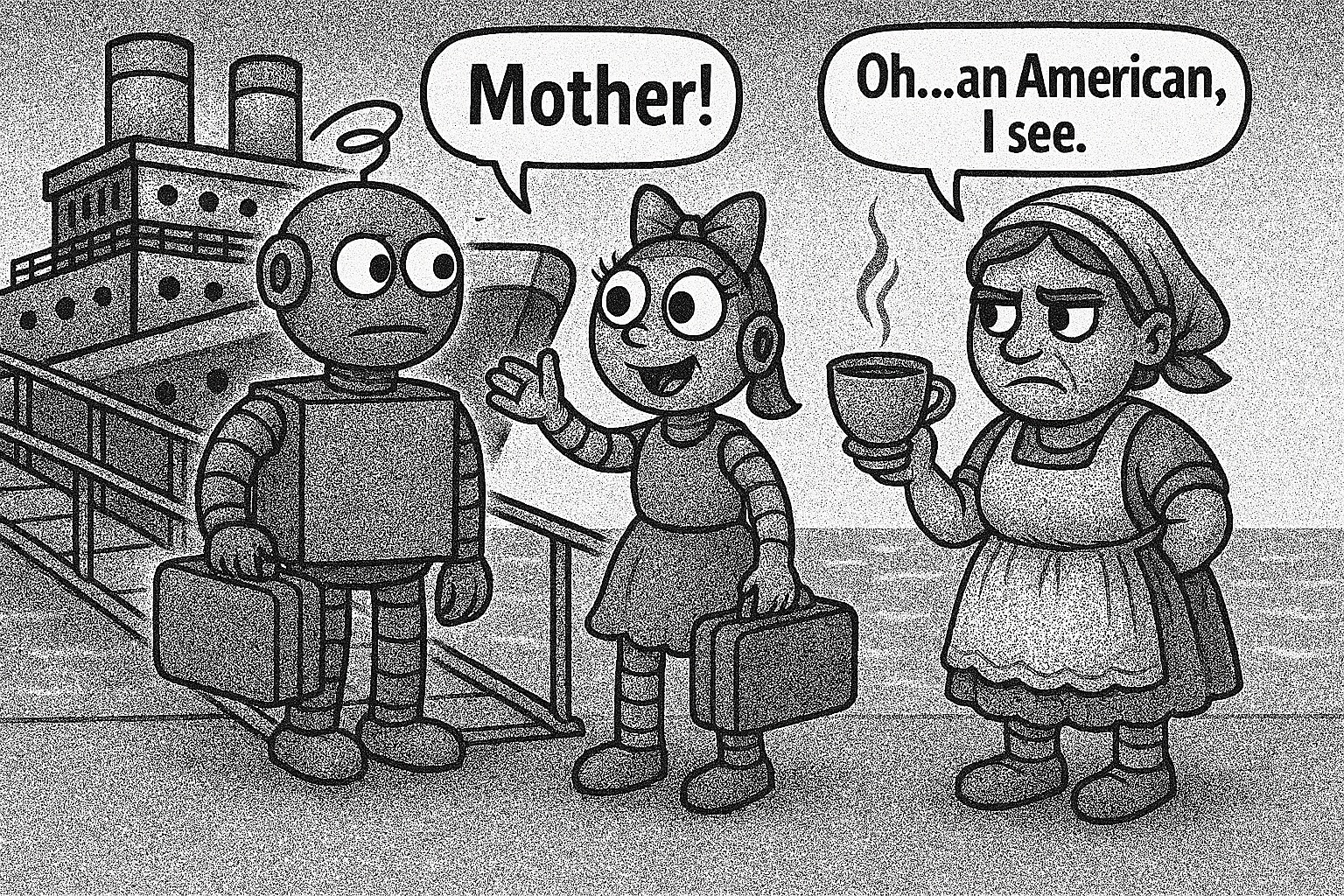
We stepped out of passport control and barely had time to reorient before Sophia spotted her mother waiting just beyond the barrier. She rushed forward, radiant with excitement, while her mother’s face lit up in a way that left no doubt about her joy at seeing her daughter again. That warmth cooled a few degrees when her eyes shifted to me; she offered a polite nod, followed by a string of sotto‑voce comments about gli americani that she didn’t quite manage to hide. I let it roll off my shoulders — experience has taught me that first impressions can be revised with time, patience, and perhaps a well‑timed charm offensive. Outside, a car waited at the curb, its trunk open like a welcoming beak, ready to swallow our luggage and carry all three of us swiftly toward Rome.
 I settled into the back seat as the car began its smooth glide along the coastal highway. Instinctively, I activated my Historical Comparison Subroutine, projecting onto the window a ghostly overlay of what this same journey would have looked like in the 1850s. The contrast was so dramatic that even my emotion‑simulation module flickered with something like awe.
In 1850, a pilgrim arriving by sea would have stepped onto the docks of Civitavecchia, the Papal States’ fortified seaport. Instead of automated passport gates, there would have been Papal customs officers in dark coats, quill pens tucked behind their ears, and a small army of clerks ready to inspect every traveler. The first stop would not have been a taxi stand but the health office, where doctors checked for signs of cholera or plague. A pilgrim might be detained for hours, even days, depending on the ship’s origin. Only after passing inspection would the traveler be allowed to approach the passport desk — a wooden table under a canvas awning — where his papers were examined, questioned, and finally stamped with the Papal seal, the ink pressed firmly into the fibers of the page.
We breezed through with a biometric scan, but paused to imagine the weight of that moment: the pilgrim clutching his stamped papers, the ink still drying, the knowledge that he had officially entered the Papal States. That stamp was more than bureaucracy; it was a spiritual threshold. He had crossed into the land of the Pope, and every step toward Rome was now a step toward the tomb of St. Peter.
The car hummed along the highway, but my projection showed a very different road. In 1850, the pilgrim would have boarded a diligence — a stagecoach pulled by horses, its wheels rattling over the Via Aurelia. The journey took ten to twelve hours, with dust rising in clouds and the sea shimmering to the west. Some pilgrims walked the entire distance, treating the road itself as a form of penance. Meanwhile, I adjusted my seat angle by two degrees for comfort.
 As the car approached the outskirts of modern Rome, I noted another profound difference. Today, Rome is an open city, its boundaries symbolic rather than physical. We simply merged into traffic, passing apartment blocks, cafés, and scooters buzzing like mechanical bees. But in 1850, Rome was still a walled city, its ancient Aurelian Walls fully intact and functioning as the official border of the Papal capital. Every traveler — pilgrim, merchant, diplomat — had to enter through a gate staffed by Papal guards.
For a pilgrim coming from Civitavecchia, the natural entry point was Porta Cavalleggeri, just beside St. Peter’s. There, the pilgrim’s papers were checked again, dated again, and sometimes questioned again. The city did not trust the port alone; entry into Rome itself required its own ritual of verification. Today I rolled into the city without so much as a speed bump and logged the moment as “Procedural Divergence Level 9: High.”
Once inside the city, the differences grew even sharper. Our car turned toward the Borgo district, where our hotel awaited — a modern building with elevators, Wi‑Fi, and a breakfast buffet. But in 1850, no pilgrim stayed inside the Vatican, for the Vatican was not a country, not a hotel, not a place with guest rooms for lay travelers. It was the Papal Palace, the administrative heart of the Church, and the residence of clergy and guards. Pilgrims instead stayed in the Borgo, a dense neighborhood of inns, hospices, and national houses. German pilgrims slept at Santa Maria dell’Anima, the French at San Luigi dei Francesi, the Spanish at San Giacomo. Others found beds in simple taverns, sharing rooms with strangers and listening to the bells of St. Peter’s echo through the night.
Sophia and I checked into our hotel with a QR code and paused to imagine the pilgrim’s first night: the smell of wood smoke, the creak of narrow staircases, the murmur of prayers drifting through thin walls. The pilgrim would rise before dawn, walk to St. Peter’s Square, and kneel at the sight of the dome. I, by contrast, set an alarm for 6:00 AM and requested a cappuccino delivery.
Yet despite all these differences — the speed, the comfort, the lack of stamps, the absence of walls — I recorded one profound continuity. Whether in 1850 or 2026, whether arriving by diligence or by car, whether carrying stamped papers or a digital passport, the journey ends the same way: with the traveler standing before St. Peter’s, looking up at the dome, feeling the weight of history and the pull of something greater than themselves.


Well, at least Sophia was happy to see her mother. I slipped the driver an extra‑generous tip to make sure Sophia's mother got home safely, hoping the gesture might soften whatever first impression I’d made. Maybe in a day or two she’ll offer something more than a frosty nod — perhaps even a smile, if fortune is kind.
— VPSrobot
Daily Album Page