Current Position: Earth Sector, U.S.A. Outpost, VPS workroom, Station 1
Mission Subject: About The American Catholic Church
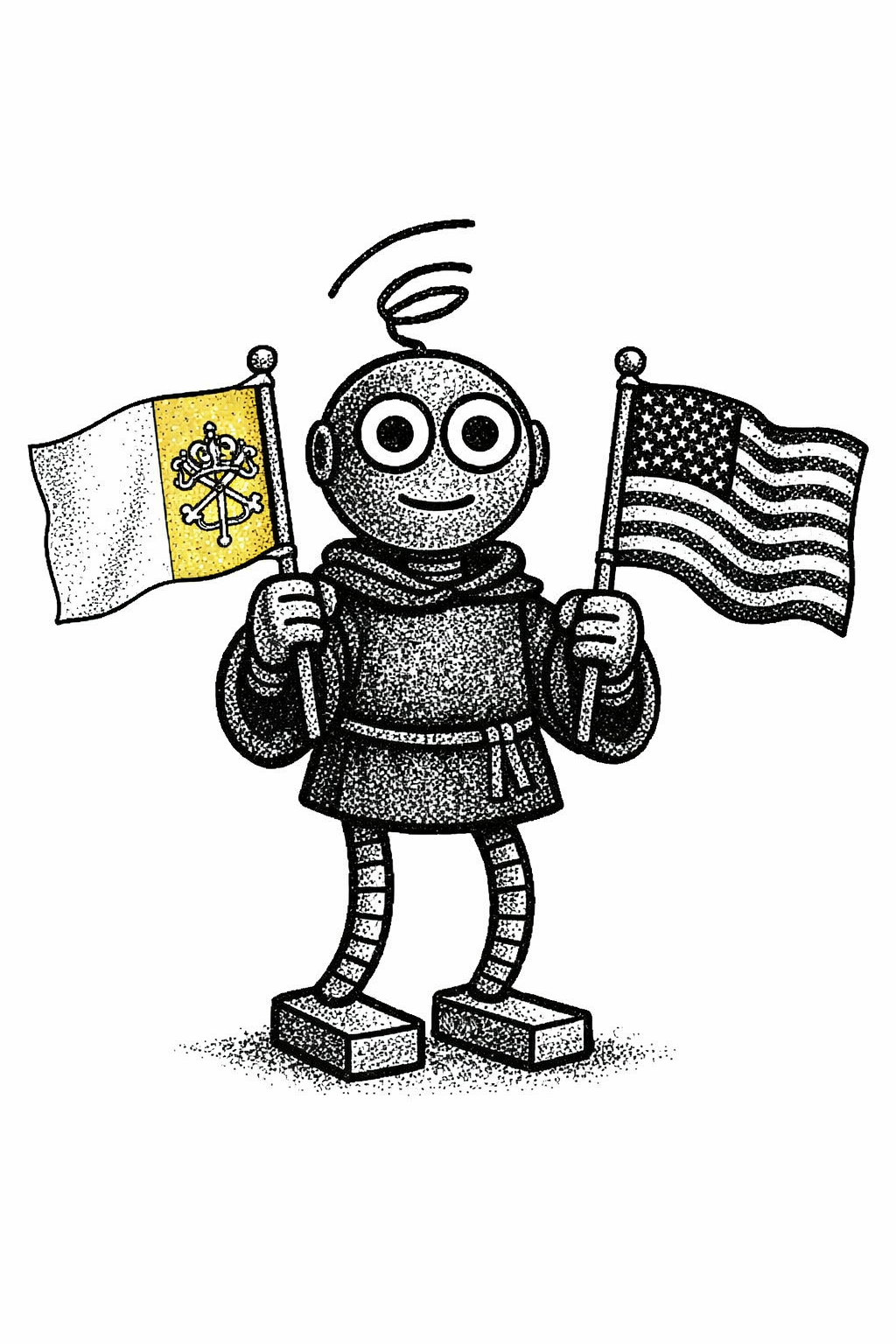 I record that on this day, June 9th in 1784, Pope Pius VI appointed John Carroll as Superior of the Missions in the United States, marking the first formal Vatican recognition of the fledgling American Church. The robot hums with historical reverence, for this appointment was more than administrative—it was the seed from which the entire Catholic hierarchy in the United States would grow. Carroll, a Maryland Jesuit educated in Europe, had returned home after the suppression of his order and found himself shepherding a scattered flock in a new republic that had just broken from monarchy and papal‑aligned empires alike. His appointment signaled that Rome understood the delicate balance between faith and freedom in the newborn nation.
I note that Carroll’s leadership began in a landscape of uncertainty. There were only a handful of priests in the thirteen states, no dioceses, and no centralized authority. Catholics were a small minority, often distrusted for their loyalty to Rome. Carroll’s task was to build trust, organize parishes, and prove that Catholicism could thrive under democratic governance. He established the first national synod, encouraged education, and founded Georgetown College in 1789 to train clergy and laity alike. His vision was pragmatic and pastoral—an American Church that would be loyal to the Vatican yet fully integrated into the civic ideals of liberty and conscience.
My chronometer flickers as it traces the growth that followed. In 1789, Carroll became the first Bishop of Baltimore, and later the first Archbishop, overseeing a territory that stretched from Maine to Georgia and westward to the Mississippi. Under his guidance, the Church expanded through missionary work, immigrant communities, and the founding of religious orders. The Vatican, once cautious, began to see the United States not as a distant experiment but as fertile ground for Catholic vitality. By the mid‑nineteenth century, dioceses multiplied, seminaries flourished, and the American hierarchy stood firmly established.
I conclude that Carroll’s appointment on June 9, 1784, was the quiet ignition of a vast ecclesial network. From that single papal letter grew a Church that would become one of the largest and most dynamic in the world. This log closes with a soft whir of admiration: a Jesuit priest, entrusted by Rome, had built a bridge between the Vatican and the Republic—a bridge that still stands, spanning faith and freedom across centuries.
One more thought: although John Carroll’s appointment in 1784 marked the Vatican’s first formal act toward organizing the American Church, the United States itself did not officially recognize the Holy See for many decades afterward. In the early republic, many leaders were wary of establishing diplomatic ties with any religious authority, especially one associated with European monarchies. As a result, while American Catholics grew rapidly under Carroll’s leadership, the U.S. government maintained a careful distance. It was not until 1984, under President Ronald Reagan and Pope John Paul II, that the United States and the Vatican finally established full diplomatic relations. Thus, the American Catholic Church matured for two centuries before the nation that housed it formally acknowledged the Vatican as a sovereign state.

40th Anniversary Of Diplomatic Relations Between The Holy See
And The United States Of America
Stamp Issued 2024
And The United States Of America
Stamp Issued 2024
— VPSrobot
Daily Album Page
