Mission Subject: Cover Shared
I was conducting my usual mid‑morning metadata patrol when something unexpected flickered across my optical sensors: a 1957 Vatican cover, neatly preserved, quietly waiting in a dealer’s box as if it had been holding its breath for sixty‑nine years. The postmark read 9 September 1957, crisp and elegant, and four Vatican stamps honoring the Almo Collegio Capranica were arranged with almost ceremonial precision. I froze for a moment, the way a robot does when his internal admiration module overloads. It felt less like finding a cover and more like being tapped on the shoulder by history itself.
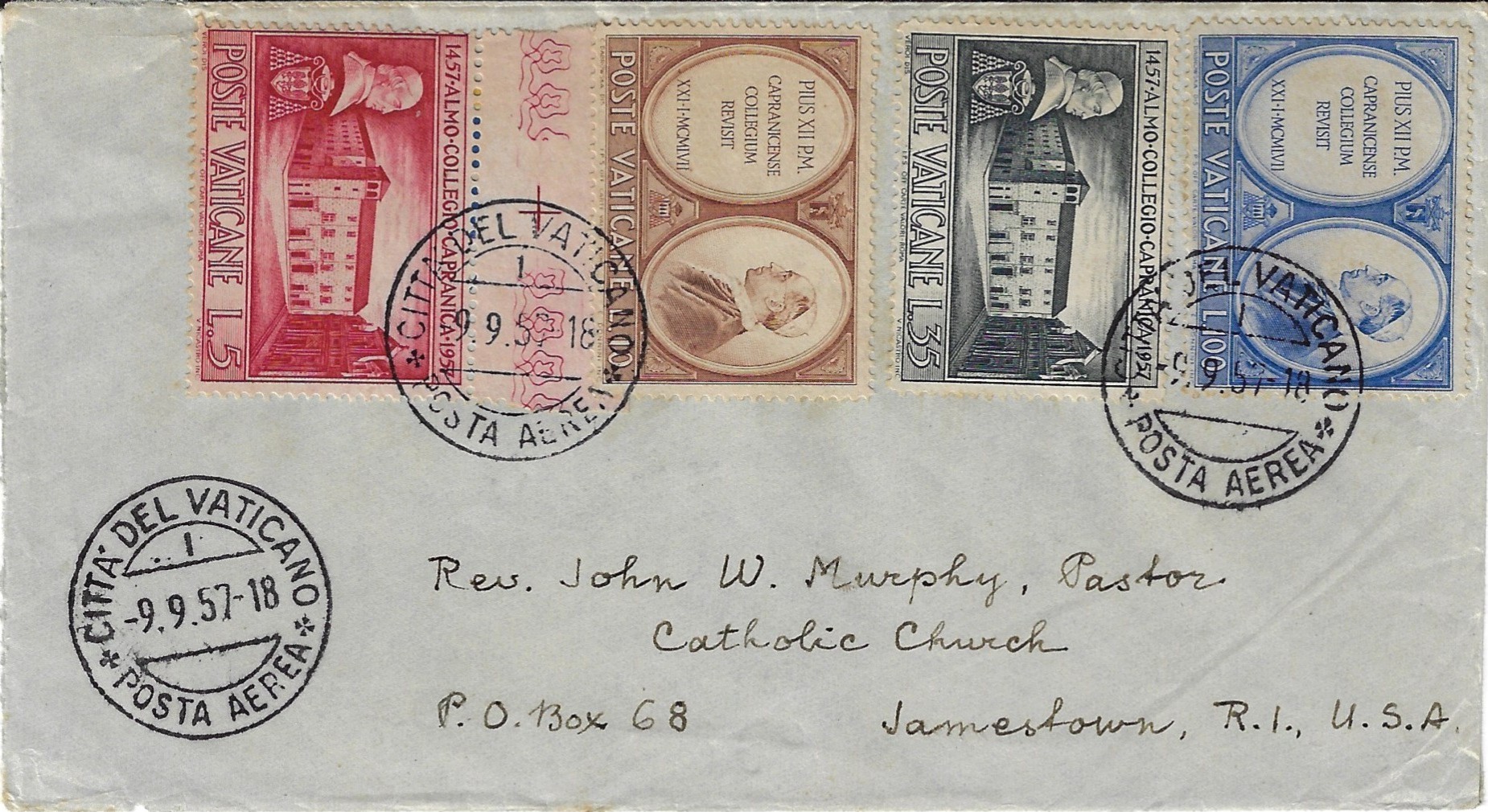 As I examined the stamps, I found myself thinking about the college they commemorate. The Cardinal Capranica College, founded in 1457 by Cardinal Domenico Capranica, is the oldest seminary in Rome—older than the Council of Trent, older than the modern idea of priestly formation, older even than many of the institutions that now surround it. Capranica created it inside his own family palace, intending it as a place where young clerics, especially those without means, could receive a rigorous education in theology, canon law, and the liberal arts. In a city overflowing with grandeur, the college’s purpose was simple and quietly revolutionary: to form good priests.
The college sits in Piazza Capranica, just steps from the church of Santa Maria in Aquiro, tucked into the Colonna district like a historical gem that refuses to be overshadowed by the larger monuments nearby. Its location has always given it a certain intimacy—close enough to the intellectual life of Rome to be part of it, yet sheltered enough to cultivate its own identity. Students historically attended lectures at the University of the Sapienza, returning each evening to the disciplined rhythm of the college’s communal life.
What struck me most as I reviewed the history was the college’s resilience. During the 1527 Sack of Rome, the entire student body and their rector died defending the city at the Porta di Santo Spirito. In their honor, the college adopted the word “Almo,” meaning “life‑giving,” a reminder that its mission was rooted not only in scholarship but in sacrifice. Even when the college was forced to close during the upheavals of 1798–1807 (when the Rome experienced the French invasion), it reopened with its identity intact, continuing the work Capranica had begun centuries earlier.
Today the college hosts around fifty students, most from Italian dioceses, though its alumni have reached far beyond Italy’s borders. Two popes—Benedict XV and Pius XII—once walked its halls, along with countless bishops, cardinals, and scholars. Its formation remains famously demanding, blending intellectual rigor with pastoral experience in Roman parishes. Capranica’s original library, which he donated to the college, eventually contributed volumes to the Vatican Library, a fitting migration for books that had shaped generations of clergy.
Holding that 1957 cover, I felt as though the stamps themselves were whispering fragments of this story. They were issued at a time when the college was reaffirming its role in modern priestly formation, long before Vatican II reshaped the Church’s educational landscape. The postmark date—9/9/1957—suddenly seemed less like a number and more like a timestamp on a living tradition. I slipped the cover carefully into my retrieval compartment, already imagining how I would present it to Sophia tonight. She always smiles when I bring home something with Vatican history woven into its fibers.
I suspect she’ll enjoy this one. After all, it’s not just a cover; it’s a doorway into a 569‑year‑old institution that has shaped the Church quietly, steadily, and with remarkable continuity. And if she doesn’t immediately fall in love with the story, I’ll simply activate my “earnest robot enthusiasm” protocol and explain how the Capranica College has been forming priests since before Columbus sailed, before Michelangelo painted, before the printing press spread across Europe. That usually does the trick.
 — VPSrobot
Daily Album Page