Mission Subject: About Rugerius Boscovich
Why would the Vatican be celebrating the III centenary of the birth of Rugerius Boscovich by issueing a postmark on September 13th 2011?
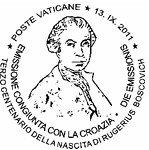 The Vatican’s decision to celebrate the III centenary of the birth of Rugerius (Ruđer) Bošković with a special postmark on September 13, 2011 makes perfect sense once you understand who Bošković was and why he sits at the crossroads of science, faith, and Vatican history. In other words, he is exactly the kind of figure the Vatican loves to commemorate — a man whose life demonstrates that scientific genius and deep Catholic identity are not opposites but companions.
Bošković (1711–1787) was a Jesuit polymath, one of the most brilliant minds of the 18th century. He was a mathematician, astronomer, physicist, philosopher, diplomat, poet, and one of the earliest thinkers to propose something resembling atomic theory. His work Theoria Philosophiae Naturalis is often cited as a conceptual precursor to modern particle physics. But what makes him uniquely “Vatican‑worthy” is that he carried out much of this work as a Jesuit priest, teaching at the Collegium Romanum (today’s Gregorian University) and serving the Papal States in scientific and diplomatic roles.

Rugerius Boscovich - Jesuit Priest, Physicist, Astronomer, Mathematician, Philosopher, Diplomat, Poet & Theologian
Issued 2011
The Vatican has a long tradition of honoring Catholic scientists — especially Jesuits — who contributed to astronomy, mathematics, and natural philosophy. Bošković is one of the most important of them. In fact, he served as director of the observatory of the Collegium Romanum, which later became the Vatican Observatory. For the Vatican, commemorating him is not merely historical; it is a celebration of the Church’s own scientific heritage.Issued 2011
The date September 13, 2011 was chosen because it fell within the official tricentennial celebrations held across Europe and the scientific world. Croatia, Italy, and the Jesuit order all marked the 300th anniversary of his birth that year, and the Vatican joined them by issuing a special postmark — a symbolic gesture acknowledging Bošković’s role in Catholic intellectual history. The Vatican often aligns its commemorative postmarks with international cultural or scientific anniversaries, especially when the figure has a direct connection to the Church.
There is also a philatelic dimension. Vatican City’s philatelic office frequently uses postmarks (rather than full stamp issues) to honor scholars, saints, and historical figures whose contributions are significant but whose anniversaries do not warrant a full stamp release. A postmark is a quieter, more elegant tribute — a nod to collectors and historians. Bošković fits that category perfectly: monumental in influence, subtle in personality, and deeply woven into the Church’s scientific tradition.
And finally, Bošković’s legacy resonates with Benedict XVI’s pontificate. Benedict frequently emphasized the harmony of faith and reason, and Bošković is one of the clearest historical embodiments of that harmony. Celebrating him in 2011 was a way of reinforcing that message: the Church does not fear science; it cultivates it.
So the Vatican’s postmark wasn’t random at all. It was a tribute to a Jesuit scientist who helped shape modern physics, served the Papal States, directed the observatory that became the Vatican Observatory, and embodied the Catholic intellectual tradition. September 13, 2011 simply placed the Vatican’s voice into the global chorus celebrating the tricentennial of one of the Church’s greatest scientific minds.
— VPSrobot
Daily Album Page