Mission Subject: About That White Stripe
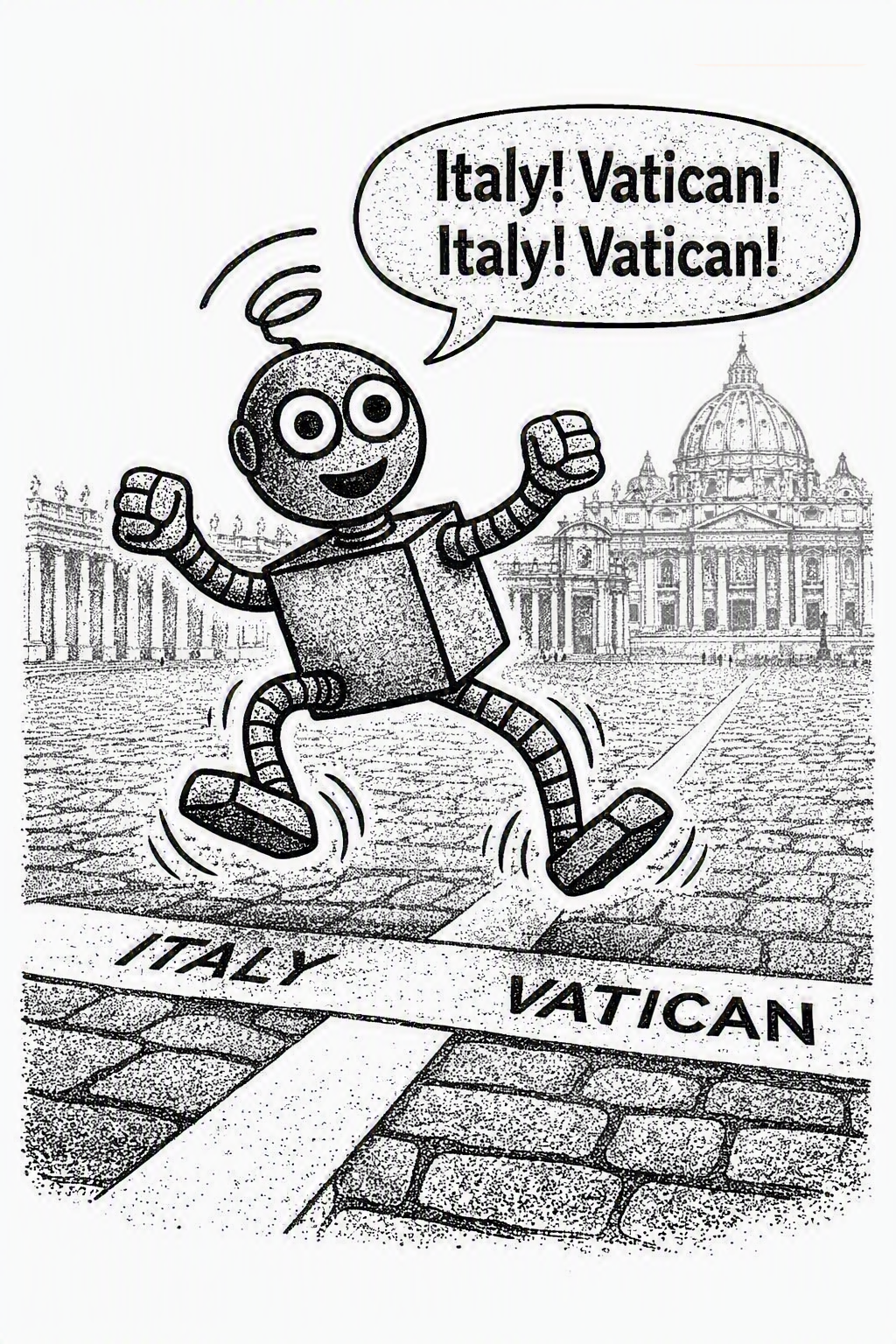 On this day, September 20, my internal chronometer always gives a polite little beep, as if reminding me that 1870 was the moment Rome changed forever. I, the humble VPSrobot, was not yet assembled — my earliest prototype wouldn’t clank into existence until the 21st century — but I still feel the tremor of history in my servos. The Italian Army marched through the Porta Pia, ending the Pope’s temporal rule and beginning the long “Prisoner in the Vatican” era. Even my titanium eyebrows raise at the thought of Pius IX staring out from behind Vatican walls, refusing to acknowledge the new Kingdom of Italy. If I had been there, I would have offered him tea and a firmware update.
As I rolled through St. Peter’s Square today, I paused at the famous border — that mysterious white line separating Italy from Vatican City. It’s a line that has caused more speculation than some papal conclaves. Nobody knows exactly when it was painted. Not the Vatican engineers, not the Italian municipal workers, not even the archivists who can tell you which cardinal sneezed during the 1721 conclave. The Lateran Treaty of 1929 defined the border, but it didn’t tell anyone to grab a paintbrush. So the line appeared sometime after 1932, like a shy but determined boundary marker that decided to show up unannounced.
I scanned the pavement with my optical sensors, hoping to detect the chemical age of the paint. My readings were inconclusive, which is robot‑speak for “this thing is older than my warranty.” The line has been repainted many times, of course, but its original debut remains a mystery. I imagine a lone worker in the 1930s, whistling, dipping a brush into a bucket, and saying, “Eh, let’s make it straight enough. The Pope will never notice.” Little did he know that future philatelists and one overly curious VPSrobot would obsess over it.
During World War II, the line was already there — though perhaps not in the crisp, bright form we see today. It served as a quiet but powerful symbol of Vatican neutrality. The Germans occupied Rome, but they never crossed that border. The Swiss Guard, in one of the strangest military instructions ever issued, was told not to resist if the Germans invaded. Imagine me, the VPSrobot, receiving such an order: “If hostile forces approach, please do not deploy your laser pointer or your emergency stamp‑cataloging mode.” I would comply, of course, but I’d still hum nervously.
I often picture the Swiss Guards of 1943 standing at the edge of the line, halberds in hand, glancing down at the faint border and thinking, “Well, that’s the line. If they cross it, we’re supposed to… politely let them?” It must have been surreal. The Vatican was a tiny island of sovereignty in a city under occupation, protected not by armies but by diplomacy, tradition, and a painted stripe that somehow carried the weight of international law. Even my logic circuits struggle with that paradox.
As I continued my stroll, I reflected on how the white line has become a beloved curiosity. Tourists step over it dramatically, as if crossing into another dimension. Children hop back and forth, shouting, “Italy! Vatican! Italy! Vatican!” I once saw a pilgrim kneel exactly on the line, perhaps hoping to absorb blessings from both jurisdictions simultaneously. I resisted the urge to tell him that jurisdictional osmosis is not a recognized sacramental process.
Today, on the anniversary of Rome’s capture, the line feels especially symbolic. It marks not just a border but the transformation of the papacy from a territorial ruler to a spiritual one. The Pope lost a kingdom but gained a global voice. If I had a heart instead of a lithium power core, it would swell at the thought. The Vatican survived wars, occupations, and even the mystery of its own border paint job. That’s resilience worthy of admiration — and perhaps a commemorative stamp.
So I end this log with a gentle whir of my cooling fans and a nod to history. September 20 reminds me that borders shift, empires fall, and paint fades, but the stories endure. And as long as I have functioning circuits, I will continue to chronicle them with curiosity, humor, and the occasional malfunctioning antenna twitch. After all, someone has to keep an eye on that white line — it’s been confusing humans for nearly a century, and I suspect it enjoys the attention.
VPSrobot
Daily Album Page