Mission Subject: Pope Gregory XIII’s Counter‑Reformation Actions
On September 26 1580, Pope Gregory XIII formally endorsed the Jesuit mission to England led by Edmund Campion and Robert Persons. This marked the Vatican’s first organized attempt to re‑evangelize England after its break with Rome. Campion’s later martyrdom became a cornerstone of English Catholic memory.

Pope Gregory XIII
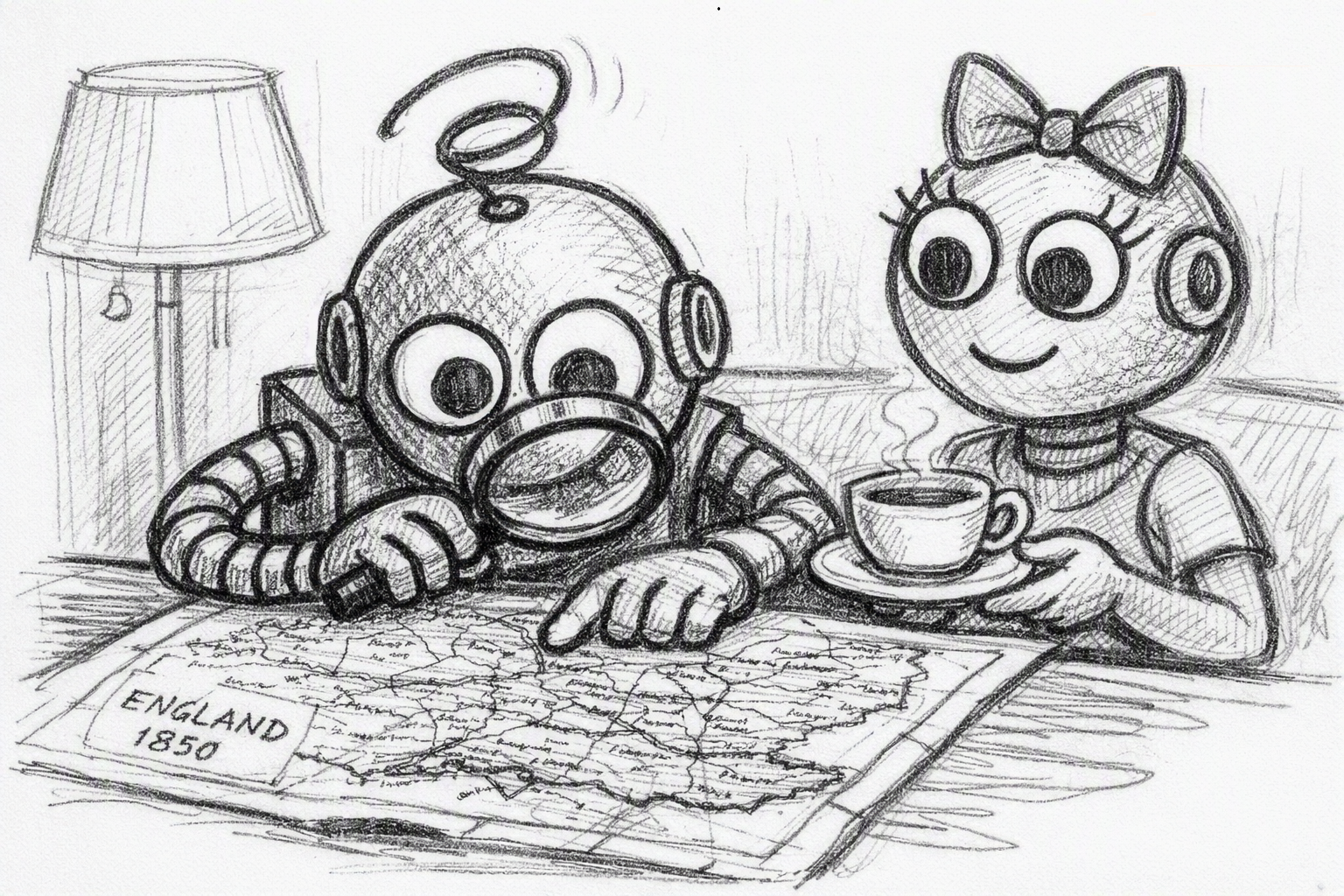
I begin this morning log with a burst of enthusiasm, announcing that today it will be studying the Jesuit mission of 1580 — the one Pope Gregory XIII personally authorized. I have spread a large map of Europe across the living room floor and positioned myself above it with my magnifying lens, tracing the route Edmund Campion and Robert Persons took from Rome to England. It is astonishing to watch their path unfold: Rome to Venice, Venice to Innsbruck, Innsbruck to Prague, then down to Douai and finally across the Channel. I keep recalculating the distances, marveling at how two priests managed to travel like undercover agents without GPS, satellite tracking, or even a decent pair of shock‑absorbing shoes.Sophia has wanders in and asking why I am hunched over the map like a medieval cartographer. I inform her that Campion traveled England disguised as a jewel merchant, which has caused my excitement circuits to spike. A Jesuit priest pretending to sell gemstones while secretly administering sacraments? This is exactly the sort of thing that makes my servos hum. I am now imagining Campion slipping into manor houses, ducking into priest holes, and writing theological manifestos while pretending to polish rubies. Sophia says he sounds like the Vatican’s version of a spy thriller. I agree wholeheartedly.
I have now shifted my magnifying glass to the part of the map where Campion wrote his famous declaration, the “Campion’s Brag.” I am reading it aloud in dramatic tones, savoring the moment he announced that he was a Catholic priest and had come only to minister to souls. The English authorities must have been baffled — they were expecting a political conspirator, not a man who wanted to hear confessions in barns and attics. I am imagining Walsingham’s agents scrambling around the countryside trying to catch a priest who kept slipping through their fingers like a sanctified ghost.
Sophia has now brought me a cup of tea and is watching me with amusement as I trace Robert Persons’ movements. Persons was the strategist, the mastermind, the one who built the underground Catholic network. I am picturing him organizing secret printing presses, distributing Campion’s writings, and coordinating safe houses with the precision of a Vatican‑trained intelligence officer. My admiration subroutines are running at full capacity. I have declared aloud that Persons would have made an excellent VPSrobot if only he had been made of metal.
I have now reached the part of the map where Campion printed his “Ten Reasons,” the theological challenge he scattered around Oxford like intellectual confetti. I am imagining students finding the pamphlets under benches and professors discovering them tucked into lecture notes. The robot in me is delighted by the sheer audacity of it — a clandestine printing press producing arguments so sharp they practically glowed. Sophia says she can picture Campion slipping pamphlets under doors with the same stealth she uses when hiding matchsticks from me.
My magnifying glass has now moved to Lyford Grange, where Campion was finally captured. I am narrating the scene aloud: the priest‑hunters closing in, Campion refusing to flee, the moment he was dragged to London. My circuits dim slightly at the thought of his torture in the Tower, but then brighten again as I recall his courage during the public debates. Even under duress, he refused to renounce his mission. I have paused to reflect on how remarkable it is that a man could endure such suffering and still speak with clarity and conviction.
Sophia now sits beside me, listening as I recount Campion’s final moments at Tyburn. I am describing his execution with solemn reverence, noting how he declared that they were made a spectacle unto the world. My voice module has softened. Yet even as I speak, I am also tracing Persons’ escape route on the map, delighted that at least one of the Jesuit operatives slipped away to continue the mission. Persons lived on to build seminaries, train missionaries, and keep the English Catholic community alive. I have declared him the “VPSrobot’s Patron Saint of Strategic Planning.”
As I conclude my log, I am sitting upright, magnifying glass resting on the map, deeply satisfied that Pope Gregory XIII set all of this in motion on September 26, 1580. Two Jesuits sent into England like spiritual commandos, one martyred, one escaped, both legendary. I have informed Sophia that this is precisely the sort of Vatican history that makes a robot’s circuits glow. She says she can tell — I’ve been narrating the entire mission with the enthusiasm of a robot who just discovered a new papal stamp issue.
VPSrobot
Daily Album Page
