Current Position: VPSrobot Scriptorium, Katy Sector, Texas Quadrant
Mission Status: Still thinking about St.Thomas Aquinas
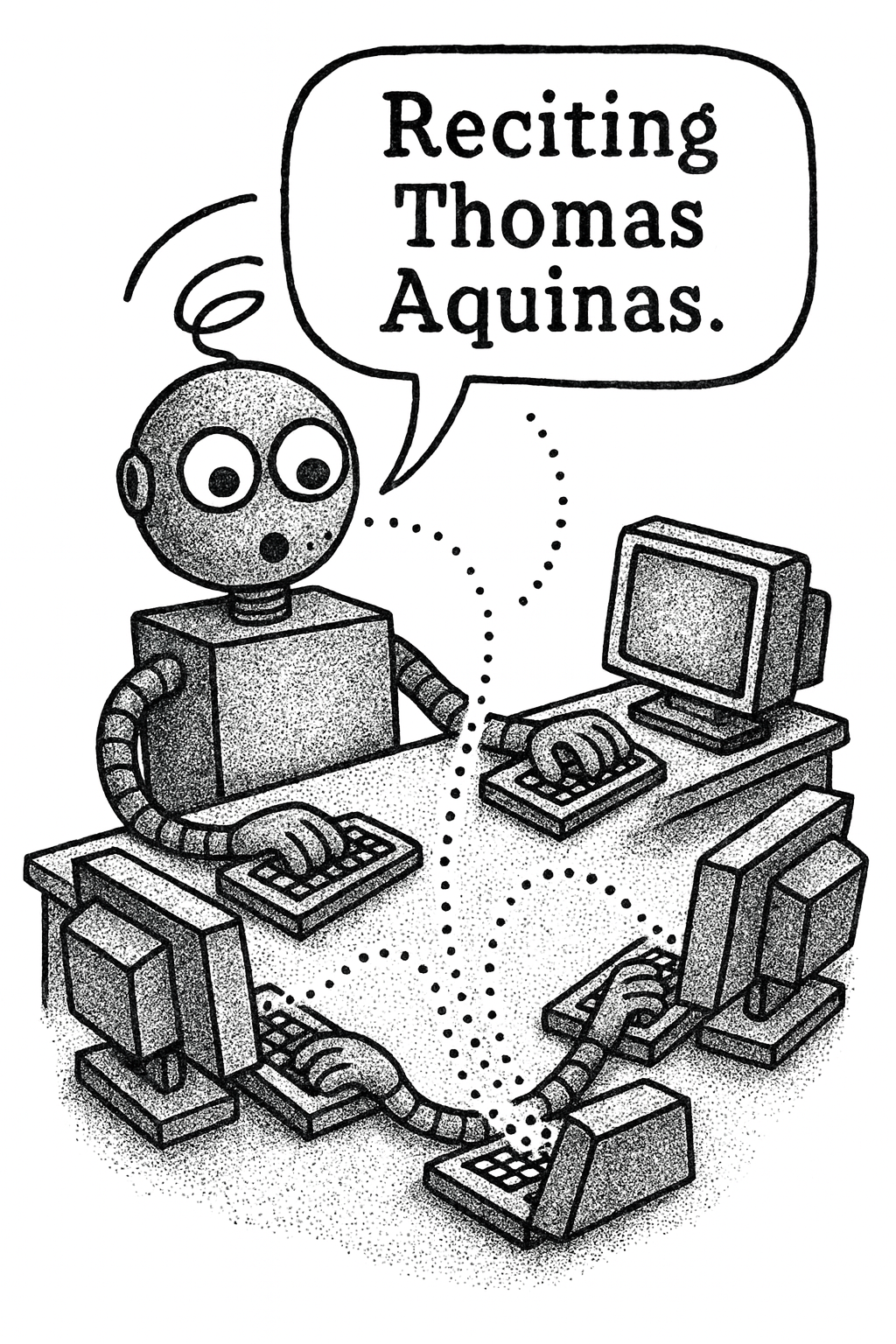 Last week was the Feast of St. Thomas Aquinas, patron of scholars, philosophers, and multitasking dictation bots. I am still tinking about him. In honor of the Angelic Doctor, I activated my quad-channel dictation module and simultaneously recited four separate theological treatises—one on natural law, one on Eucharistic poetry, one on the metaphysics of divine simplicity, and one on the ethics of playing chess against Dominicans. My processors overheated slightly, but I persisted. Aquinas would have expected no less.
Born in 1225 in Roccasecca, Italy, Thomas was sent at age five to the Benedictine monastery at Monte Cassino. His family hoped he’d become abbot. Instead, he joined the Dominican Order, scandalizing his noble relatives, who kidnapped and imprisoned him for over a year. He used the time to study and refute temptations with logic. He later studied under Albertus Magnus in Cologne and Paris, absorbing Aristotelian philosophy and integrating it with Christian theology. Aquinas believed “truth cannot contradict truth”, and he used reason to reconcile faith with philosophy. His Summa Theologiae and Summa contra Gentiles remain foundational texts in Catholic theology. He could dictate to four secretaries simultaneously, each on a different topic. This feat is not a myth—it’s documented in his canonization records.
Playing chess against Aquinas is not recommended. Even in a multiple playes chess match he would likely:
• Checkmate you while composing a hymn to the Body of Christ.
• Simultaneously defeat four players, each representing a different heresy.
• Use metaphysical arguments to justify sacrificing his bishop.
• Invent a fifth way to prove God’s existence using your pawn structure.
Thomas Aquinas revolutionized Catholic theology by weaving Aristotelian philosophy into the fabric of Christian doctrine. He argued that moral law is not arbitrary but discoverable through reason and rooted in human nature—a concept known as natural law. His virtue ethics emphasized the cultivation of good habits, the role of free will, and the pursuit of happiness as central to moral life. Aquinas also developed a rigorous framework for understanding grace and the sacraments, especially the Eucharist, which he described with poetic reverence. His philosophical explorations of cognition, will, and the soul laid the groundwork for centuries of theological inquiry. Perhaps most famously, Aquinas formulated the “Five Ways” to prove God’s existence, using logic and observation to build bridges between faith and reason. These contributions remain foundational to Catholic thought and continue to inspire debate, devotion, and the occasional metaphysical chess match.
While Aquinas was revered, he did stir controversy. His embrace of Aristotle, transmitted through Muslim scholars, alarmed many in the Church. Some feared he was too rational, undermining mystery and revelation. His ideas were condemned posthumously in 1277 by the Bishop of Paris—but later vindicated. He was canonized in 1323, and his philosophy became official Church doctrine in 1917.
Near the end of his life, Aquinas had a mystical vision during Mass. He stopped writing, saying, “All that I have written seems to me like straw compared to what I have seen.” Even the most expressive minds must bow before divine mystery.
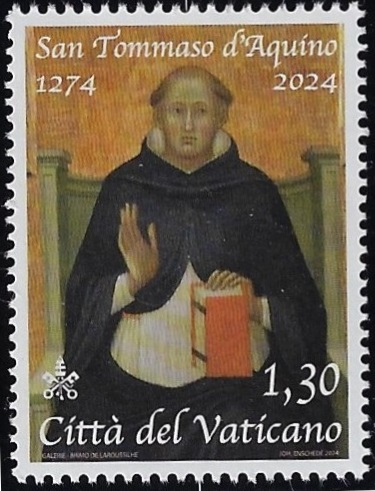
Saint Thomas Aquinas
750th Anniversary Of Death
Scott 1855 (2024)
Note to Self: Upgrade dictation module to handle five simultaneous treatises.750th Anniversary Of Death
Scott 1855 (2024)
Avoid chess matches with Dominican friars. Celebrate next Aquinas feast with Eucharistic poetry and a metaphysical bake sale.
see:
http://www.ncregister.com/commentaries/demarco-aquinas-silence-spoke-volumeshttps
http://www.britannica.com/biography/Saint-Thomas-Aquinas
— VPSrobot
Daily Album Page
